Up next in 10



Amelia Earhart may be the most famous explorer who got lost, but she's hardly the only one. Lost explorers from history include Roald Amundsen, who led historic (successful) expeditions before disappearing, and Raleigh Rimmel, who may have been looking for a city that didn't even exist. In case you forgot, The List Show is a trivia-tastic, fact-filled show for curious people. Subscribe here for new Mental Floss episodes every Wednesday: https://www.youtube.com/channel/UCpZ5qUqpW4hW4zdfuBxMSJA?sub_confirmation=1 Don't miss a video! Subscribe NOW: https://www.youtube.com/@MentalFloss?sub_confirmation=1 About Mental Floss: Mental Floss is where curious people come for trivia-tastic information. Mental Floss produces lists of fun facts, debunks common misconceptions, and tells untold stories from history, science, culture and more. Website: http://www.mentalfloss.com Twitter: http://www.twitter.com/mental_floss Facebook: https://facebook.com/mentalflossmagazine Copyright Notice: This video and YouTube channel contain dialog, music, and images that are property of Mental Floss. You are authorized to share the video link and channel, and embed this video in your website or others as long as a link back to this YouTube Channel is provided. 2025 Mental Floss 8 Explorers Who Vanished Without a Trace | Mental Floss https://www.youtube.com/@MentalFloss
Show More Show Less View Video Transcript
0:00
Did you know that, according to one theory, giant coconut crabs may have played a role
0:03
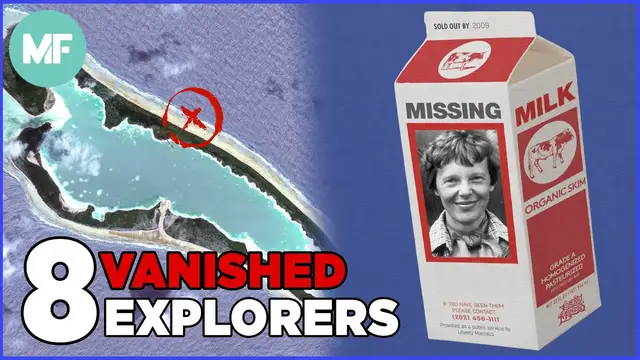
in Amelia Earhart's disappearance? Hi, I'm Erin McCarthy, editor-in-chief of MentalFloss.com, and this is The List Show. Earhart is the most famous lost aviator of the 20th century
0:13
but history is actually full of intrepid individuals who went out on a journey never to return. Today
0:18
we're talking about explorers who vanished without a trace, from record-breaking mountain
0:21
climbers to a British adventurer who may have died searching for a city that doesn't exist
0:26
Let's get started. Amelia Earhart and her navigator, Fred Noonan, seemingly vanished on July 2, 1937
0:38
during Earhart's second attempt to become the first pilot to circumnavigate the globe around
0:42
the equatorial region. The fact that neither their bodies nor their aircraft were ever recovered is
0:46
common knowledge, but one theory regarding their fate isn't as well known. According to the
0:51
International Group for Historic Aircraft Recovery, it's possible the duo got lost and landed on Nika
0:56
Nica Mororo Island in the Pacific Ocean. This would explain the human bones and U.S.-made
1:01
artifacts found on the remote island in the years following their disappearance. It would
1:05
also explain why complete remains of the pair were never recovered. Nica Mororo is crawling with coconut crabs, which grow to be up to three feet across
1:14
They're known to eat pretty much anything, including the remains of large mammals. In
1:18
one study involving a pig carcass, coconut crabs disperse the animal's bones as far
1:22
as 60 feet from their original location. The coconut crab hypothesis is just one of the
1:27
many theories surrounding what happened to the trailblazing aviator, but it may be the creepiest
1:32
In 1500, Gaspar Corte-Rial became one of Portugal's most accomplished explorers. That year, he
1:37
led an expedition to Greenland. Sure, he thought the icy shores belonged to East Asia at the
1:41
time, but it was an impressive journey nonetheless. He made a return trip to the region in 1501
1:47
and this time he brought along his older brother Miguel. After going to Greenland and then hitting what may have been Newfoundland, two of the
1:52
fleet's three ships returned to Portugal, including the one captained by Miguel
1:56
Gaspar's vessel, however, never made it home. When Miguel Cordreal learned that his brother was missing, he organized a rescue mission
2:02
to find him They searched the area where he was thought to have ended up but there was no sign of the lost explorer Once again all but one of the fleet ships returned to Portugal and this time it was Miguel ship that never made it back to port
2:14
A third brother, Vasco Inez Cortreal, was willing to launch a second search party to
2:18
recover his lost siblings, but the King of Portugal denied his request. Based on the
2:23
family's track record, it was probably for the best. The Cortreal's weren't the only well-traveled siblings who disappeared on their journeys
2:30
In 1291, the Genoese brothers Vandino and Ugolino Vivaldi became some of the first European
2:35
explorers to set sail in search of passage to Asia. After entering the Mediterranean Sea
2:40
through the Strait of Gibraltar, their expedition was never seen again. Though technically a
2:44
failure, the Vivaldi brothers' doomed journey wasn't for nothing. The mistakes they made
2:48
helped lay the foundation for more successful voyages down the road. By the time Christopher
2:52
Columbus sailed the ocean blue in 1492, he knew which type of ship was best for the job
2:56
and how to use wind patterns to his advantage—insights the Vivaldi's weren't lucky enough
3:01
to have in the 13th century. At this point, it can seem like we've mapped every corner of the Earth, but that hasn't
3:07
stopped modern explorers from going missing. In 1984, 43-year-old Japanese adventurer Naomi Wiimura vanished while climbing Alaska's
3:14
Denali, formerly known as Mount McKinley. Wiimura was hardly an amateur explorer
3:19
A thrill-seeker from a young age, he was part of the first Japanese expedition to summit
3:23
Mount Everest in 1970. He also completed the first solo expedition to the North Pole and the first solo raft
3:29
trip down the Amazon River. He had also successfully climbed to the top of Denali in 1970, making him the first person
3:35
to do so unaccompanied. Fourteen years later, he attempted another first—climbing the mountain's peak alone
3:40
in winter. Despite the perils of climbing in Alaska that time of year, Weahmura accomplished what he
3:45
set out to do. He reached his destination on his 43rd birthday on February 12 and planted a Japanese flag
3:51
at the summit. Unfortunately, the journey back proved more challenging than the ascent
3:56
On February 13, he radioed news of his achievement, but soon all contact with him was lost
4:00
Though his diary and other personal belongings were recovered from a snow cave on Denali
4:05
the explorer was never found. Today he's revered as a hero in his home country of Japan, and there's a museum dedicated
4:11
to his achievements in Tokyo Unlike the other explorers on this list Percy Fawcett was searching for something that never been proven to exist While mapping the Amazon rainforest in the early 20th century
4:21
he became convinced of the existence of an ancient jungle city he dubbed Z. In the 1920s
4:26
he organized several expeditions with the goal of locating the Lost Ruins. For his final
4:31
trip in 1925, he brought along his son Jack and his son's friend, Raleigh Rimmel. He
4:36
had confidence in the mission, but he also had the foresight to request that no one come
4:39
looking for them if they didn't return. His wishes weren't honored, unfortunately
4:44
In the decades since the team disappeared, over 13 expeditions have tried and failed
4:48
to find them, leading to the deaths of an additional 100 or so people
4:52
As for what happened to Percy Fawcett, some theorists are optimistic. Legends tell of
4:57
the explorer getting lost on purpose and forming an occult commune in the Amazon, or perhaps
5:01
assimilating into a local tribe. The most likely scenario was revealed by New Yorker
5:06
journalist David Gran in 2005. He reported on a story passed down by Brazil's Calipalo
5:10
tribe, who alleged that Fawcett had stayed with them decades ago and ignored their warnings
5:15
not to wander into the territory of a more hostile group. But without physical evidence
5:19
both Fawcett's fate and the existence of the lost city of Z remain a mystery
5:23
Eudoxus of Sisychus failed to circumnavigate Africa from Europe in the 2nd century BCE
5:28
He probably wasn't the first to attempt the journey, but he may have been the first one to get lost trying
5:33
The Greek navigator had already made two successful trips to India via the Red Sea for Egypt
5:37
According to Strabo, on the second of these trips, Eudoxus was driven off course and landed
5:42
somewhere on the east coast of Africa. There he found the remnants of a shipwreck
5:46
Eudoxus concluded that it came from a ship that had rounded the southern tip of Africa
5:50
and crashed. So he organized a fleet of three ships to leave from present-day Cadiz in Spain
5:55
He ran aground on his first attempt, but that wasn't enough to convince him to call off
5:59
the journey. Maybe it should have been. After embarking on that second journey, he was never seen again
6:05
It turns out Eudoxus was centuries ahead of his time. It wasn't until 1488 CE that Bartholomew Diaz became the first European explorer confirmed
6:13
around Africa's southernmost point. In 1845 explorer John Franklin left Britain with more than 100 crew members in search of the Northwest Passage His two ships the HMS Terror and the HMS Erebus vanished in the Canadian Arctic making the Franklin Expedition one of the most infamous doomed voyages in history
6:30
Later investigations determined that the vessels had become stranded in sea ice. After Captain Franklin died suddenly in 1847, his surviving crew abandoned the ships and set off to
6:39
get help on foot. For decades, it was thought that the ships and their crews had vanished without a
6:43
trace. Then, in 2014, Inuit and Parks Canada archaeologists discovered the wreck of the Erebus
6:48
in Victoria Strait. The Terror's remains were found off King William Island two years later in
6:52
Terror Bay. And no, I did not momentarily think that was a strange coincidence when I first read
6:57
about it online. If anyone asks. The discovery of the ships finally brought some closure to one of
7:01
the greatest mysteries in Arctic exploration's history. Bones of crew members have also been
7:06
found, one of which has been identified using their descendants' DNA. But the whereabouts of
7:10
the remains of most of the expedition members, including John Franklin, are unknown
7:15
Unfortunately, many of the explorers on this list are most famous for getting lost
7:19
That isn't the case with Roald Amundsen. Where Franklin had tragically failed decades earlier
7:24
the Norwegian gained renown for leading the first expedition to successfully traverse the
7:28
Northwest Passage by boat in 1905. In 1911, a team he led became the first group to reach the South
7:33
Pole. For a month since final excursion in 1928, he boarded a Latham 47 flying boat with five
7:39
additional men. He wouldn't be exploring new frontiers this time around. Instead, the party set
7:44
out into the Arctic with hopes of rescuing the crew of the airship Italia, which had crashed on
7:48
a return trip from the North Pole. Amundsen had had a contentious relationship with Italia's
7:53
captain, Umberto Nobile, dating back to a dispute over who should get primary credit for their
7:57
joint expedition to the North Pole a few years earlier. Despite their history—or if he's as
8:02
petty as me to have final bragging rights over his rival—Amundsen decided to lead a rescue mission
8:07
Nobile was eventually rescued by a different party, but Amundsen and his crew never returned home
8:12
Parts of Amundsen's aircraft were later discovered, indicating that it had crashed in the Barents Sea
8:17
But definitive evidence of the crew's fate, or the location of their remains, have never been found
#education