Up next in 10



Longshot Space is building a massive gun that could one day launch satellites into orbit without rockets.
Show More Show Less View Video Transcript
0:00
Four, three, two, one
0:06
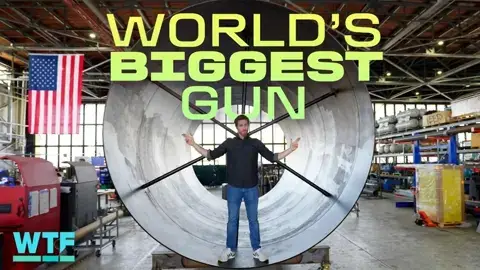
Wow. How does that feel? I could hear the hundred years. I'm standing on top of the world's biggest gun
0:15
And if the makers behind this have their way, one day a gun even bigger than this
0:19
will be shooting satellites off into space. Every rocket that's ever left Earth has worked the same way
0:25
Strap a payload to a giant tank of fuel, light it, and burn most of that fuel just fighting gravity on the way up
0:32
It's expensive, it takes a massive amount of fuel, and it's the only option we've had for 70 years
0:38
Longshot Space thinks there's a better way. Longshot's building gigantic mass drivers, kinetic accelerators
0:44
base cannons for throwing stuff to space. Not launching stuff to space, that's what a rocket does
0:50
I'm talking about throwing stuff to space. A rocket might carry 2% or 1% of its total mass at takeoff is payload
0:58
The rest of it is just the energy for lifting the fuel that lifts the payload
1:03
The idea behind long shot is pretty simple. Inject compressed gas into a giant tube to push payloads to hypersonic speeds
1:10
Normal gun, you go boom and the thing goes off. I don't go boom. I go bum bum bum bum bum bum bum bum bum bum bum bum bum bum bum bum bum bum bum bum bum bum bum bum bum chasing the bullet gradually pushing in gas behind it maintaining the pressure The idea of kinetic launch the idea of just adding a whole bunch of speed on the ground
1:27
and then throwing things, is that you leave the energy on the ground. If this concept looks or sounds familiar
1:33
you may have seen videos from Spin Launch. That company wants to use giant centrifuges
1:37
to hurl payloads to space. Longshot, on the other hand, wants to build a giant gun
1:42
that could be up to 15 kilometers long to launch satellites. That thing will look like a tinker toy, right
1:48
It'll mostly be concrete. It'll basically be a concrete tunnel with a steel lining on the inside that stretches off into the horizon
1:56
placed in the middle of a large desert, I think very likely in Australia
2:00
That's the long-term vision. Right now, Longshot is starting much smaller, testing this gun that measures just six inches in diameter
2:07
All right, so looking all the way down the gun, if you look at the ground, you can see these bolts that are keeping the gun in place
2:12
even with these thick, massive bolts in the ground. Look at how much the gun manages to move during a
2:18
shot. Look at these circles here. They represent different shots and how much the gun moved
2:22
This is the projectile that they use during test shots. There's usually a magnet on the inside
2:26
there that allows them to track the speed. This tail sits behind the projectile. It's pinched with
2:30
gas on either side to propel the projectile forward. And this is what they look like after
2:34
hitting a cement wall at Mach 4 Longshot guns use pressure vessels on both sides of the barrel that hold what Grace likens to a balloon The business that we in is the extremely precise popping of balloons What key for Longshot is getting that gas to pinch the projectile at the perfect speed
2:51
So if you imagine like this is a pressure vessel and here the gun is mated up on one
2:56
side of this and the vehicle's passing. If we strike a match back here, how long does
3:02
it take the hydrogen to actually apply pressure over here? And like the timing that we have
3:07
to do is so precise that the speed of that combustion, it might look completely instantaneous
3:12
to the naked eye, but it matters a lot for us. Okay, so I just saw the test gun that you have
3:16
over in the other facility, but now we're seeing something completely different in scale. So tell
3:21
me what we're looking at. So that was a six inch interior diameter gun, and this is a 29, a little
3:27
bit more than that, interior diameter gun. This is the full diameter, but sub-length version of what
3:34
we're going to be building next. Grace says the full version of this gun will be half a kilometer
3:38
long and fire a 100 kilogram projectile up to Mach 8. You might be looking at these guns and
3:44
notice something a little strange. They don't curve towards the sky. So how would something
3:49
shot from one of these find its way to space? That's where physics comes in. And then you're
3:54
going to be accelerating at about 200 Gs over the course of like a 10 kilometer long accelerator You going to exit you going to hit the atmosphere at around 5 kilometers per second You then going to start decelerating So you go from acceleration to deceleration and a pull maneuver and it sacrifices some of its momentum for lift So Longshot hopes that eventually
4:15
in the long run, they'll be able to shoot from a barrel that's 10 meters in diameter. Now, a barrel
4:20
that size they think would allow them to launch a vehicle weighing as much as 120 tons, carrying
4:25
about 60 tons of payload. The barrel I'm standing in right now is about three and a half meters in
4:30
diameter, and they think from a barrel this size, they could launch a vehicle weighing up to 10 tons
4:34
carrying about two tons of payload. One of the big questions around the viability of Longshot
4:39
systems is whether satellites can actually survive all that force. Longshot acknowledges that problem
4:49
makes it impossible to transport people or fragile tech, but Grace thinks it won't be hard for
4:54
satellite manufacturers to adapt. So we're pretty confident that at 200 Gs, the difficulty of
5:01
redesigning, basically sort of supporting a satellite, it's not going to be a huge effort
5:05
in terms of the redesign, particularly for smaller satellites. So in just a couple of weeks
5:09
Longshot plans on taking this six inch gun out to the desert in California
5:13
filling it with hydrogen and doing about a month of test shots on it, followed by tests in December on that 30 inch gun that we saw earlier
5:20
If you enjoyed this video, don't forget to give it a thumbs up, subscribe to CNET for
5:24
more and I'll see you in the future
#Celebrities & Entertainment News