Up next in 10



Scientists are trying to recreate the power of the sun.
Show More Show Less View Video Transcript
0:00
We're here at ITER in the south of France
0:02
We're all around us. You can hear them building the world's largest fusion reactor
0:06
Building the world's largest artificial sun has not been a smooth process
0:10
A series of setbacks have added years to the timeline and billions more to the budget
0:15
This is why ITER is so expensive. It's taking so long. At the same time, private fusion startups have been multiplying
0:22
with many hoping to beat ITER to major milestones. That China and Russia were going to collaborate with the U.S. and Europe
0:29
and add in Korea and India and Japan. That's either genius or insane
0:35
I ventured into the heart of this one-of-a-kind mega project made to contain temperatures 10 times hotter than the core of the sun
0:41
to meet the people bringing this godlike power down to Earth. And what I discovered is that Eater is already changing the world
0:48
and it's not even finished yet. The dream of Eater comes to us from the sun
0:52
which is living proof that the holy grail of a self-sustaining fusion reaction
0:56
is possible under the right conditions. Controlled fusion releases millions of times more energy than the burning of fossil fuels
1:03
and four times more energy than the reactions that power traditional nuclear power plants
1:08
Without the risk of meltdown, long-lasting radioactive waste, or releasing carbon into the atmosphere
1:13
We just have to create the right conditions to make it happen. But recreating these conditions on Earth is like trying to catch lightning in a bottle
1:23
Meet plasma, the fourth state of matter along with solids, liquids, and gas
1:27
It occurs when a substance gets so hot, the center of each atom separates from its electrons
1:33
making a very spicy soup of free electrons with charged ions moving through it
1:37
And because plasma is made up of all of these charged particles, the only way to effectively bottle it is with magnets
1:44
If I am weaving a magnetic field from a central magnet made in San Diego
1:50
D-shaped magnets going around the vacuum vessel that are made in Italy and Japan
1:54
and then circular magnets made in Russia, in China, in Europe, etc
1:59
If I want to contain those microscopic particles, the weave has to be like Egyptian cotton
2:06
It has to be super, super tight. If I make the machine 10 times bigger
2:10
the precision still has to be in millimeters ITER central solenoid magnet is the largest magnet in the world Once in place and fully assembled it will be five stories tall
2:21
weigh 1,000 tons, and play an essential role in starting and maintaining ITER's fusion reactions
2:28
ITER's ultimate goal is to study these reactions in pursuit of a game-changing tipping point for fusion energy
2:34
We want to get to something called a burning plasma. It takes a lot of energy to reach fusion temperatures
2:40
but a burning plasma heats itself, so fusion reactions create the heat for more fusion reactions
2:48
Humans have been able to create burning plasmas in a lab with lasers and in H-bombs
2:52
but those reactions last a very short time. ITER wants to create a burning plasma using the same technology commercial fusion energy companies are most likely to use
3:01
ITER's ability to deliver on this burning plasma dream hinges on building the world's largest ever tokamak
3:07
that will control plasma heated to temperatures more than 10 times hotter than the core of the sun
3:13
Why even hotter? Because the sun has an advantage thanks to the immense gravity bearing down on the particles inside its core
3:20
increasing their density and allowing fusion at lower temperatures. ITER will only be using less than a gram of fuel within its comparatively huge vacuum chamber at a given time
3:31
So what ITER lacks in fuel density, it has to make up in heat
3:34
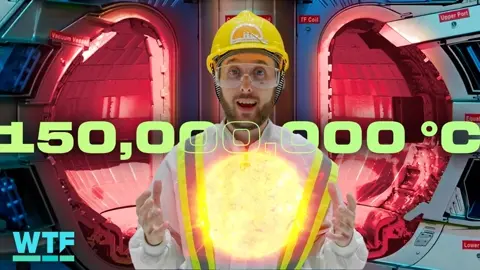
The 150 million degrees Celsius plasma inside Eater's tokamak will make it one of the hottest
3:41
places in the solar system. But the superconducting magnets that wrap around the tokamak and keep that
3:47
plasma contained need to be kept at incredibly cold temperatures in order to work. We're talking
3:53
just a few degrees above absolute zero. So to pull this off, it requires putting one of the hottest
4:00
environments right next to one of the coldest environments, all separated by this very thin
4:05
heat shield. And it's inside this heat shield between the extremes where some very small cracks
4:11
created some very big problems. We found that we had three leaks in these pipes out of about 61
4:17
tests. And the result was to rip out all 20 kilometers of that piping and rebuild or
4:23
refabricate those shields We will need about 5 billion euro more which is a hell of a lot of money of course I will not deny that but we want to do it right Problems of quality then end up causing extra costs It actually quite normal quite expected that you would have these kinds of setbacks
4:40
When you explain that to a politician who's controlling your funding, that's a more difficult thing to get your hands around
4:46
Speaking of politicians, did I mention that there are more than 30 countries collaborating on Eder
4:50
You have specified contributions from each of the members. Europe, 45 percent. Each of the others, 9 percent each
4:57
It's a percentage of value because the members contribute components. With so many cooks in the kitchen and so much resources at stake
5:03
Eater decided on a consensus decision-making model similar to what is used by the Antarctic Treaty
5:09
the World Trade Organization, and NATO. What we've also done is to create a de facto global supply chain
5:15
That global supply chain leads here, to the Eater-Tokomac Hall, where a precise choreography of scientists and engineers from around the world is consistently on display
5:26
Here you have slices of the vacuum chamber. Once these are assembled, these giant yellow cranes are going to come
5:32
pick them up, and lift them over the wall into the tokamak pit, which is our next stop
5:37
The tokamak pit is arguably the most sensitive and sacred part of the sprawling eater complex
5:42
It's protected from contamination and construction dust by a strict cleanliness protocol inspired by the aerospace industry
5:48
and visits from outsiders to this part of the facility are rare. Please make sure that you have nothing on you that can drop
5:56
You will never get it back. Got it. And the machine won't work
6:03
This, as they say, is where the magic happens. ITER's chosen fuel for its fusion reactions will be deuterium and tritium
6:10
which are just fancy names for hydrogen with one and two neutrons. This is the same fuel mix that's most likely to be used
6:17
in the commercial fusion reactors ETER is hoping to help with its research
6:21
The fusion reaction between these two particles produces helium and a spare high-energy neutron that's very hot and without charge
6:29
meaning the surrounding magnets containing the charged plasma can't control it. As fusion occurs, these particles will slam into the walls of the tokamak
6:37
so they have to be well-designed to withstand that sort of impact. As you see these yellow holes in four of these holes we will attach a shield block It just a component that will stop the neutrons Some of ITER shield blocks will also have a special material inside them
6:53
that could unlock another fusion energy superpower, the ability for a reactor to make its own fuel
7:00
Deuterium is abundant in nature. Tritium is very, very scarce. You have to breed it
7:04
from putting lithium in some form in the walls of the tokamak. That's been demonstrated
7:09
but we need to demonstrate it at scale. ITER is ultimately a research tokamak
7:14
meaning it won't be providing power to the grid, but that was never its purpose
7:18
ITER represents a bridge between research facilities and commercial machines. Every problem ITER is able to solve is one less that commercial fusion companies will have to
7:27
confront. Many of the new tokamaks look like ITER after all of this knowledge. We are developing a
7:31
lot of software to predict what the plasma is going to do. Now we are trying to release this
7:36
One of the things that struck me most about ITER is how the project is treated like an open book
7:42
We're in the process of writing an ITER engineering handbook, and we talk about mistakes
7:46
We talk about this is what we learned, this is what we did wrong. Every member state in the ITER agreement has access to all the science that comes out of ITER
7:53
And any non-member state that wants access to the science can get it, as long as all the member states agree to share it with them
7:58
We have become a model for how countries of unlike persuasion can actually work over decades
8:06
through trade wars, hopefully not armed conflict, only through the shared vision of a better world
8:12
that everybody wants for the next generations. This type of collaboration between public and private entities
8:17
has already led to world-changing technologies like the internet, GPS, space travel
8:23
even modern consumer tech like Siri, touchscreens, and Google Search. This is a public-funded project, and this is the knowledge of the world
8:32
Fusion is one of those technologies people often say feels like it's always a decade away
8:36
But actually seeing the future Eater is building with my own eyes gave me hope that we may actually be living in the last decade where people speak about fusion as a distant dream
8:45
This is the Eater Control Center and as you can see it's still being built out right now
8:50
But by the time Eater ignites its first plasma, this place will be buzzing with activity
8:54
Eater's first plasma is now scheduled for 2034. What do you think of fusion power
8:58
Let us know down in the comments and subscribe for everything that makes you say what the future
#Celebrities & Entertainment News