Up next in 10



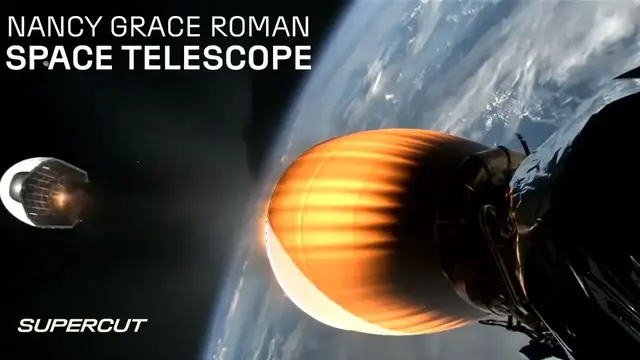
Watch NASA and SpaceX launch NASA's newest space telescope to explore the universe in unprecedented detail.
Show More Show Less View Video Transcript
0:00
5, 4, 3, 2, 1, ignition, and liftoff
0:07
Go Falcon Heavy and go Roman Space Telescope. And liftoff of NASA's Roman Space Telescope on a mission to revolutionize our understanding of the universe
0:20
All M1D chamber pressures are nominal. Falcon Heavy has cleared the tower and is on its way to space
0:30
Looks like a beautiful launch so far Steve. Great shot there from on top of the rocket looking down and then now tracking up looking
0:40
at those 27 Merlin engines lifting the Falcon Heavy and Roman Space Telescope off into space
0:50
Falcon Heavy soaring. Power. Central Energy nominal. Falcon Heavy soaring into the Florida sky
0:58
We are 53 seconds into this flight. Rocket will be heading into Max Q
1:03
Falcon 9 is supersonic. Picking up speed and altitude very quickly. Engines will throttle down slightly to reduce the mechanical pressure
1:16
and the mechanical stress on the rocket. Max Q. And we heard that call out for max Q
1:28
which is the point of maximum aerodynamic pressure as the rocket is ascending
1:33
Now, coming up in just under a minute from now, we're going to have a large series of events happening back to back
1:39
We'll be starting with BECO, or booster engine cutoff, where the engines on those boosters will power down
1:46
We'll then have side core separation of those two boosters, followed by that. We will then have MECO of the main core and then stage separation of that
1:56
as well as second engine start one following that. Now those two boosters will be heading
2:02
back to Florida today. They'll be doing boost back burns to put them on trajectories back towards
2:08
Kennedy in Florida. Now we should be hearing that call out for BECO in just about 13 seconds from now
2:19
Sight booster separation confirmed And there we saw stage separation and you can actually see the view
2:44
from the main core on the left and then the two side cores on the right hand side of your screen
2:50
PY boost back startup. NY boost back startup. And there's confirmation of the boost back startup
2:57
on those two side core boosters. So at this point both Falcon Heavy side boosters are performing
3:02
their boost back burns, which is the first of three burns each side booster will undergo
3:06
on the way back to Cape Canaveral Space Force Station. Now, the primary objective of the boost
3:12
back burn is to quickly reorient the side boosters onto the required return trajectories
3:17
and this is required in the event of a return to a launch site as opposed to a drone ship ocean
3:21
recovery. And today, they're headed towards landing zones 2 and 40 in Florida. Now, meanwhile
3:26
in the center core, the nine M1D engines are continuing to power Falcon Heavy on its nominal
3:31
trajectory. Now the engines on that center core are still burning right now. They're set to burn
3:42
for about another 12 seconds or so, and then they'll throttle down and we'll have our MECO
3:48
our main engine cut off of that, and then we'll have stage separation of this center core and the
3:54
second stage shortly thereafter. PY boost back shutdown. NY boost back shutdown
4:02
Pico. Stage separation confirmed. And great shot there as the first, as the main core and second stage separate from one another
4:15
And we just heard that call out for second engine startup. and you can see the MVAC engine there on your screen with a beautiful view of Earth behind it
4:27
Faring separation confirmed. And we also just heard confirmation of faring separation
4:34
As I said earlier, those faring halves are no longer needed. And you can see one there on your screen
4:42
And four minutes, 38 seconds into the mission, Roman Space Telescope gets its first taste of space
4:51
Payload fairing is jettisoned. All vehicles are following nominal trajectories. And we are coming up on an expected AOS, or acquisition of signal, important step
5:09
Really just getting spacecrafts just sending its pulse over the NASA systems Yeah that right The acquisition of signals should hopefully be coming up here in a minute or so That be the first opportunity that the spacecraft can go and quote talk to the ground station
5:27
the folks back at Goddard, to make sure that it's still happy and healthy on the way during the Stage 2 burst burn
5:33
But everything's looking good as far as telemetry is concerned for MVAC. You can see there the nozzle extension glowing orange as it's going around the Earth
5:43
Launch of the Roman Space Telescope looking very good as the Falcon Heavy carries the observatory into orbit
6:01
Of course, the Roman Telescope won't really open its eyes, so to speak
6:06
Until later in the mission when it gets out to that Lagrange 2 point, about a million miles from Earth
6:19
Everything that we're seeing, a rocket performing exactly as it's supposed to
6:24
TY entry burn startup. NY entry burn startup. And nominal trajectory so far
6:30
Very exciting moment for the spacecraft team. That's for sure. TY entry burn shutdown
6:36
Yeah, Steve, so we just had the entry burns on those side core boosters
6:43
as they're making their way back to Earth right now. Now, as mentioned earlier, we will be attempting to recover both side boosters
6:50
which are targeting a landing at landing zone 40 and a landing at landing zone 2 at Cape Canaveral Space Force Station
6:58
And you can actually follow the vehicle telemetry of those side boosters
7:04
via the telemetry on your screen there. NY FTS is safe. NY Transonic
7:11
Now we're just waiting for those landing burns to start up in just about 10 seconds from now
7:25
Stage two FTS is safe. NY Landing Burn. N.Y. landing burn
7:34
Stage 2 is in terminal guidance P.Y. landing leg deploy N.Y. landing leg deploy
7:43
P.Y. landing confirmed N.Y. landing confirmed Thank you And we got a beautiful shot of one of those side core boosters there on your screen
8:21
We did, of course, have confirmation of successful landings of both of those side core boosters
8:27
and certainly most people in the vicinity heard those sonic booms. Now, coming up next, we are expecting the shutdown of the second-stage MVAC engine
8:35
and this is known as second-engine cutoff one or SECO one, and we should be hearing that call out here shortly
8:43
and afterwards we'll just be waiting for confirmation of good orbit. Nominal orbit insertion
8:51
And there's that callout for nominal orbital insertion after we turn off the MVAC engine on the second stage there
8:59
So coming up next, we have a bit of a breather coming up before the next milestone for the mission
9:04
SCS-2, when the MVAC engine on the second stage restarts as it continues to its orbital destination
9:10
And we have a shot of the Mission Director Center here at KSC on the right
9:17
Let's see if we can see. Nancy Grace Roman Space Telescope, separation confirmed
9:25
There we go. Nancy Grace Roman Space Telescope flying free on its way to Lagrange 2
9:32
and to open a new eye on the universe. Of course, a lot of celebration with the team, Jared
9:39
I know you represent a lot of people in NASA's Launch Services Program
9:44
and across NASA a lot of work goes into this. I hope you have enjoyed it
9:49
We've enjoyed having you. you? Yeah, it's been great. Yeah, wonderful. Spacecraft deploy
9:54
Hear all the claps here behind us in the mission control room
9:58
I'm sure the same at Goddard. Thanks so much for having me today. And most importantly, congratulations to the whole Roman team on behalf of the Launch Services
10:06
Program. It's been great working with everybody, and we really can't wait to see
10:09
all the great science that you're going to do out there. It's going to be terrific. Roman
10:14
is on its way, and we are going back to Zach at Hawthorne, California
10:18
in SpaceX. Thanks, Steve and Jared, and what a spectacular deployment. Of course, a huge thank you from SpaceX to everyone at NASA for the partnership on this
10:30
mission and to all the teams on both sides who brought NASA's Nancy Grace Roman Space
10:35
Telescope to the pad and into space
#Celebrities & Entertainment News