Up next in 10

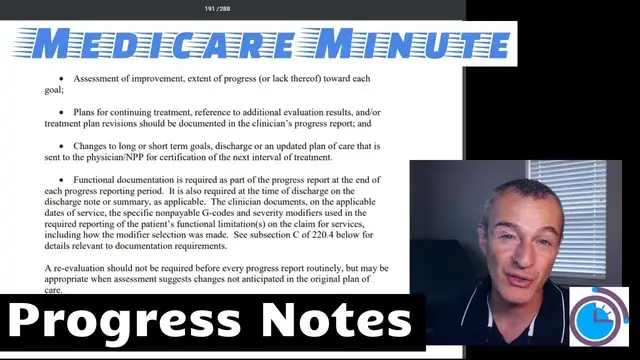
Medicare Progress Note Requirements for Physical Therapy, Occupational Therapy #MedicareBilling
Oct 29, 2022

#physicaltherapymedicare #occupationaltherapymedicare #speechtherapymedicare
✔️ If you would like to learn more about Medicare billing please join our FREE Facebook community at https://www.facebook.com/groups/mcrbilling/
✔️ If you are interested in learning more about billing Medicare check-out our website at www.learnmedicarebilling.com
✔️ And if you just want to learn more about me 😀 check-out my Facebook profile at https://www.facebook.com/anthony.maritato.73
If you would like to mail me:
Total Therapy Solutions
5900 Long Meadow Dr
Middletown, OH 45005
Show More Show Less View Video Transcript
0:00
So let's take a look at page 191 in the Medicare Benefit Policy Manual where it specifically states
0:05
what needs to be included in the progress note. Now if you saw the last video I was talking about
0:11
when the progress note needs to be done, what exactly the 10 treatment day rule is
0:17
and how to complete the progress note. Now we're talking about what needs to be included
0:22
in the progress note. So the content of the clinician, in this case the therapist
0:26
so we need an assessment of improvement extent of progress or lack thereof toward each goal so each
0:35
goal in the plan of care needs to be addressed now if you're doing this as part of the daily
0:40
treatment notes if you follow my guidelines so if you remember i said let's pretend if you want
0:48
to do four short-term four long-term goals or just eight functional goals you do the evaluation on day
0:55
one. That's done. The first follow-up treatment, which is actually session number two, you're
1:02
addressing the first goal, whether it be the first short-term goal, impairment goal, or just the first
1:07
goal in general. Treatment number three, the third day the patient has arrived, you're addressing goal
1:13
number two, right? So then goal number three, goal number four, goal number five, goal number six
1:19
and so on if you're doing the four short-term impairment goals once you get to treatment number
1:26
five the evaluation and four follow-ups you've addressed all those four impairment goals now
1:34
what you're going to do is you're going to review let's say for example impairment goal number two
1:38
didn't get met so session number six is going to address that goal session number seven might be a
1:47
summary of all the goals, session number eight might be the first long-term goal. And so as you
1:55
continue session number nine, then of course we hit session number 10. And session number 10
2:03
if you've addressed all of your goals, your progress report is in the daily treatments
2:10
But if it's not, then you do a separate document that would be considered a progress report
2:16
in which you assess improvement, just like they ask for, the extent of progress, lack of progress toward each of those goals
2:25
If we look at the second item, plans for continuing treatment, reference to additional evaluation results and or treatment plan revisions should be documented in the clinician progress report In most cases you not gonna be changing a whole lot So that a real simple continue per original plan of care
2:45
changes to the longer short-term goals, discharge or an updated plan of care
2:51
that's sent to the physician for certification. Now, typically, we're looking at
2:58
you know, and every case is different. Let's say, for example, you have an evaluation
3:02
new patient evaluation you develop a plan of care and you create a certification period for the full
3:09
90 days of which you're allowed maybe it was a rotator cuff repair and you're seeing them fresh
3:15
post-op so you create a plan of care you request a 90-day certification period and you're documenting
3:22
your daily treatment notes and within that you're addressing all of the information that needs to be
3:29
recorded for the progress note, you don't need that separate document. But let's say, for example
3:35
you're not recording everything that needs to be recorded in your daily notes. And so on the 10th
3:41
treatment session or sooner, you perform a progress note. You review everything. You review the goals
3:48
You review the progress. You review any limitations. If there was any goals that were going to be
3:55
updated or modified or added you included in this progress report you still haven't gone through
4:02
your 90-day certification that you asked for on the original plan of care so you're just continuing
4:08
that original plan of care you do not have to ask for a new certification period unless you foresee
4:16
at this point yeah we're going to need more than the 90 days i requested or if you requested you
4:22
know 30 days and now it's a day 29 and you're going to need to extend that certification you're
4:29
going to request another 30 days this is where that happens in this progress report
4:34
any functional documentation you know it's required as part of the progress
4:40
and at the end of the reporting period let me scroll down here so we can look at this fully
4:47
it's also required at the time of discharge if you're discharging and that is acting as your
4:55
progress report the clinician documents on the applicable dates of service specific non-payable
5:03
g codes and severity modifiers if you're doing that remember this isn't a requirement for 2019
5:10
on claims for services including how the modifier selection was made So let say you use the Oswestry or the cervical the neck index
5:22
or the lower extremity functional scale. You want to indicate what tool you were using, what the raw score was
5:29
and how that is interpreted relative to the levels of impairment. below there's details you know a re-evaluation should not be required before every progress note
5:43
but may be appropriate when an assessment suggests changes not anticipated in the original plan of
5:52
care and so the re-evaluation if you remember the previous video if i haven't posted it before i
5:59
post this it'll be coming but we're talking about evaluation and re-evaluation the re-evaluation
6:04
Re-evaluation is another evaluation. It's not a progress report. Re-evaluation and progress report are separate documents with different purposes
6:15
So think of the re-evaluation as you've been treating this patient, something major changed
6:22
and now you must truly re-evaluate. Not evaluate progress, not assess where they've come, not any of the stuff that would be done in a progress note
6:32
but a whole new evaluation that is what a re-evaluation essentially is and so if you
6:40
don't have a big enough change in status to support or justify another evaluation you do not use
6:48
re-evaluation and then we continue here care must be taken to assure that the documentation
6:55
justifies the necessity of services provided during the reporting period particularly when
7:01
reports are written at the minimum frequency that would be every treat every 10 treatment days
7:06
justification for treatment must include for example objective evidence or a clinically
7:12
supportable statement of exception let's scooch down that in the case of rehabilitative therapy
7:22
which is what most of us are going to be doing the patient's condition has the potential to improve
7:30
or is improving in response to therapy, maximum improvement is yet to be obtained
7:36
so there's still room for improvement, and there's an exception that the anticipated improvement
7:42
is attainable in a reasonable and generally predictable period of time. If it maintenance that we providing and we doing a progress note for a maintenance program treatment by the therapist is necessary to maintain prevent or slow further deterioration
7:58
of the patient's functional status and the services cannot be safely carried out by the
8:04
beneficiary him or herself or a family member or another caregiver or unskilled personnel
8:10
out and so remember you know look go back to medical necessity look at their definition of
8:17
what is medically necessary what the definition of these terms is because that is where you're
8:24
going to get the answer to what is a covered service and thereby billable to medicare what
8:29
is not a covered service and thereby you may charge a cash rate to the beneficiary
8:36
so objective evidence consists of standardized patient assessment instruments outcome measurement
8:45
tools and measurable assessments of functional outcomes guys just take it from the horse's mouth
8:51
listen to what they're telling you if if i hate the back index it's all about pain but they're
8:57
saying that that's what they want you to the information they want you to provide okay now
9:03
maybe there's a tool out there somewhere that kind of meets your personal like what you believe is
9:10
important and complies with the medicare guidelines but if not just use what's available
9:18
photo is out there there's just so many tests that you can use standardized assessments
9:23
good or not right or wrong doesn't matter they're saying this is what we want we're paying the bills
9:30
this is what we want you to give us okay so just kind of get out of your own way a little bit with
9:36
this use of objective measurements at the beginning of treatment during or after treatment is
9:42
recommended as well to quantify progress and support justification for services for continued treatment such tools are not required but their use will enhance the justification of
9:57
needed therapy. And so if you want, I mean, it could be as simple as at the beginning of therapy
10:03
this patient was able to lift five pounds and carry it 20 feet. As of today, three weeks later
10:10
this patient's able to lift 25 pounds and carry it 50 feet, right? Super simple, clean, objective
10:17
Guys, in the next video, we'll get into some of these examples so we can look at exactly what
10:22
Medicare is telling you they want to see in the documentation. Thanks for watching. Subscribe
10:27
to the channel. I'll catch you in the next video