0:00
All right, welcome back. Today we are
0:02
doing a deep dive into something that is
0:04
uh arguably one of the hardest inner
0:09
>> Just seeing yourself clearly.
0:11
>> It really is. We're getting into why
0:12
personal growth can so often feel
0:15
>> well like you're moving through fog.
0:16
>> That's the perfect word for it. Fog. So,
0:18
what's our mission here?
0:20
>> The mission is to see that the fog isn't
0:22
you. It's it's layers of old stories,
0:25
emotional residue, belief structures you
0:27
picked up years ago. The goal isn't to
0:30
fix yourself. It's just to see what's
0:32
already there with, you know, honesty
0:35
>> Okay. So, how do we start seeing past
0:38
those layers? Our sources all seem to
0:40
point to this one core mechanism.
0:41
>> They do. True self-awareness isn't just
0:44
paying attention. It's the ability to
0:46
observe your thoughts, your reactions,
0:47
your whole internal world without
0:49
getting caught inside of it.
0:50
>> Ah, okay. Like the director's chair
0:52
analogy you mentioned.
0:53
>> Exactly. You step out of the character
0:55
you're playing on autopilot and you
0:56
watch the scene unfold. the director
0:58
isn't in the drama, right? They're
1:00
>> I love that analogy, but isn't that
1:02
incredibly hard to do in the moment? I
1:05
mean, a strong emotion hits and stepping
1:07
into a director's chair feels
1:10
>> It does at first. Yeah, it takes
1:12
practice, but the payoff is huge because
1:14
your patterns, they stop being this uh
1:17
inevitable destiny. They just become
1:20
>> Data. So, if I notice I always get angry
1:23
>> That's not a flaw. It's
1:25
>> what a data point.
1:27
>> It's just a data point that says, "Hey,
1:28
a need is not being met here." That's
1:31
it. It's actionable information, not a
1:33
>> That makes so much sense. But, okay, if
1:35
we're the director, it feels like our
1:37
main actor, the mind, has its own
1:39
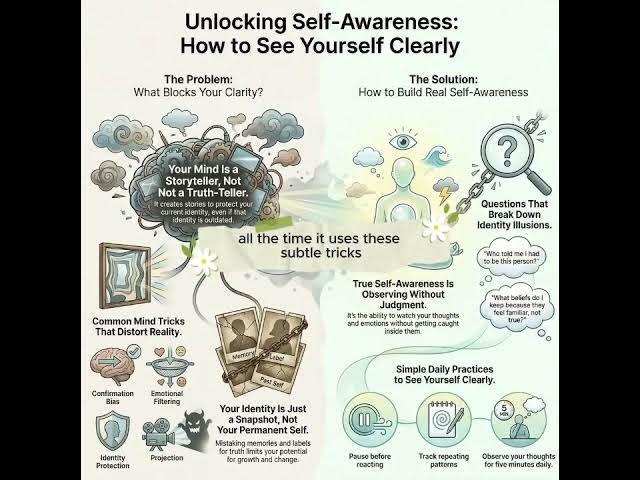
>> The sources say the mind is a
1:41
storyteller and sometimes a liar.
1:43
>> A very convincing liar because its main
1:45
job is to keep things stable. It wants
1:47
to protect your current identity even if
1:49
that identity is, you know, completely
1:50
outdated. So, it tells these little
1:52
stories to justify staying put
1:54
>> all the time. It uses these subtle
1:55
tricks. Confirmation bias is a huge one.
1:57
>> Oh, I fall for that constantly. I'll
2:00
read three objective reports, but the
2:01
one headline that confirms what I
2:03
already believed is the one that sticks.
2:05
>> That's it. Exactly. Or there's emotional
2:07
filtering where your mood literally
2:09
colors reality. A rainy day doesn't just
2:11
feel gray, it makes an argument feel
2:14
hopeless. And the biggest one seems to
2:16
be identity protection where you just
2:17
automatically reject an idea if it
2:20
threatens how you see yourself.
2:22
>> Yes. And that all hinges on
2:24
understanding what that self-image even
2:26
is. We think it's this solid permanent
2:30
>> It's more like a map, not the actual
2:33
>> It's a snapshot, a flexible collection
2:35
of memories, labels, and expectations.
2:38
mistaking that snapshot for the real
2:40
permanent you. That is the single
2:42
biggest thing that caps your growth.
2:44
>> Wow. So, if we want to start challenging
2:46
that to get past the mind's defensive
2:48
storytelling, what's the most important
2:51
>> You have to find what you're still
2:52
defending. So, you ask yourself and you
2:55
have to sit with the discomfort of it.
2:56
What parts of me feel borrowed instead
3:00
>> And the follow-up is just as critical.
3:02
What beliefs do I keep around just
3:04
because they feel familiar, not because
3:06
they feel true? Okay, so these are
3:09
>> but practically, you know, for someone
3:12
>> how do we start building this director's
3:14
perspective dayto-day?
3:16
>> It starts really small. It's about
3:17
intentional effort, not extreme effort.
3:20
The first practice is just to pause
3:24
>> 3 seconds. That's it. And in that pause,
3:27
just ask what emotion is really driving
3:29
the response. Don't engage it. Just
3:33
>> Just name it. And the second practice,
3:35
>> just as simple, spend five minutes a day
3:38
just observing your thoughts. Don't grab
3:40
on to them. Don't argue with them. Just
3:42
watch them pass by like cars on a
3:44
>> Anyone can do that. That's really
3:46
>> And when you do that, you know, you're
3:47
stepping off the autopilot. You stop
3:49
repeating the old stories. And that
3:51
clarity, it brings freedom. Freedom
3:54
>> And that's the whole point, isn't it?
3:56
Choice. That's a perfect place to leave
3:58
>> So, here's the thought we want to leave
4:00
>> if seeing clearly is the foundation of
4:02
real choice, consider this. What's one
4:06
choice you're making every single day
4:08
that's driven purely by a belief that
4:10
only feels familiar, but maybe not