Up next in 10

The Meat Pies That Fed Railroad Workers in the 1800s During the Great Expansion West
Apr 8, 2026

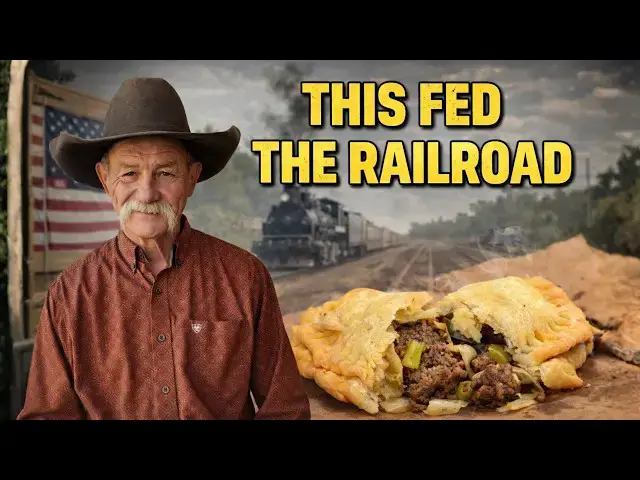
If you are wondering what railroad workers ate during the building of the Transcontinental Railroad, this historic baked meat pie recipe tells the real story. Crews working for the Union Pacific Railroad and the Central Pacific Railroad relied on hearty, filling meals like this meat pies. This old-fashioned recipe is a true example of railroad camp cooking. If you enjoy cowboy cooking, Dutch oven recipes, cast iron meals, and historical recipes from the Old West, this is a must-try dish that brings American food history to life.
Used in this video:
Cowboy hash knife https://www.kentrollins.com/shop
propane camp stove https://amzn.to/2MG9vo9
Kent's original seasoning https://www.kentrollins.com/shop
Can't Get Full on Fancy Yeti: https://www.kentrollins.com/shop
DJI Mic 2 https://amzn.to/4ewAHAw
Cowboy Hat: Chazhatz.com
For more suggested products seen in our videos click here: https://www.amazon.com/shop/cowboykentrollins
======================
Printable Recipe: https://kentrollins.com/blogs/beef/railroad-meat-pies
======================
Check out our BEST SELLING cookbooks. Get your copy here: https://www.kentrollins.com/shop
Show More Show Less View Video Transcript
0:02
Y'all ever wonder what railroad workers
0:03
took for lunch back in the mid-1800s?
0:05
[music]
0:06
Back when America was building the
0:07
railroads, thousands of men were working
0:10
miles away from camp. So, what was in
0:13
[music] that lunch pail? Meat pies. In
0:15
this episode, we're exploring what it
0:17
was really like during the great
0:18
expansion of America and the meals that
0:21
traveled the rails with them.
0:33
During the railroad expansion in the
0:35
mid-1800s,
0:37
crews laid miles and miles of track
0:39
through the plains, over the mountains,
0:41
and through the deserts. Now, at those
0:43
construction camps for railroad workers,
0:46
a cook could feed 2 to 300 men.
0:48
But, they got [music] farther and
0:49
farther away from camp and farther from
0:52
the groceries. And that meant that the
0:54
meals must travel with them. In a tin
0:56
can or wrapped in a cloth. The tin lunch
0:59
pail wasn't just practical.
1:01
>> [music]
1:01
>> It had a clever trick. Workers would
1:03
fill the bottom compartment with hot
1:05
coffee and set their food on a tray
1:07
above it, so the steam kept the meal
1:09
warm for hours while they worked. That
1:11
design became so associated with the
1:13
working class that by the early 1900s,
1:17
politicians were running campaigns on
1:19
promises to keep [music] the lunch pail
1:21
full. Now, these meat pies were
1:23
portable, filling, and easy to eat with
1:25
your hands. And that's [clears throat]
1:26
what we're whooping up today. [music]
1:41
Got all my veggies assembled here. Some
1:43
cabbage, onion, jalapenos, and some
1:45
garlic. All things I'm sure that the old
1:47
cook had in them railroad camps. But,
1:49
we're also going to add us some carrot
1:51
in there, we are. And we're not just
1:52
going to chop it, because I think it
1:54
don't blend right. If you can grate that
1:56
carrot that you're putting in here, it's
1:58
going to blend with that meat sort of
1:59
tied all together. So, we're just going
2:01
to grate these.
2:03
And y'all might be thinking to yourself,
2:05
have I seen a cousin to them meat pies
2:07
you're doing? You sure might have.
2:09
Called the Cornish pasty. It was made
2:12
over in Cornwall, England for the tin
2:14
miners over there for them to carry in
2:16
the mine for them to eat.
2:20
When you see the color change from
2:21
orange to blood red, you know you went
2:23
too far and got your finger. When it
2:25
gets about that close,
2:26
we're just eat the rest of it.
2:36
The original Cornish pasty [music] had a
2:38
thick crimped edge that the miners were
2:40
supposed to hold while eating, then
2:42
throw away.
2:43
The idea was the miners' hands were
2:45
covered in arsenic from the tin ore. So,
2:48
the crust acted as a handle that kept
2:50
the poison off the food. Now, the
2:52
biggest difference in the railroad camp,
2:54
the meat was browned with the vegetables
2:56
and then put in the dough. Now, whereas
2:58
the pasties were not. It was raw meat
3:00
and vegetables and then it was cooked.
3:08
>> [music]
3:10
>> Well, I've got me a pound of ground beef
3:12
and it is browned up. Time to add the
3:14
seasoning. We'll put all this in here to
3:17
one little pile. And we have some
3:19
oregano, some ancho chili, smoked
3:21
paprika, little cumin. You're going to
3:23
let it have it.
3:24
But, I am going to season it, too. The
3:26
cook might not have had it,
3:29
but I know he would have wanted some if
3:30
he'd have got the chance.
3:32
Cuz there was no salt in there, and we
3:34
need this. It's got a little And I'm
3:36
using our low sodium original season. I
3:39
didn't know if some of y'all knew it was
3:40
out there, but hey, same great flavor,
3:43
just a little less salt. So, let's get
3:45
that stirred up and let all them flavors
3:48
blend really well.
3:50
And it's going to be time to add the
3:52
veggies.
4:01
Well, all the veggies is [music] in the
4:03
skillet. We're going to let that cook
4:05
about 5 minutes till them veggies get
4:06
good and tender, then we'll pull it off
4:08
the fire.
4:14
After them veggies is tender and right
4:16
at the last, add in some of that
4:18
Worcestershire, however you want to
4:19
pronounce it.
4:22
The Civil War had just ended and the
4:25
nation was desperate to reconnect itself
4:27
coast to coast. The answer was the
4:30
railroad. Before the railroad, traveling
4:32
from the East Coast to California could
4:34
take 4 [music] to 6 months by wagon.
4:36
Once the rails were finished, that same
4:39
journey could be made in about a week.
4:41
Railroad camps moved constantly as the
4:44
[music] track pushed westward. Entire
4:46
temporary towns sprang up almost every
4:48
night. Now, a railroad camp cook might
4:51
be responsible [music] to feed two or
4:52
300 workers at a time, turning out big
4:55
kettles of beans, meat, potatoes,
4:58
biscuits, and coffee. Camp kitchens were
5:00
not fancy places. Most were large canvas
5:02
tents set up beside the construction
5:04
camps. The camp cook worked over wood
5:06
fire stoves and open fires, using large
5:09
iron kettles, Dutch ovens, and heavy
5:12
cast iron skillets. Many railroad bosses
5:14
believed the cook was [music] one of the
5:16
most important men in camp, because if
5:18
the cook quit, the crew might [music]
5:20
quit right along with him. A camp cook
5:22
feeding hundreds was not likely making
5:24
pies like this every day. But, wrapping
5:26
leftover meat, potatoes, or vegetables
5:29
in a simple crust [music] was a
5:30
practical way to turn yesterday's supper
5:33
into a portable meal for smaller
5:35
traveling crews. Along with the meat
5:37
pie, a railroad worker's lunch might
5:39
include thick slices of bread, biscuits,
5:42
cold fried potatoes, pickles, or even
5:44
dried meat. Well, it's time to make some
5:47
dough. And this is just about as basic
5:49
and simple a pie dough as you can make.
5:51
Now, we started out with some flour, all
5:53
purpose. Going to add a little salt,
5:56
which is the correct amount, some baking
5:59
powder.
6:00
We're going to mix that really well.
6:04
Now, back during them railroad camps,
6:06
old cookie probably used lard. Me, I'm
6:09
going to use butter. Now, I like to keep
6:11
it frozen, but it's warmed up today on a
6:13
lot of them ranches, too. I'd start out
6:15
with a piece of butter that was pretty
6:16
well cold, cold. Time I'd get it to the
6:18
chuck box and it's 100° standing by old
6:20
Bertha and trying to grate it, you just
6:22
better cut it in there with your knife.
6:24
The reason I like this pie dough, it's
6:26
got a full stick of butter. Don't y'all
6:28
run off. Butter's good for you, we got
6:30
to have it. So, we're going to put it in
6:31
there.
6:33
And then we're going to work it with a
6:34
fork to get it to like a cracker crumb
6:37
consistency.
6:39
Now, if you're doing this in the house,
6:41
if you'll freeze that butter
6:43
and then grate it, this process is so
6:45
much quicker. But, when I was little,
6:47
when it come time to making pie crust at
6:49
holidays, you know who they give the
6:50
fork to to do this? The littlest kid in
6:53
the bunch, and that was me.
6:54
>> [music]
6:54
>> So, I'm just going to go to see if we
6:56
can get that incorporated in there.
7:04
Got her looking just right, we do.
7:06
We are going to add us some water first.
7:11
And I like to give it just [music] a
7:12
little stir, not much, just a tad.
7:15
That's enough.
7:16
And then we're going to add in some oil.
7:21
I like to not use it all at once, that
7:23
way I can know what consistency we're
7:25
getting here, cuz I'm thinking we may
7:27
have to have a little flour.
7:30
We're close, but it's still just a tad
7:32
wet, so we're going to sprinkle just a
7:34
little in there.
7:37
Cuz I want this to be soft, but I don't
7:39
want it sticking to my hand. Y'all have
7:41
made pie crust before, you know what
7:43
we're looking for. What, you ain't made
7:44
no pie crust?
7:46
This will be your first time. I'm so
7:47
excited for you, because when you get
7:49
these meat pies, whoop,
7:51
put together,
7:52
you'll be wanting to make pie dough
7:53
every day.
7:56
>> [snorts]
8:00
>> Let's see where we're at. Get a little
8:01
on your hands.
8:05
I think time we work that just a little
8:07
right here on this board. Flour your
8:09
surface.
8:12
Now, I want this dough to be good and
8:14
moist, but this is still just a tad wet.
8:17
That's why I'm going to work it just a
8:18
little. Sprinkle me a little more right
8:20
here on top.
8:24
I'd say if it don't stick to your hand
8:26
and it feels soft, you're in pretty good
8:28
shape.
8:50
Whoa!
8:54
We have rolled her out to about a eighth
8:56
of an inch thick. Now, you cut these in
8:58
however big you want them, but most time
9:01
if I was eating, always used one thing
9:03
to cut them every time. Always was in
9:04
the pantry, it was.
9:06
Top of the lid off of a Crisco.
9:09
You just put them in there. Whoop. Give
9:11
them a little mashing. You can even give
9:12
them a little turning if you like.
9:14
And let's see, does it come out of
9:16
there? Lot of times you may have to take
9:18
the knife to finish up the Crisco job.
9:24
There we go. And if you ever see it, and
9:26
it happens a lot of time, after you cut
9:28
pie dough, you'll see it sort of try to
9:30
join back together cuz it's scared. You
9:32
can roll them back out a little, do you
9:34
need to. Let me put a little flour right
9:36
here, so
9:37
things don't stick. [music]
9:39
And we'll get them all cut out.
9:50
All the dough has been run out, [music]
9:52
but it's tried to shrink a little, it
9:53
has. I might add just a little flour on
9:55
this board, not much,
9:57
cuz I just want to give them a little
9:58
rolling right here at the last.
10:02
And it's amazing to me or I can start
10:03
out with something round and if I roll
10:05
it again, it might turn into a
10:06
rectangle. So, you never know.
10:08
So, got her like we want her.
10:11
Take about, I'd say,
10:13
probably two of these tablespoons.
10:16
Place it right in the center.
10:18
Pull it over from one direction or the
10:19
other, I don't care. We'll turn it this
10:21
way for camera's sake.
10:24
And then we need to crimp it.
10:27
So, you can use your hands, your
10:29
fingers, mash it.
10:31
Whatever you would like.
10:33
But that there is the basics of a meat
10:36
pie. Now, I've cooked these on ranches a
10:38
lot and I would deep fry them. But today
10:40
we're going to bake them in a Dutch oven
10:42
and whoo, I can't hardly wait. Sealed up
10:44
it is.
11:08
Building the railroad was one of the
11:09
toughest jobs in 19th century America.
11:12
Historians estimate that nearly 25,000
11:15
laborers took part in building the first
11:17
transcontinental railroad. Two companies
11:20
were racing toward each other across the
11:22
continent. The Union Pacific Railroad
11:24
started in Omaha and pushed across the
11:26
Great Plains, while the Central Pacific
11:29
Railroad began in Sacramento and fought
11:31
[music] its way through the mountains of
11:33
California and Nevada. Irish immigrants
11:36
made up much of the workforce on the
11:38
Union Pacific side, while Chinese
11:40
laborers played a critical [music] role
11:42
on the Central Pacific line. At the
11:44
height of construction, more than 10,000
11:46
Chinese workers were laboring in the
11:48
Sierra Nevadas.
11:50
Some of the most dangerous work involved
11:52
blasting tunnels [music] through the
11:53
mountains. In places where the cliffs
11:55
were too steep to climb, Chinese workers
11:57
were lowered down the rock face in
11:59
baskets to [music] drill holes, pack
12:01
them with explosives. The federal
12:02
government paid each railroad company
12:04
for every mile of track they built. In
12:07
one remarkable feat, Central Pacific
12:09
workers laid more than 10 miles [music]
12:11
of track in a single day, setting a
12:13
record that still stands today. Finally,
12:16
>> [music]
12:16
>> in 1869,
12:18
the two railroads met in the Utah
12:20
Territory at Promontory Summit. There, a
12:24
ceremonial golden spike was driven to
12:26
mark the completion of the first
12:27
transcontinental railroad. The hammer
12:30
used to drive that spike was wired to
12:32
the telegraph lines, so people across
12:35
the country could know the exact moment
12:37
it [music] was struck. When the final
12:39
spike was tapped into place, telegraph
12:42
operators sent a single word across the
12:44
country.
12:45
Done.
12:48
For the first time in history, the
12:51
United States was connected [music]
12:53
from coast to coast by rail.
13:09
Now, if you're cooking this outside in a
13:10
Dutch oven,
13:11
put your coals around the outside edge
13:13
of that trivet
13:15
and then coals on top. I usually go
13:17
pretty heavy on top, a little lighter on
13:18
the bottom, because remember, the meat
13:21
is cooked. We're just browning that pie
13:23
dough up really good on both sides to
13:24
where we can pick it up and eat it when
13:26
it cools off. Now, get you a shovel, get
13:29
you some coals. Make sure you always
13:31
have plenty and they're good, white and
13:32
hot.
13:34
But you don't want to just put ash on
13:35
there. Get you a shovel got some holes
13:37
in it. Termites been bad out here this
13:38
year.
13:39
That way you sift that ash out of there
13:41
and you're just getting live coals under
13:43
that oven. So, we'll rotate it a little
13:45
while the wind is blowing back and forth
13:47
it is, just to keep our temperature
13:49
evened out top and bottom.
14:29
Meat pie's cooked up. You're probably
14:31
thinking, "Did he burn the bottom and
14:32
just ain't showing us?" Look there. I
14:35
mean, that is what you call good crust
14:36
it is. I'm going to go ahead and have me
14:38
a bite cuz I'm ready.
14:41
Mhm.
14:44
The meat has so much flavor, but that
14:47
crust is out of this world. Mhm, so
14:50
[clears throat] good.
14:52
Mhm, mhm.
14:55
Mhm, mhm.
15:00
Chew, chew, chew, chew, buggy, chew,
15:01
chew.
15:03
Well, there was a lot of history covered
15:05
today and it went down many mile of
15:07
track it did. Changed America forever
15:09
from the East Coast to the West Coast,
15:11
it was united across the United States.
15:14
Well, I want you to think about it when
15:15
you see them folks that's going down
15:16
that railway today of all the hours that
15:19
were put in and all the labor that it
15:20
took. Lives were lost and sacrifices
15:23
were made, but they got the job done.
15:25
So, we appreciate each and every one of
15:27
them, we do. But also, if you get to
15:29
thinking about this recipe and think you
15:31
might have seen it, it's also in our
15:33
first cookbook, A Taste of Cowboy. But
15:35
it is with pride, honor and privilege
15:38
that I tip my hat to all our servicemen
15:39
and women and all the veterans that have
15:41
kept that old flag a flying. Keep them
15:43
in your thoughts and prayers, we lift
15:45
them up daily, we do. God bless you each
15:47
and every one. Get on in here close, I'm
15:49
going to give you a big old hug.
15:51
Huh. And we'll see you down the meat
15:53
[music] pie trail.
#People & Society