0:00
We have the point level detections for
0:03
all liquids, solids. In solids you can
0:06
see coal application, powder
0:08
application. In liquids there could be
0:10
solvents, there could be chemicals,
0:12
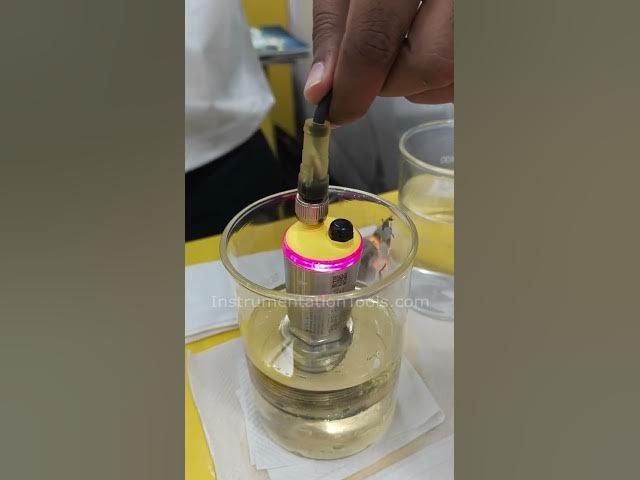
there could be water. So this instrument
0:15
is basically calibrated for the water
0:18
application. So once I dip the
0:20
instrument in the water, you can see
0:23
there is an immediate switch change
0:25
which clearly indicates that there's a
0:28
switching that the fluid has reached the
0:30
level and you should power off. So this
0:33
is the secondary switch what we have. So
0:36
here you can see clearly there is an oil
0:38
and water in between. So there is a
0:41
clear separation between oil and water.
0:44
So this instrument is calibrated with
0:48
respect to water again. So once I dip
0:51
this in the oil jar, you can see there
0:54
is no change in the uh switching. But
0:56
once I dipped into water, you can
0:59
clearly see there is a switch change
1:04
So this is a capacitance technology. So
1:07
which is purely based on the dilectric
1:09
constant. So it works basically on the
1:12
dialectric constant value and then this
1:14
is again similar technology for the
1:17
solid applications what we have. So here
1:20
you can see that there are lot of
1:21
deposition. So switch is in green color
1:24
right now and once I dip it in the solid
1:29
you can see that is a switch change. So
1:32
which means the capacitive technology
1:34
can be mainly used in spite of these
1:37
depositions happening in the level
1:41
My name is Vinat Kumar. So I am from
1:43
Vega, India. I worked in Vega for past
1:45
14 years. So Vega is basically a German
1:48
based company. Uh we deal with level and
1:52
pressure measuring instruments. For any
1:54
further details, I request you to
1:56
contact myself. I'm Vinodumat. I'm
1:59
responsible for business development for
2:02
renewable energy and also product
2:04
specialist for the point level
2:05
switching. So thank you so much.