Up next in 10



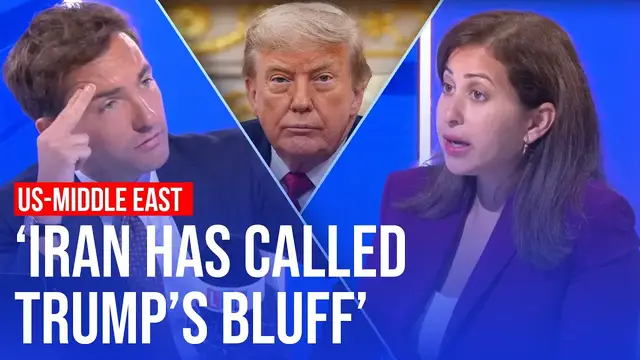
Former Obama adviser Jasmine El-Gamal did not mince her words with Lewis Goodall when it came to the Iran war, claiming Iran has 'called Trump's bluff' and the President's tactics have 'failed'. The Iran war broadened over the weekend despite a pause in U.S. strikes, as Yemen's Iran-aligned Houthis attacked Saudi oil installations along the Red Sea coast and Iran accused Ukraine of targeting one of its vessels in the Caspian Sea. The U.S. military said on Saturday its naval blockade against Iran "remains in full effect" but did not explain why it halted a streak of 13 nights of escalating strikes. There were also no weekend reports of attacks by Iran on neighbours, similar to its daily rejoinders to the U.S. attacks. Asked about the pause, a senior official in the US administration said that Donald Trump "has always been clear that his preference is diplomacy, but he has shown Iran what will happen if they fail to come to the table in a serious way." The US president has decided, for now, to back away from plans to ramp up attacks on Iran, the New York Times said on Saturday, citing two people briefed on the discussion. The president and his advisers, the newspaper said, have concerns about expanding the conflict, depleting defense stockpiles, alienating Middle East Gulf allies and affecting energy supplies and the global economy. Listen to the full show on the all-new LBC App: https://app.af.lbc.co.uk/btnc/thenewlbcapp #lewisgoodall #iran #israel #trump #middleeast #obama #war #usa #news #debate #LBC LBC is the home of live debate around news and current affairs in the UK. Join in the conversation and listen at https://www.lbc.co.uk/ Sign up to LBC’s weekly newsletter here: https://l-bc.co/signup
Show More Show Less View Video Transcript
0:00
The Iran conflict, which is intermittent, which Trump occasionally says he's going to ramp up, then he says he's going to take it down
0:09
And so where are we this weekend? Or are we just where we've been for previous weeks, which is a war which is sort of on and sort of off
0:15
Yeah, I think where we are is Trump has continued to back himself further and further into a corner
0:22
He's used to dealing with adversaries. And before he became president, used to dealing with real estate competitors in this sort of blustery, you know, I'm going to bluff
0:31
I'm going to threaten to leave it all on the table and people will come running after me to stop me
0:37
Of course, that doesn't work in diplomacy. You have to put yourself in the other person's shoes or the other country's shoes and try to understand what it is they want
0:46
Now, the conflict or the relationship with Iran, this is way back from when I was in government
0:51
during the Obama administration was always occupied with the nuclear issue, right
0:58
And what happened when President Trump bombed Iran during negotiations for the second time in a row
1:03
is that he shifted that relationship from the nuclear issue to something that we hadn't thought of before
1:10
we haven't engaged with Iran with before, which is control over the Strait of Hormuz
1:15
And if you take away all the noise, the question basically is a real central one
1:20
which is can the U.S. open the Strait of Hormuz by force
1:24
That is really the central question. And of course, the answer is no, because the U.S. cannot do militarily what it needs to do to open this trade by force
1:34
So technically it could, but not at the cost that it would take
1:39
So that brings us to... Which would be some sort of amphibious invasion. Absolutely
1:43
Actually using troops, essentially hundreds of thousands of troops. Land invasion. I mean, we're talking months. We're talking high number of casualties
1:51
Ongoing occupation of some description. All things that the U.S. just simply won't do and can't do and that people won't stand for
1:57
The Iranians know that. The Iranians, I mean, if you and I know that and are talking about it here
2:02
then the Iranians for sure know that. And that's been their driving force over the last few months
2:08
They know where the U.S. ceiling is. So Trump can go on X. He can go on truth social
2:15
He can say we're going to destroy civilization. He can say all the things he says, but the Iranians know that that is an empty bluff
2:23
And that is really dangerous when it comes to diplomacy. If the other party is calling your bluff, you're in a really tough position
2:30
So I think and I've been saying this for the last few weeks, the real opportunity here lies not in the U.S. and Iran finding a way to trust each other
2:42
That just won't happen. but it's about the role of the mediators and other countries that can come in and try to bridge that gap
2:49
And that's why I thought it was really welcome and interesting. And I hope this does happen, that the UK under this new government is now saying with France and the US
2:59
you know, let's sit down and try to work out diplomatically an international mechanism
3:04
to try to figure out where we're going here. I mean Trump it feels to me feels like a man who as you say not only has backed himself into a corner but he assumed that basically American military power was limitless
3:19
Yes. And of course, the American military is the mightiest military that's ever been assembled
3:24
but it is not limitless in terms of its capabilities and its power, at least unless you're willing to absolutely maximise its use, which as we discussed, he's not
3:31
And in a sense, with the scales of that falling beneath his eyes, he hasn't really got a plan B
3:37
Right. Well, he has been in conversations with his team over the last few days. And General Cain, the chairman of the Joint Chiefs, has mentioned just that. He said, look, we're using Patriot missiles. We're using interceptors. These things are not limitless, as you said. They cost millions of dollars and take months and years to restock and redeploy
3:58
And so we're really at a point here where the U.S. actually has to figure out, of course, at the same time, strategic petroleum reserves are decreasing, moving steadily towards the bottom limit, which which, of course, would be catastrophic in some ways
4:14
So you're really at a point here where the U.S. has to reckon with the limits of hard military power
4:20
And for someone like President Trump, who has always been enamored with U.S. military hard power, you saw the operation in Venezuela, the 12-day war
4:29
I mean, that to him was just pure, raw military power. The Secretary of Defense, Pete Hegseth, he talks about this all the time
4:37
It's this very, you know, testosterone-fueled, you know, we're going to kill everyone, we're going to drop bombs
4:43
that doesn't work. And so now, as you said, they have to go back to the drawing board and try to
4:48
figure out how do we get ourselves out of this. But that would be to accept, tacitly accept that
4:52
American military power has been humbled. It has been. I think everybody knows that. I mean
4:58
that will have ramifications moving forward. You can be sure that China is watching everything
5:02
that's happened over the last few months and looking at how the US fights a war
5:08
So this will have huge repercussions and ripple effects moving forward. I'm sure we'll be
5:13
back talking about some of it in the coming months, maybe years, Lewis. But for now, I think
5:18
the question is, this is not sustainable. The two parties could continue to fight a low level
5:24
conflict until one or both of them are depleted. Obviously, the Iranians are hurting too
5:30
economically, they can't continue this forever. But their appetite for suffering, let's say
5:37
is higher. And they're not accountable to the Iranian people. In fact, they don't care
5:43
And so they can go on for longer. They don't need much to continue to exist
5:48
The U.S. can't just exist in order to win this. So I do think you're going to see renewed diplomatic efforts, by the way, which have been ongoing this whole time
5:58
The Qataris, the Omanis, the Iranians, they have been talking this whole time
6:03
And I think you'll start to see the fruits of that surfacing in the coming days
6:07
I mean, oil prices have been rising again. They hit $100 a barrel, I think, on Friday
6:12
There's talk, you've already mentioned it, gentlemen, about a UK-US-France conference this week to explicitly address the Strait of Hormuz specifically Do you hold out much hope for that Doing anything We heard a lot from those governments over the last however many months and not much has really translated I would like to see it happen because like I said I think diplomacy is the only way out of this
6:33
And moving forward, there has to be some sort of agreement both between states in the Gulf and the region who have a huge stake in this and global powers on the future of the Strait of Hormuz because it's a global issue
6:46
I think the the approach of the Europeans so far and the Brits has been this is Donald Trump's problem
6:52
We're not going to bail him out. And I get it. It's very frustrating to feel like you have to come in and clean Donald Trump's mess
6:59
But the fact is, this isn't just Donald Trump's problem. It's not even just the Middle East's problem. This is a global issue
7:06
And I think this is a real opportunity for the new prime minister and the new defense minister to come in and take that spot on the global stage in a leadership position
7:15
in a convening position, the way they did with Ukraine, the way the previous government did with Ukraine
7:19
Although Andy Burnham has indicated that he'd rather focus his energies on the domestic agenda
7:24
Look, I've, you know, every US president comes in saying they don't want to focus on the Middle East
7:30
and they want to focus on domestic issues. It's just not the way the world works. So I think the question here, and I speak to a lot of friends
7:36
and colleagues here in the UK, British citizens who say, you know, we had such high hopes for Keir Starmer
7:43
to take a leadership role, to fill that void in global leadership under President Trump
7:49
when it came to Gaza, when it came to other issues related to the Middle East
7:54
And he didn't. He didn't step up. He never did. And now is an opportunity for Andy Berman and West Streeting
8:00
Both have said many of the right things about the Middle East to step up and take that leadership role
8:07
Just talking to me, you mentioned Gaza, of course, the West Bank as well. Christina Lamb in the Sunday Times today is reporting that the IDF have shot an infant child, baby
8:17
They've also claimed this was an accident. We talk a lot about Gaza, have talked less about the West Bank
8:23
but there's been rising, significant rising tension there for some time now
8:26
And lots of people thinking there could be yet another outbreak of significant violence
8:31
Do you think that what we've seen with that young child being shot is emblematic of the rising tension there
8:37
Well, you know, we say rising tension. The tension has been rising for years and years. It's not tension. I mean, it's terrorism. You know, we have to call it what it is. And the
8:48
Terrorism from the IDF, you mean? Israeli terrorism, settler terrorism. It's really important to, you know, and I say this, Louis, as someone who works, you know, part of my work behind the scenes is in conflict mediation
9:01
And I'm a huge believer that in order for the region to be safe and secure, we have to find a way for Israel to change its behavior, be integrated into the region and for all of the regional actors to live in safety
9:13
So that caveat, you know, let me put it out there. That said, I think this incident, this is not the first infant to be killed by the IDF
9:22
These are not the first children to be killed by Israeli soldiers
9:26
And so the question really is what is that spark that is necessary in order to get Western governments specifically to view the situation and the problem set differently Under Prime Minister Starmer the conversation was about a few individuals a few settlers
9:47
But the incident in Area A in the village of Tal recently, where Israeli settlers went in
9:53
they said they were hiking, but they were armed. They went in and a Palestinian who lived there, by the way, this area is off limits for Israelis
10:00
in self-defense, grabbed a gun and tried to defend himself. And that is being labeled as terrorism
10:09
And so I think we really need to look at the situation and flip it
10:13
What is terrorism and what is self-defense? We talk a lot about Israel's right to self-defense
10:18
Everyone has a right to self-defense. Where's the conversation about Palestinian self-defense
10:23
Well, we had a lawyer, Faye Sreil, on the program the other day, or Leicester Sunday, saying that there is no illegal settlement
10:30
And indeed, they've written a long letter about this in response to that interview or someone has
10:35
And they've said, among other things, that, you know, this is state land and this is empty state land
10:40
And therefore, this is not illegal. Well, I mean, you I think everyone watched that clip of you ending that conversation and not giving it any more air, which is which was the right thing to do
10:53
The occupation of the West Bank and Gaza is an illegal occupation under international law
10:59
The International Court of Justice has reiterated that it's illegal and that all states that support the occupation have an obligation to end that support
11:09
So we're talking about international law here. We're not making anything up. But the issue is what I really want to try to underscore here, especially as new leadership is coming in and has come in in the UK, is that this is not a problem of a few individuals
11:26
This is a problem of state accountability. And again, you saw that in the recent incident where any Israeli settler that goes into the home of a Palestinian, a Palestinian home, they go in, they start a clash, they start to intimidate the Palestinians living there
11:44
We've seen this all, of course, on videos. And the Israeli military is then obligated to go in and defend those Israeli settlers
11:55
When that happens, tensions increase. As you say, there are altercations. And if the Palestinians in question start to try to defend themselves and their lives
12:05
I mean, Louis, you have to think about how terrifying it is in that moment for someone
12:10
sitting in their home to see someone come in brandishing weapons and trying to expel them
12:15
or intimidate them. Now, what we've seen the response from the Israeli government
12:20
and this is both by Benjamin Netanyahu and the opposition, is to say, this is Palestinian
12:26
terrorism. We are going to now go in, demolish the home of the person who was trying to defend
12:31
themselves and accelerate settlement building in the West Bank. And so, again, this is not a
12:38
problem of individuals. It's a problem of state accountability. And that's how it should be
12:43
treated moving forward
#news