Up next in 10



Almost £200,000 worth of fuel has been stolen from UK forecourts every day since the start of the Middle East crisis.
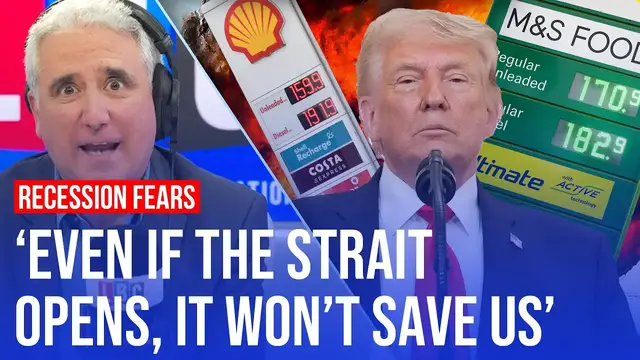
00:00 | Economist Duncan Welder explains why fears of a recession are growing
05:50 | Juliet Morrison discusses the explosion of fuel theft from petrol stations since the Iran war began
Fuel theft prevention company Forecourt Eye said incidents of fuel taken without payment soared by 20% in the five months after the conflict began in February, compared with the preceding five months.
The increase in prices driven by the war means the value of stolen fuel rose by 48% over the same period, reaching an estimated daily average of £194,000 across the UK's 8,359 forecourts.
For first-time offenders, there was a 23% increase in the number of incidents and a 26% rise in the volume of fuel stolen, compared with 17% and 20% respectively among repeat offenders.
Simon Marks gets the numbers from Duncan Weldon, Economist and former economic policy adviser to the Labour Party, and Juliet Morrison, Editor of Forecourt Trader - a publication which focuses on the petrol-retailing sector.
Listen to the full show on the all-new LBC App: https://app.af.lbc.co.uk/btnc/thenewlbcapp
#simonmarks #donaldtrump #petrol #iran #iranwar #economy #costofliving #recession #lbc
LBC is the home of live debate around news and current affairs in the UK.
Show More Show Less View Video Transcript
0:00
The war in Iran, it could prove to be the depth charge that explodes under Andy Burnham's hopes for the UK's economic revival
0:08
The accountancy giant EY, formerly known, of course, as Ernst & Young, said today the UK should be bracing for a recession next year if the Strait of Hormuz remains closed
0:22
And at the moment, that seems like a stone cold certainty. We're going to talk not about where the war goes, but about what it all means for us here at home in the UK
0:33
Because EY predicted today that Britain's GDP could slow to 0.5% this year and could even shrink next year if the conflict continue
0:46
And that should be grabbing the attention of all of us. Joining me to kick our conversation off this evening is Duncan Weldon, economist and former economic policy advisor to the Labour Party
0:56
He's the author of the book Blood and Treasure, the economics of conflict from the Vikings to Ukraine
1:03
Mr Weldon, it's great to have you on the programme this evening because we, of course, are going to talk about the economics of conflict in Iran
1:10
And for the UK, it is beginning to look like those economics are a very perilous problem for Andy Burnham and John Healy
1:20
Good evening to you. Good evening. No, it's definitely a perilous problem
1:25
And I think those numbers that report today you mentioned from EY suggesting, you know, a potential big spike in inflation, prices rising faster
1:36
a big slowdown in economic growth, maybe even a recession. None of that is unlikely if the Strait of Hormuz, this crucial waterway, remains closed
1:47
Of course, the big question is, is it going to reopen? Because, you know, the outlook could change very, very quickly if oil and natural gas starts flowing again
1:59
But, you know, as you will obviously be aware, Mr Weldon, this conflict started on February the 28th
2:04
It's now August the 3rd. All negotiations to try and get the Strait of Hormuz reopened have so far failed
2:11
Currently, the Iranians and the Omanis are discussing it among themselves. But when Oman a few weeks ago suggested that, like Iran, it might charge per vessel tolls or service fees
2:22
the American president even threatened to attack Oman, which, of course, is an American ally
2:28
I mean, we do have prudently to assume that normal service in the strait, normal traffic
2:36
is not going to resume any time soon, don't we? I mean John Healy will be presumably factoring all of that into his decision process Oh absolutely And you know we should also be absolutely clear if you know Donald Trump was to sign another deal with Iran tomorrow and both sides were to say the
2:54
strait is open you know that there wouldn't be an immediate relief of this pressure. For a start
2:59
it's quite a brave oil tank the captain who's going to you know steam up the strait tomorrow
3:06
not knowing if it's going to close again the day afterwards and it's not just that. Lots of these
3:11
oil producing regions such as Iraq, Kuwait, you know, they've had five months of not being able to
3:18
supply their product to the markets. They have run out of storage capacity and had to close down
3:24
wells. Now, oil wells, it's not just like flipping a light switch on and off. It takes several weeks
3:30
to get these things back up and running. That's before we even start to take a point of any of
3:35
the damage to facilities during the war. So Qatar, which is a big provider of liquefied natural gas, you know, quite early on in the
3:43
conflict, towards the end of March, beginning of April, its largest LNG liquid natuified
3:49
gas support facility took the hit from an Iranian drone. They think that's reduced their export capacity by 17 percent and it will take them years
3:58
to repair it. So there is no immediate fix. So what would you be advising the government to do, both in terms of the economic plans that it's making, but also perhaps in the messaging behind the scenes that it's presenting to the American government
4:15
I think the messaging behind the scenes to the American government, I think from Britain and from all of the countries of the EU, we're all very exposed to this international energy
4:26
International energy price shock should be to reiterate that we are staring down the barrel of a very serious economic crisis
4:33
Now, it sometimes feels a little bit like economists have sidewall from this because we've had the strait closed for five months
4:41
We keep being told we're going to see really serious impacts very, very quickly
4:46
Now, there's been a lot of pain. Anyone that's filled up their car recently knows there's quite a lot of pain out there, a lot of price pain
4:53
Things haven't been as bad as they might have been for a couple of really big factors
4:58
One is that China, the surprise of almost everyone, has been able to really cut the amount of oil it's been importing for the last few months
5:07
running down stockpiles, which seem to be much larger than anyone expected
5:11
Now, China can't keep doing that forever. There is a limit to even the size of Chinese stockpiles
5:17
And also, there's been a lot of sort of running down of, you know
5:22
oil that was already in the system, that was in tanks, that was being stored, of gas that was stored
5:26
But all of these levels of inventory are now getting dangerously low So we are at the point when we do need resolution in the coming weeks not the coming months There was more evidence today of the economic pressure that is building
5:42
We learned that every single day since the war on Iran began, UK drivers have stolen
5:50
200,000 quid's worth of petrol from garages all over the country. 200 grand every day
6:00
Forecourt Eye, which is the UK's leading fuel crime prevention platform, says nearly 50% more fuel is being nicked today
6:09
versus what was happening in the five months leading up to the war
6:14
There are 2,872 incidents of fuel thefts in which people either just drive off without paying or fill up and then claim that they have no way of paying
6:29
And joining me now to explain what impact this is having on forecourts all over the country is Juliet Morrison, the editor of Forecourt Trader, a publication which, as its name suggests, focuses on the petrol retailing sector
6:47
Juliet Morrison, thank you so much for joining us on the programme this afternoon
6:51
I mean, these are, this evening rather, these are staggering numbers and must be having a disastrous impact on businesses all over the country that are trying to sell petrol and either find people just driving off without paying or then saying they haven't got the cash to cover their costs
7:10
Good evening. Yeah, yeah, absolutely. And I think what's really important to point out and remember is that a lot of these businesses are independently owned family businesses
7:20
They might have the BP or the Shell or the SO totem pole, but they're independently owned
7:28
And so it's not a victimless crime. It's very much these businesses are feeling it at their bottom line
7:35
And, you know, it's a time as well when their costs are increasing, energy costs are increasing for them, staff costs
7:44
They're providing an invaluable service to the community, often 24 hours. and, you know, it's a big hit
7:51
You just told the figures there. It's astounding, the figures, and it's a perennial problem
7:59
It always gets worse during times when fuel prices increase or a cost of living crisis as well
8:06
But, you know, it's not uncommon for our readers to see four or five incidents a day
8:12
which is a huge impact on their bottom line. And what does it do I mean it can only result in driving the price up further right Yeah yes well that right I mean they often that will happen in the shop The shops
8:29
are becoming more and more important for forecourt operators. And they're offering a host of
8:34
different services now than they ever did before, install butcheries and local products. So yeah
8:43
The cost has to be passed on. They can't absorb it. These operators have already invested a lot of money in equipment to stop drive-offs
8:53
CTTV equipment that can identify number plates and problem vehicles so that the cashier doesn't turn on the pump until they're assured that it looks like a legitimate purchase
9:13
So they're investing a lot and they just need backup now from the police
9:18
to not leave it to the sector to manage and police themselves
9:25
And what happens if a motorist fills up and then walks, you know
9:29
doesn't drive away without paying but goes in and says to the cashier
9:32
I'm sorry, I can't pay for it? Yeah, so people are using that as a payday loan
9:36
to give them buying a bit of time to pay that cost
9:42
Sometimes they do pay it a few days later. Sometimes they don't
9:47
And the problem is that's what we call no means of payment
9:51
And that's a civil offence. So it can be trickier to get that money back
10:00
And that's just one of many ways that people are stealing fuel. We've even had instances of trucks parking in nearby fields next door to the petrol forecourt
10:12
and siphoning, siphoning with big pipes into the field, into the forecourt tanks, if they've got above-ground tanks
10:22
And vans turn up and they've got empty containers in the back
10:27
and they're filling them up as well. So it's a huge issue. I mean, typically a forecourt operator would lose about £50
10:34
with one of these drive-offs. But if it's a bit more sophisticated, it could be hundreds of pounds
10:42
Juliet Morrison, I'm really grateful to you for joining us on the programme tonight. Editor of Four Court Trader, a publication focusing on the petrol retailing sector
10:50
and reflecting on the revelation that every single day since the war on Iran began
10:57
UK drivers have stolen £200,000 worth of petrol from garages all over the country
11:03
That's 50% more than was being stolen in the five months leading up to war
#news