Up next in 10



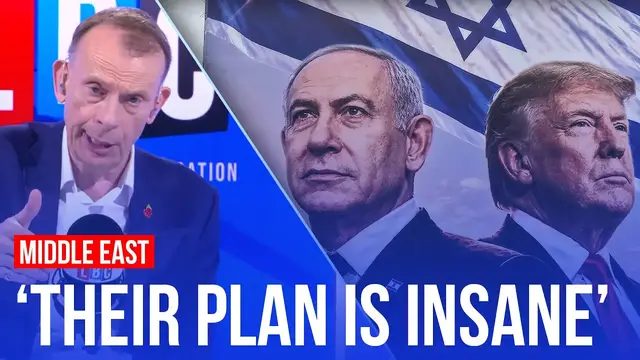
Could Donald Trump restart the war with Iran after the US midterm elections?
Andrew Marr speaks to two former senior officials about growing fears of renewed escalation between the US, Israel and Iran.
Jeffrey Feltman, former head of the UN Department of Political Affairs and former US Assistant Secretary of State for Near Eastern Affairs, says Washington and Tehran are sending 'mixed messages', with both sides 'beating the drums of war' while efforts to negotiate continue behind the scenes.
Andrew then speaks to Daniel Levy, President of the US Middle East Project and Former Peace Negotiator and a former adviser to Israeli prime ministers, about the aftermath of Israel's election and allegations surrounding the Arab Israeli vote.
Asked about reports of a renewed war with Iran after the US midterms, Levy says escalation remains a serious possibility and warns: "It will be more dangerous if they do escalate."
Listen to the full show on the all-new LBC App: https://app.af.lbc.co.uk/btnc/thenewlbcapp
#andrewmarr #uspolitics #politics #israel #israelielections #israelelections #netanyahu #benjaminnetanyahu #eisenkot #iranwar #israeliranwar #iranisraelwar #donaldtrump #trump #LBC
Show More Show Less View Video Transcript
0:00
Andy Burnham's hopes and fears for Britain's economy are very much in the hands of America
0:04
How Donald Trump reacts to next week's midterm elections is critical for all of us
0:09
Does he use this as the moment to restart the war on Iran and plunge us into a new cycle of energy shortages and inflation
0:17
There are early warnings that he will. This is Senator Chris Murphy, who sits on the U.S. Committee on Foreign Affairs
0:25
He says he's been briefed on the war plan Trump is expected to unleash after next week's vote
0:30
Just listen to this. I will just say this. Their plan is insane
0:37
It will lead to devastating escalation and the likely destruction of our commitment to the rule of law
0:50
Well, let's discuss that now with Jeffrey Feltman, former head of the United Nations
0:54
Department of Political Affairs and U.S. Assistant Secretary of State for Near Eastern Affairs
0:59
Jeffrey, thank you very much indeed for joining LBC. What we heard there sounds extremely alarming
1:05
What do you hear about the possibility of a restarted and much more aggressive short war
1:10
after the elections? I think we're hearing entirely mixed messages, Mixed messages from Washington and mixed messages from Tehran
1:18
We have the drumbeat of war that the senator just described, which I agree, that sounds insane at this point
1:26
But you have Trump talking about escalating after the midterms. And you have the Iranians saying, well, we have a lot of power
1:33
We can really hit things in the Gulf as well. So you have both sides sort of beating the drums of war
1:38
At the same time, you have J.D. Vance, the U.S. vice president, talking about reaching out to the national security advisor in Iran, the hardliner Mohsen Rezaei, to say, let's get together again, let's start talking again
1:50
You have the Qataris that are talking about that they have passed some plans on. And you had the other day representatives from Egypt, Saudi Arabia, and Pakistan in Tehran talking to the Iranians
2:01
So on the one hand you have this terrible foreshadowing of potential escalation next week On the other hand you have lots of hints that there actually negotiations going on behind the scenes I have to wonder if President Trump himself hasn made up his mind which way he going to go But a lot of these advisors who are
2:18
skeptical of the war to begin with, like J.D. Vance, are trying very hard to make sure there's
2:22
an alternative to the escalation, because what would the escalation at this point achieve
2:27
I just wonder what you think those comments about an insane plan and undermining America's
2:33
commitment to the rule of law would actually mean in practice. What do you think he's talking about
2:39
I think that, I mean, in the first stages of this war, back starting February 28th, going through
2:46
going up until, you know, the first couple of months, the United States with Israel hit Iran
2:51
hard, took out its leadership, you know, sunk its navy, took out a lot of the missile program
2:55
Did Iran break? No. In fact, we ended up with a regime that's even harder line than the one
3:00
that was there before. And do we think that the Iranians are going to suddenly surrender and say
3:06
okay, you can have the Strait of Hormuz open the way it was before while we're under bombardment
3:10
I think that's a fundamental misunderstanding of an Iranian regime that feels that it's facing an
3:16
existential threat, and it's going to do everything in its power to do that. Now, for the
3:22
Iranians, they are looking for the U.S. to blink first, and the Americans are looking for the
3:30
Iranians to blink first. And I think both sides are miscalculating that neither side is at the
3:35
point where they're going to blink first. The midterms will be over. The gas prices have been
3:39
manageable in the United States, and the Iranians have shown no proclivity to surrender under fire
3:45
It sounds to me as if those of us worried about a further spike in oil prices and shortages
3:50
with another war are right to be worried. I think you are right. I think you are right to be worried
3:55
But I also think that there is a way out. I'm just not convinced that the two sides are going to find their way to it
4:04
The elements that were in the June Memorandum of Understanding that was signed in Islamabad
4:07
J Vance was the head of the U delegation the parliament speaker from Iran was the head of the Iranian delegation came up with the elements that would lead to a deal But it was heavily it was heavily the sequencing was heavily favored in Iran favor heavily
4:23
on Iran's favor. And so Iran looks at that as the sort of minimum, the floor for negotiations
4:29
And the United States is looking for a lot of concessions from Iran instead. Very, very, very tough indeed, Mr. Feldman
4:34
Thank you so much for joining us tonight. Now, quite deliberately, I didn't return to the aftermath of the Israeli elections yesterday
4:41
because everything still seems so unclear. I can't honestly say it's getting a lot clearer
4:47
but Benjamin Netanyahu's liquid party, and he is ahead, if only by a finger
4:52
and not yet in a place to form a new coalition government. Well, they have said the elections were stolen by a foreign entity
5:00
The election commissioner in Israel has talked of foreign funding being involved
5:04
and wants to bring in the Israeli intelligence service Shin Bet. Let's talk now to Daniel Levy, president of the U.S. Middle East Project and a former advisor to multiple Israeli prime ministers
5:16
Daniel, thanks very much indeed for joining me. How serious do you think this allegation from the Benjamin Netanyahu side effectively that too many Arab Israelis have been voting is
5:28
Is it serious as something that genuinely happened and will be corroborated
5:34
No, I don't think it is. Is it serious, though, as an indication of what the government of Netanyahu is willing to do in order to discredit and delegitimize the Arab vote
5:49
and go for any possibility that the opposition Zionist bloc will cooperate with the 19 seats now held by the two parties representing Palestinian Arab citizens of Israel
6:01
In that respect, I think it is very serious, including in the suspicions that it raises that part of the security establishment is going to be willing to work with Netanyahu in trying to pull that off
6:14
Because the head of the internal security service what known in Israel as the Shin Bet is someone who is very much part of the radical religious nationalist rights settler movement a Netanyahu appointee And it not by the way that the Central Election Commission has said there are suspicions of a problem It that they have to respond to a letter by the largest party and to ask for an investigation
6:35
That's what they're doing. So underlying all this, is there a danger of what we might call the fabric of Israeli society
6:41
Because these Arab-Israeli voters have an absolute right to vote, and this appears to be an attack on their status inside Israel
6:48
well look Andrew I'd say it's a way of escalating yet further how that minority which is structurally
6:59
discriminated against is treated I think something really interesting that is important took part
7:04
took place in this election which is that you had the highest I think ever turnout of the Arab
7:10
population inside Israel and their highest ever representation now in parliament of 19 seats
7:15
I don't think those voters went to the polls thinking, well, if we get enough of our members elected, things are going to be bright and rosy
7:23
No, no, indeed. Daniel, final question, if I might. Are you hearing what we are hearing about the rumours of a restarted war on Iran sometime maybe after next week's midterm elections in the United States
7:37
absolutely andrew and there was these reports uh before the election that perhaps there was going
7:45
to be an attempt to escalate then uh there is certainly the sense now that perhaps for his
7:51
political purposes and netanyahu in order to scupper the option of an alternative coalition
7:57
or perhaps to pave the way for his own uh coalition for bringing people in to go into
8:03
government with him that he may advance this, but also because he may see this is the opportunity
8:07
This is the moment where Trump is going to be most prone to again listening to an Israeli
8:13
argument. Trump may be angry after the midterms if the Republicans do as badly as is anticipated
8:18
He's frustrated with the way the war is going. There's no reason, by the way, to think that
8:22
things will go any better. It will be more dangerous if they do escalate. But I think
8:26
that is very likely to look out for a dark message. But if I may say so, Daniel, lovely
8:32
to have you on the show anyway. Thank you so much for that
news
Politics
Campaigns & Elections
War & Conflict