live_tv
Livestream Starting Soon
00
Hours
:
00
Minutes
:
00
Seconds
Up next in 10


Russia says it needs a new wide-body aircraft—but recent decisions tell a very different story.
In late 2025 and early 2026, funding for Russia’s next-generation wide-body jet was quietly paused and redirected toward existing aircraft programs. At the same time, the much-hyped PD-35 engine remains years away from real flight readiness. Without a new engine, without a new airframe, and without active R&D, Russia’s long-haul aviation future has effectively defaulted to a familiar platform.
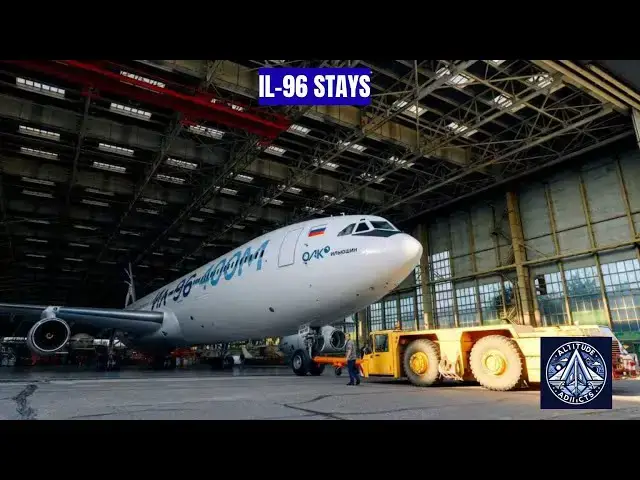
In this video, we explain why the Il-96—often dismissed as outdated—is actually set to remain Russia’s primary wide-body aircraft for the foreseeable future. From frozen development programs and engine reality checks to industrial continuity and strategic necessity, this is the real story behind Russia’s wide-body dilemma.
This is not about nostalgia. It’s about what actually exists, what can fly, and what Russia can sustain in the real world.
#Il96 #RussianAviation #WidebodyAircraft #AviationAnalysis #CivilAviation #RussianAircraft #AviationNews #LongHaulJets #AircraftEngines #PD35 #AerospaceIndustry #AltitudeAddicts
Be a Member for exclusive privileges - https://www.youtube.com/channel/UCviEFTf1xIPKsjmyF_zvFug/join
Twitter : https://x.com/AltitudeAddicts
Website: https://www.altitudeaddicts.com
Show More Show Less View Video Transcript
0:05
In mid December 2025, during a joint
0:09
annual press conference and direct
0:11
address, President Vladimir Putin issued
0:13
a statement that although seemingly
0:15
self-evident, held significant strategic
0:17
implications. Russia requires its own
0:20
widebody aircraft,
0:23
not as a prestige project or an abstract
0:25
technological objective, but as a
0:27
fundamental practical necessity.
0:30
Widebody aircraft serve as the
0:32
foundation of longhaul transportation,
0:34
international corridors, and a nation's
0:36
capacity to demonstrate economic and
0:39
logistical sovereignty. According to the
0:42
president, the construction of such
0:44
aircraft represents one of the most
0:46
intricate industrial undertakings
0:48
conceivable, necessitating extensive
0:50
collaboration across advanced
0:53
technological sectors.
0:55
Concurrently, he candidly acknowledged
0:57
that unresolved issues persist.
1:00
The Ministry of Industry and Trade
1:02
reiterated this stance, emphasizing that
1:04
a domestically produced widebody
1:06
aircraft is essential for both
1:08
international transportation and for
1:10
linking Russia's vast internal
1:12
territory.
1:14
Nevertheless, both statements utterly
1:16
overlook the most critical question,
1:18
which specific aircraft will fulfill
1:20
this role.
1:22
In the quiet gap between aspiration and
1:25
actuality, the resolution has gradually
1:27
become inescapable.
1:29
In January 2026, a government directive
1:33
subtly yet definitively reoriented
1:35
Russia's civil aviation trajectory.
1:38
Funds previously designated for the
1:40
development of a new widebody longrange
1:42
aircraft were officially reallocated to
1:45
the modernization of existing programs,
1:47
most notably the 2214 and the MC21310.
1:53
Although the total amount was
1:55
comparatively modest, the symbolism was
1:57
unmistakable.
1:59
This was not a momentary accounting
2:01
adjustment. It represented a formal
2:04
recognition that the widebody program
2:06
had entered a hiatus phase. The decision
2:09
essentially signified the conclusion of
2:11
active research and development efforts
2:13
on an entirely new widebody aircraft
2:16
within the medium-term.
2:18
It also reaffirmed a long-held suspicion
2:21
among aviation experts. Russia presently
2:24
lacks the industrial, technological, and
2:26
financial capacity to simultaneously
2:29
complete multiple aircraft families
2:31
while also undertaking the development
2:33
of a next generation widebody aircraft
2:36
from the ground up.
2:38
This delay does not signify surrender.
2:41
It signifies the act of prioritization.
2:44
and that prioritization inexurably
2:47
reverts to the sole widebody aircraft
2:49
currently in Russia's possession.
2:52
The Illusian IL96 is often described as
2:55
antiquated, a remnant of a bygone era.
2:58
Nevertheless, this perception overlooks
3:01
a crucial fact. The L96 has never ceased
3:03
to exist. It persisted within production
3:07
tools, design documentation, engineering
3:09
knowledge, and organizational memory.
3:13
While Western manufacturers swiftly
3:15
advanced twin engine efficiency and
3:17
global supply chains, Russia maintained
3:19
a resource arguably more valuable under
3:22
current circumstances, a completely
3:24
sovereign widebody platform.
3:27
The most recent variant, the L96400M,
3:30
is not a historical artifact. It
3:33
features an elongated fuselage, advanced
3:36
avionics, enhanced navigation systems,
3:38
and upgraded onboard architecture.
3:41
Its four PS90A1 engines may not be the
3:44
most fuelefficient globally, but they
3:46
are dependable, domestically
3:48
manufactured, and well understood by
3:50
Russian industry.
3:53
Most notably, the aircraft is not merely
3:55
a conceptual design, but a concrete,
3:57
verifiable prototype.
3:59
During a time when Russia's aviation
4:01
industry must emphasize reliability over
4:04
innovation, this holds greater
4:06
significance than aerodynamic
4:08
sophistication.
4:10
For many years, the outlook for Russian
4:12
widebody aviation was linked to a
4:14
completely new aircraft, often studied
4:17
within the framework of international
4:19
collaboration or advanced technological
4:22
development.
4:23
The expectation was that this aircraft
4:25
would completely replace the IL96,
4:28
providing twin engine efficiency,
4:30
composite structures, and enhanced
4:33
global competitiveness.
4:35
However, expectations conflict with the
4:38
principles of physics, metallurgy, and
4:40
the passage of time.
4:42
At the core of these plans is the PD35
4:45
engine, a power plant designed to
4:47
provide propulsion in the 35 to 40 ton
4:50
range, facilitating twin engine widebody
4:53
configurations.
4:55
In principle, this power plant would
4:57
enable the development of a completely
4:59
new category of Russian aircraft.
5:02
In practical application, the PD35
5:05
continues to serve as a technology
5:07
demonstrator.
5:08
The existing experimental units generate
5:11
considerably less propulsion than
5:13
necessary and the materials required for
5:15
continuous operation at the desired
5:18
performance levels are not yet available
5:20
in sufficient industrial quantities.
5:24
The development of such an engine is not
5:26
a matter of years but rather decades.
5:30
The estimated completion date around
5:32
2030 does not assure readiness. It
5:35
represents an aspirational goal. And
5:38
even if the engine were to be realized
5:40
tomorrow, integrating it into an
5:42
existing airframe would be considerably
5:45
complex.
5:47
There is a widespread misconception that
5:49
the IL96400M
5:51
can be readily re-engineed with new
5:53
power plants, thereby converting it into
5:56
a modern twin engine widebody aircraft.
5:59
In fact, this concept fails under
6:01
rigorous engineering analysis.
6:04
The PD35 is considerably large in
6:07
physical dimensions.
6:09
Its diameter, mass, and length
6:11
significantly surpass those of the
6:13
PS9A1.
6:15
The installation of such engines
6:17
necessitates a completely redesigned
6:19
wing, modified pylons, reinforced
6:21
structural components, extended landing
6:24
gear, and adjusted ground clearance.
6:27
Without these modifications, the engines
6:29
would be positioned perilously close to
6:31
the runway surface, risking debris
6:34
ingestion and jeopardizing safety.
6:37
By that time, the aircraft would cease
6:39
to be classified as an E96 derivative.
6:43
It would be a completely new aircraft
6:45
bearing a historic name. The resources
6:48
necessary for such a transformation
6:51
would be comparable to those required
6:53
for designing a new aircraft from
6:54
scratch. the very endeavor that has now
6:57
been formally halted.
7:00
While Russia considers its future in
7:02
widebody aircraft, the global aviation
7:04
industry continues to evolve
7:06
dynamically.
7:08
China's long range widebody aircraft is
7:10
anticipated to begin service prior to
7:12
the end of the decade. Western
7:15
manufacturers persist in optimizing
7:17
their platforms, leveraging extensive
7:20
supply chains and decades of incremental
7:22
advancements.
7:24
This raises a significant strategic
7:26
question. Why develop a late entry
7:29
aircraft that will encounter immediate
7:31
competition when a viable alternative is
7:33
already available?
7:36
The response increasingly leans in
7:38
support of the L96,
7:41
not due to its potential to dominate
7:43
global markets, but because it
7:45
consistently and independently meets
7:47
Russia's internal requirements.
7:50
President Putin's statements regarding
7:52
widebody aircraft extended beyond
7:55
ordinary transportation considerations.
7:58
They were concerned with industrial
8:00
sovereignty.
8:01
Aircraft programs do not constitute
8:03
isolated engineering endeavors. Rather,
8:06
they function as complex ecosystems.
8:09
When manufacturing processes are halted,
8:11
skills tend to deteriorate.
8:14
When design bureaus decline in
8:16
significance, knowledge becomes
8:17
scattered.
8:19
Restarting such ecosystems at a later
8:21
stage is exponentially more difficult
8:24
than sustaining them in a diminished yet
8:26
active state.
8:28
The IL96 program sustains the vitality
8:31
of this ecosystem.
8:33
It encompasses extensive experience in
8:35
widebody assembly, large aircraft
8:37
systems integration, certification
8:40
expertise, and long range operational
8:42
proficiency.
8:44
Even limited production maintains these
8:46
capabilities in ways that no future
8:49
rapid development effort could readily
8:51
duplicate.
8:52
In strategic terms, the L96 serves as a
8:56
technological intermediary, not the
8:58
ultimate objective, but the platform
9:00
that enables Russia to attain it when
9:02
circumstances are favorable.
9:05
Another frequently neglected aspect is
9:07
the IL96's flexibility.
9:10
Beyond civilian passenger
9:12
transportation, the platform has
9:14
demonstrated its suitability for
9:15
specialized missions, government
9:18
transportation, airborne command
9:20
centers, and aircraft necessitating
9:22
extensive internal space and substantial
9:25
electrical power capacity.
9:27
These roles require greater reliability,
9:30
endurance, and customization than
9:32
marginal fuel savings.
9:34
In these missions, the L96 has no
9:37
domestic equivalent and no viable
9:39
foreign alternative.
9:42
By the early 2030s, Russia is likely to
9:45
reconsider the development of a new
9:47
widebody aircraft potentially equipped
9:50
with advanced next generation engines
9:52
and supported by a stable industrial
9:55
capacity.
9:56
However, until that moment occurs, there
9:59
is no substitute prepared to take its
10:01
place.
10:02
The pause of new widebody development,
10:05
the reallocation of funds, the ongoing
10:07
engine challenges, and the realities of
10:10
global competition all lead to the same
10:12
conclusion. The latest variants of the
10:15
IL96 will remain Russia's primary
10:17
widebody aircraft for the foreseeable
10:20
future.
10:21
Not because they embody the apex of
10:23
contemporary aerospace engineering, but
10:26
because they are tangible, autonomous,
10:28
and attainable
10:30
in aviation. As in strategic planning,
10:33
survival frequently hinges not on the
10:35
ideal solution, but on the one that is
10:38
practically available.
10:42
If you like the video, please subscribe,
10:44
share, and like. Also, please take the
10:47
memberships to encourage us.