0:05
The technical complexity of modern
0:07
turboan development along with mounting
0:10
pressure on Russia's aviation sector is
0:12
once again in focus after the latest
0:15
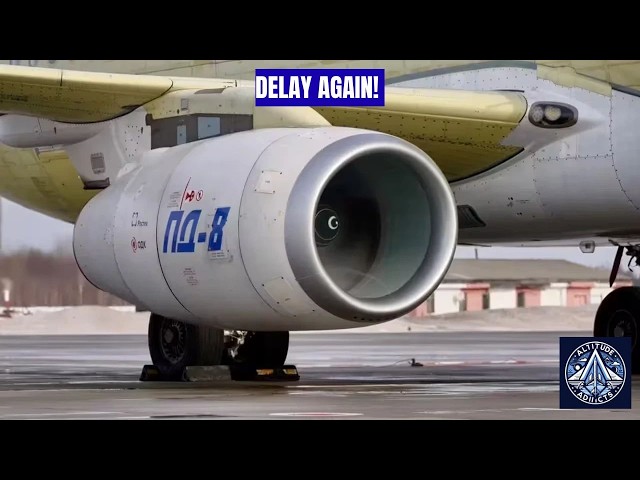
delay in certifying the PD8 engine. The
0:18
type certificate was originally expected
0:23
but that timeline has now slipped.
0:26
Officials say certification could arrive
0:29
within about a month, though that
0:31
promise has been heard before.
0:34
And now, as we move into what feels like
0:36
yet another shifting milestone, the
0:38
certification timeline itself tells a
0:41
story. According to Deputy Industry and
0:44
Trade Minister Jannadi Abraov, the PD8
0:47
could be cleared within a month. That
0:50
sounds reassuring on paper, but this
0:53
isn't the first time the schedule has
0:57
Earlier projections had firmly pointed
0:59
to April 2026 as the finish line. Yet,
1:04
as the month wrapped up, it became clear
1:06
that certification would not land on
1:08
time. In aviation, even a few weeks can
1:12
ripple across entire programs. And yeah,
1:15
it's one of those situations where a
1:17
small delay isn't actually small.
1:20
The PD8 isn't just another engine
1:22
sitting in a test facility. It's central
1:26
to Russia's aviation road map. It's
1:28
meant to power the domestic version of
1:31
the Sukcoy Superjet 100 known as the SJ
1:34
100. It's also expected to support
1:37
aircraft like the Bereer B200.
1:41
Without this engine, those aircraft
1:43
simply cannot move forward.
1:46
So, when we zoom out a bit, a pattern
1:48
starts to appear. This isn't the first
1:51
delay. Certification was initially
1:54
planned for late 2025,
1:57
then it moved to early 2026,
2:00
then April, and now beyond.
2:04
These repeated shifts highlight
2:07
Developing a modern turboan engine is
2:10
incredibly difficult,
2:12
especially when access to foreign
2:14
technology is limited. Russia has had to
2:17
redesign systems, replace imported
2:19
components, and validate everything
2:22
again. That's not a quick fix. It's a
2:25
full rebuild in many ways.
2:28
Still, progress hasn't stopped. The
2:30
program has gone through extensive
2:32
testing. Endurance runs, extreme
2:35
condition stress tests, and safety
2:37
validations have all been completed.
2:40
Each step is necessary to meet aviation
2:43
standards. And honestly, this is where
2:46
things get both impressive and
2:50
Now, we get to the part everyone is
2:51
watching closely, the thrust question.
2:54
Back in late 2025, reports suggested the
2:58
PD8 couldn't produce enough thrust for a
3:01
fully loaded aircraft.
3:03
That's a serious issue because if an
3:06
engine can't deliver enough power,
3:08
everything else becomes secondary.
3:11
Thrust defines how an aircraft takes
3:13
off, climbs, and performs under
3:16
pressure. Without sufficient thrust,
3:18
payload capacity drops, operational
3:21
flexibility shrinks. and airlines start
3:25
asking uncomfortable questions.
3:28
Officially, the PD8 is rated at around
3:30
8,56 kg force of thrust. That places it
3:35
in the right category for regional jets.
3:38
But hitting that number consistently
3:40
under certification conditions is where
3:45
Very tricky, actually.
3:47
There have been signs that the issue was
3:49
addressed during later testing phases,
3:53
but the continued delay suggests that
3:55
full validation may still be ongoing.
3:59
Or maybe it's just taking longer than
4:01
expected. Or maybe both. And here's
4:05
where Altitude Addicts would point out
4:09
Certification isn't just about hitting
4:11
performance numbers once. It's about
4:14
proving reliability again and again
4:17
under strict conditions.
4:19
That's where many programs slow down.
4:22
Despite everything, the PD8 has achieved
4:25
several key milestones.
4:27
It has undergone bird strike testing.
4:30
High altitude and high temperature
4:34
and extended operation at maximum power.
4:37
Basically, they've been pushing it hard.
4:41
Tests have shown the engine can exceed
4:43
8,000 kg force of thrust. That suggests
4:47
the core design is solid, but
4:50
certification requires consistency, not
4:52
just peak performance, and consistency
4:55
is harder than it sounds.
4:58
Another interesting detail is the use of
5:00
advanced manufacturing techniques.
5:03
Some components are produced using
5:05
additive manufacturing or 3D printing.
5:09
This helps reduce weight and improve
5:13
It's modern, it's smart, and it also
5:17
Looking at the bigger picture, the PD8
5:19
is more than just an engine. It's part
5:22
of a national strategy.
5:25
Russia is working to build a
5:26
self-reliant aviation industry, and
5:30
engines are at the heart of that effort.
5:33
Limited access to western aircraft and
5:36
components has accelerated this push.
5:39
Domestic alternatives are being
5:41
developed across the board and the PD8
5:44
is one of the most critical pieces. No
5:47
pressure, right? The SJ100 program
5:51
depends heavily on this engine. Any
5:54
delay here affects aircraft timelines
5:57
which affects airlines
5:59
which affects the entire ecosystem.
6:04
And as Altitude Addicts often
6:06
highlights, engine certification is
6:09
usually the bottleneck in aircraft
6:11
development. It's the hardest part to
6:14
get right and the hardest part to rush.
6:18
So delays, while frustrating, aren't
6:22
Beyond the Superjet, the PD8 is expected
6:25
to support other aircraft as well. that
6:29
makes it a foundational element in the
6:33
If it succeeds, multiple programs
6:35
benefit. If it struggles, the impact
6:39
Now, stepping back into the engineering
6:42
side of things. Building a turboan
6:45
engine is one of the toughest challenges
6:49
It combines aerodynamics,
6:50
thermodynamics, material science, and
6:53
advanced manufacturing
6:55
all working together. or sometimes not
7:00
Even under ideal conditions, delays are
7:03
common. Add supply chain changes and
7:06
redesigns into the mix and timelines
7:08
stretch further. That's exactly what
7:11
we're seeing here. It's complicated and
7:16
The PD8 is also part of a broader engine
7:19
family that includes the PD14.
7:22
Together, these programs aim to create a
7:24
fully domestic aviation capability.
7:28
That's a long-term goal. And this is
7:30
just one step in that journey. So, what
7:34
happens next? The focus now shifts to
7:37
final testing and regulatory approval.
7:40
Every parameter must be verified.
7:43
Safety, performance, reliability, all of
7:45
it. If certification is granted soon, it
7:49
will be a major milestone. It will allow
7:52
aircraft programs to move forward and
7:55
bring the SJ 100 closer to service.
7:59
That's the goal. But certification isn't
8:02
the finish line. Production scaling
8:05
comes next. Then integration into
8:08
fleets. And yeah, that's another set of
8:13
In the end, this delay highlights
8:15
something bigger. Developing advanced
8:18
aerospace technology is never
8:22
especially under constraints,
8:24
especially with this level of ambition.
8:28
At the same time, progress is clearly
8:30
being made. The engine is moving closer
8:33
to completion. The question is whether
8:36
it can fully meet expectations
8:39
and meet them consistently.
8:42
For Russia, the stakes are high. The PD8
8:45
is more than just an engine. It
8:48
represents technological independence.
8:51
And as Altitude addicts would say, this
8:53
is where ambition meets reality.
8:59
If you like the video, please subscribe,
9:01
share, and like. Also, please take the
9:04
membership of the channel to encourage