0:05
The development of domestically designed
0:09
built specifically for the
0:10
transportation sector is signaling a new
0:13
phase in Russia's pursuit of
0:14
technological independence.
0:17
At the center of this effort is NIIT
0:20
operating under the element group. The
0:22
institute is preparing to roll out a new
0:24
microcontroller based on the risk V
0:26
architecture with supply expected in the
0:29
fourth quarter of 2026.
0:33
This shift reflects a broader change in
0:35
Russia's micro electronic strategy.
0:38
Instead of relying on western
0:40
intellectual property, the focus is
0:42
moving toward open architectures and
0:45
domestic production. The chip itself is
0:48
not meant to compete with high-end
0:50
consumer processors. And honestly,
0:52
that's not even the point. Its
0:55
importance lies in transportation
0:56
systems where reliability,
0:59
certification, and independence matter
1:01
far more than raw computing power.
1:04
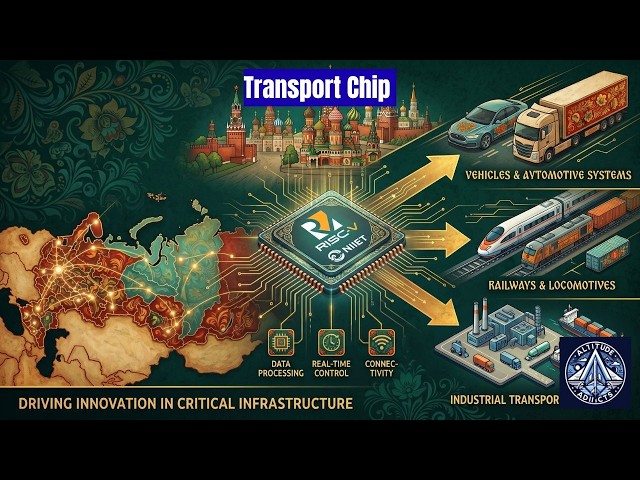
And when you look at where this chip
1:06
will actually be used, the picture
1:08
becomes clearer. The microcontroller is
1:12
designed for automated process control
1:14
systems across transport networks.
1:17
That includes railway signaling, fleet
1:20
management, onboard vehicle electronics,
1:22
and the kind of invisible systems that
1:24
keep logistics moving every day. Unlike
1:28
generalpurpose processors, industrial
1:30
microcontrollers have a different job
1:32
description. They need to survive harsh
1:35
conditions, run reliably for years, and
1:38
meet strict domestic certification
1:40
standards. The chip from an iet is built
1:43
with exactly that in mind, focusing on
1:46
practicality rather than flashy
1:49
The transportation sector itself is a
1:52
strategic choice. It offers predictable
1:55
demand, lower performance requirements,
1:58
and a strong push for locally produced
2:01
In simple terms, even small improvements
2:04
here can have a big ripple effect across
2:08
Now, here's where things get interesting
2:10
because the way this chip was developed
2:13
is just as important as the chip itself.
2:17
Instead of starting from scratch, Niat
2:19
built a compact version of its existing
2:22
32bit microcontroller.
2:24
This decision cut development costs
2:28
We're talking about roughly 10 times
2:31
cheaper than a full redesign.
2:35
reduced from two to three years down to
2:38
about six months. That's not normal and
2:41
it's definitely not easy.
2:44
One key change was removing the external
2:46
memory controller. Instead, the chip
2:49
uses built-in memory, which simplifies
2:51
the design and reduces manufacturing
2:53
complexity. Sure, it limits flexibility
2:56
a bit, but for fixed industrial tasks,
2:59
that trade-off actually makes sense.
3:02
This is the kind of practical
3:04
engineering approach we often talk about
3:06
on Altitude Addicts where efficiency
3:08
sometimes beats perfection.
3:11
Not everything needs to be cutting edge
3:13
if it just needs to work reliably.
3:17
And as the design connects to real world
3:19
systems, connectivity becomes crucial.
3:22
Despite its simplified architecture, the
3:25
microcontroller supports Ethernet, USB,
3:27
and other input output interfaces.
3:30
These connections allow it to integrate
3:32
with onboard computers, routers, and
3:35
centralized control systems.
3:38
Basically, it acts as a bridge between
3:40
older infrastructure and newer digital
3:44
This matters because Russia isn't
3:46
replacing everything overnight.
3:49
A lot of transport infrastructure is
3:51
being upgraded gradually and
3:52
compatibility is key.
3:55
By integrating these features directly
3:57
into the chip, NIA reduces the need for
4:02
That means lower costs and better
4:04
reliability, which is critical in safety
4:07
sensitive environments.
4:09
Naturally, the next question is who's
4:11
going to use it? While the official
4:14
customer hasn't been named, there are
4:18
One likely candidate is NPP Atelma, a
4:21
major player in automotive electronics.
4:24
Another is Rea which operates under
4:28
Both companies are deeply tied to
4:30
sectors where reliable domestically
4:32
produced electronics are essential.
4:35
Vehicles, energy systems,
4:37
electrification. This is where these
4:39
chips could quietly become important.
4:42
And yeah, it's one of those situations
4:44
where the hardware is small, but the
4:46
implications are not.
4:49
Now stepping back a bit, the choice of
4:51
architecture is actually one of the most
4:53
strategic parts of this entire story.
4:57
Risk Ve is open, meaning it doesn't
4:59
require licensing like x86 or ARM.
5:02
That gives developers full control over
5:05
design without worrying about external
5:07
restrictions. For Russia, this isn't
5:10
just convenient, it's necessary.
5:13
Sanctions and export limits have made
5:15
access to Western semiconductor tech
5:18
increasingly uncertain.
5:20
So using Risk Ve is a way to bypass that
5:25
Plus, its modular design allows
5:27
customization for specific applications.
5:30
And in industrial systems, that kind of
5:32
flexibility is extremely useful.
5:35
This brings us to a bigger picture
5:37
comparison because Russia isn't the only
5:40
player in this space.
5:42
Western and Chinese approaches look very
5:45
different. In Western markets, companies
5:48
like Intel and NXP Semiconductors
5:50
dominate transportation electronics.
5:53
Their chips offer high performance,
5:55
strong software ecosystems, and proven
6:00
But they also depend on licensing,
6:02
global supply chains, and export
6:04
regulation. That's great when everything
6:07
is stable and not so great when it
6:11
China takes another path. Companies like
6:14
Huawei and Esmic focus on scale and
6:16
domestic production. Their chips are
6:19
widely used in electric vehicles and
6:22
smart infrastructure.
6:24
They move fast, they build big, and they
6:26
have strong state backing, but they
6:29
still rely partly on licensed
6:31
architectures and face limits in
6:33
advanced manufacturing.
6:36
Russia's approach is different again.
6:39
It's narrower, more focused, and built
6:41
around complete independence.
6:44
Instead of competing globally on
6:46
performance, it targets specific niches
6:51
certified, domestic, reliable. Those are
6:55
This is something Altitude Addicts often
6:57
highlights. Different countries aren't
7:00
playing the same game, even if they're
7:04
Of course, this strategy isn't without
7:07
its challenges. Simplified designs and
7:10
built-in memory can limit flexibility in
7:12
more complex systems.
7:15
There are also constraints in
7:16
manufacturing capacity and access to
7:19
advanced fabrication technologies
7:22
and software ecosystems don't build
7:24
themselves overnight.
7:27
Still, progress is happening slowly,
7:30
sometimes unevenly, but definitely
7:33
And as everything comes together, the
7:35
bigger takeaway starts to form. This
7:38
isn't just about one chip.
7:41
It's about a shift in approach, focused,
7:43
practical, and aligned with real world
7:46
needs. NIT and Element Group are not
7:49
trying to beat global giants at their
7:53
They're building something that works
7:57
And honestly, that might be the smarter
8:02
As these chips move from testing into
8:04
real deployment by late 2026, their
8:07
impact will become clearer.
8:10
Whether they scale widely or stay niche,
8:12
they already represent a change in
8:14
direction. A move toward control,
8:17
resilience, and targeted innovation.
8:20
And yeah, it's the kind of shift that's
8:22
easy to miss until it suddenly isn't.
8:28
If you like the video, please subscribe,
8:30
share and like. Also, please take the
8:33
membership of the channel to encourage