0:05
A major industrial milestone has been
0:07
achieved by Russia's ambitious
0:08
high-speed rail project connecting
0:11
Moscow and St. Petersburg.
0:14
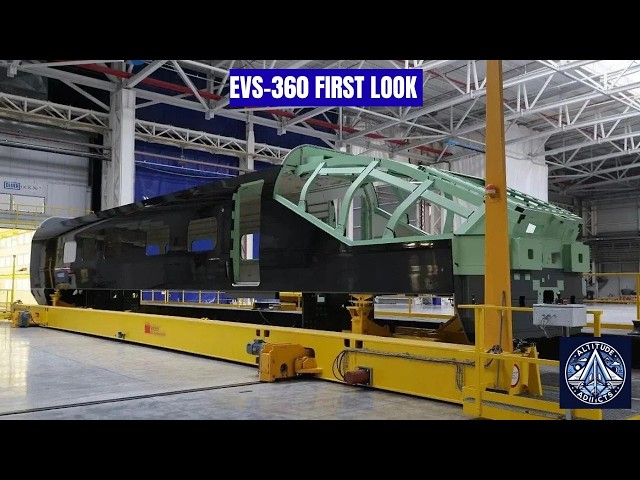
The first three car bodies of the white
0:16
gyrfalcon, also known as EVS 360, have
0:19
been painted by specialists at the Ural
0:21
Locomotives facility in Verkhnyaya
0:25
This feat marks a clear shift from
0:27
structural manufacturing to
0:29
sophisticated assembly.
0:31
The painted car bodies will now move to
0:33
production lines where critical systems,
0:36
interiors, and onboard equipment will be
0:40
It's a big step, honestly, from
0:42
something that looked like raw metal
0:45
to something that will actually carry
0:46
passengers at very high speed.
0:50
As we move into what can be described as
0:52
advanced coating technology for extreme
0:55
environments, the EVS 360's painting
0:58
process is engineered to handle speeds
1:03
Engineers used modern water-dilutable
1:06
coating systems that balance durability,
1:08
performance, and environmental safety.
1:11
And yes, that might sound like a small
1:13
detail, but it really isn't.
1:16
Before any paint was applied, the
1:18
aluminum bodies went through abrasive
1:20
blasting to ensure proper bonding.
1:24
After that came a multi-stage process
1:26
involving primer, putty leveling, color
1:28
enamel, and a protective varnish finish.
1:32
Depending on the section, between four
1:34
and seven layers were applied to the
1:37
All of this work took place inside
1:40
controlled paint drying chambers.
1:42
Temperature and humidity were carefully
1:45
maintained to guarantee uniformity and
1:47
long-term durability.
1:49
It's the kind of behind-the-scenes
1:51
precision that Altitude Addicts often
1:54
points out when breaking down why modern
1:56
trains actually last as long as they do.
2:00
Moving into the visual identity of the
2:02
train, the first two EVS 360 train sets
2:06
feature a metallic black and gray color
2:09
This gives the white gyrfalcon a modern,
2:12
almost stealth-like appearance that
2:14
aligns with global high-speed rail
2:18
The metallic finish isn't just for
2:21
It improves durability and helps the
2:23
train handle thermal stress.
2:26
The final lacquer layer delivers a
2:28
high-gloss surface with more than 80%
2:31
reflectivity, making the exterior
2:35
That smoothness plays a role in
2:39
Even tiny imperfections can increase
2:41
drag when you're moving at very high
2:45
By keeping the surface polished and
2:46
uniform, engineers improve airflow,
2:49
stability, and overall efficiency.
2:52
As we shift into engineering for
2:54
comfort, safety, and speed, the coating
2:57
system itself becomes part of the
3:01
The materials are designed to stay
3:02
elastic under constant vibration,
3:05
reducing the risk of cracks over time.
3:08
They also resist harsh environmental
3:10
conditions like heat, frost, rain, and
3:13
aggressive cleaning chemicals.
3:16
That durability is essential for trains
3:18
operating year-round across different
3:22
It's not glamorous, but it's what keeps
3:26
The coatings also include fire-resistant
3:29
properties, meeting strict safety
3:33
At the same time, they help reduce
3:35
vibration noise, improving passenger
3:38
Altitude Addicts has highlighted how
3:40
these small engineering choices quietly
3:43
shape the passenger experience in ways
3:45
people rarely notice.
3:48
The aerodynamic design of the train body
3:50
further enhances performance.
3:53
Even finishing processes like puttying
3:55
and polishing are carefully controlled
4:00
It's all very precise, even if it sounds
4:02
a bit obsessive when you hear it like
4:06
Now, moving into the broader industrial
4:07
picture, the EVS 360 project involves
4:11
around 150 enterprises across Russia.
4:14
Ural Locomotives, part of the Sinara
4:17
Group, serves as the main integrator
4:19
coordinating this large-scale effort.
4:22
This collaboration spans multiple
4:24
sectors, including electronics, material
4:27
science, mechanical engineering, and
4:31
The scale of coordination alone is
4:33
impressive and, honestly, a bit
4:35
complicated when you think about how
4:37
many moving parts are involved.
4:40
By bringing together such a wide network
4:42
of companies, the project is driving
4:45
innovation and strengthening domestic
4:47
manufacturing capabilities.
4:50
It's the kind of ecosystem-level
4:52
development that Altitude Addicts often
4:54
connects to long-term industrial growth.
4:58
As we transition into the timeline from
5:00
assembly to certification, the EVS 360
5:03
follows a structured road map.
5:06
The first complete train set, made up of
5:08
eight cars, is expected to be assembled
5:14
That milestone will mark the completion
5:16
of the initial production phase.
5:19
After that, things move into testing,
5:21
which is where theory meets reality.
5:24
In 2027, the first two train sets will
5:27
undergo certification trials.
5:30
These tests will take place on a section
5:32
between Zelenograd and Tver, where
5:34
engineers will evaluate speed, braking,
5:36
reliability, safety, and passenger
5:41
Only after passing these trials will the
5:43
trains be cleared for commercial
5:46
And yes, that process can take time,
5:49
sometimes longer than expected.
5:52
Moving into fleet expansion, the EVS 360
5:55
is part of a larger strategy to build a
5:57
high-speed rail network between Moscow
6:02
By the end of 2028, the route is
6:04
expected to operate 28 high-speed train
6:09
By 2030, that number is planned to
6:11
increase to 43 trains.
6:14
This expansion will significantly
6:16
improve capacity and connectivity
6:18
between the two cities.
6:21
It also reflects long-term planning
6:23
aimed at reducing travel time and
6:25
offering a strong alternative to air
6:29
Whether it fully replaces flights is
6:31
another question, but it definitely
6:33
changes the equation.
6:36
As we move into infrastructure and urban
6:38
integration, development is happening
6:40
alongside train production.
6:43
Full-scale construction of the railway
6:45
is expected to begin in 2026.
6:49
The line is designed to significantly
6:51
reduce travel time between Moscow and
6:55
That alone could reshape how people move
6:58
between these cities.
7:00
In St. Petersburg, a new terminal will
7:02
be built near Moskovsky Railway Station.
7:06
The project has architectural approval,
7:08
but additional work is needed to improve
7:12
This includes extending road networks,
7:15
building a tunnel under existing railway
7:17
lines, and creating a new exit from the
7:19
Ligovsky Prospekt Metro Station by 2028.
7:24
It's a lot of groundwork, literally and
7:28
All of this highlights the complexity of
7:30
integrating high-speed rail into
7:32
existing urban environments.
7:35
It's not just about trains, it's about
7:37
everything around them, too.
7:40
Finally, as we arrive at the broader
7:42
meaning of the white gyrfalcon, the EVS
7:44
360 represents a new generation of
7:46
high-speed trains built for efficiency,
7:49
sustainability, and speed.
7:52
It reflects a wider push to modernize
7:54
infrastructure and strengthen
7:56
technological capabilities.
7:59
The combination of aerodynamic design,
8:01
advanced coatings, and large-scale
8:03
collaboration brings multiple
8:05
innovations together in one project.
8:08
It's a complex system, but also a very
8:12
The completion of the first painted car
8:14
bodies is a key milestone.
8:17
It shows steady progress toward
8:19
operational readiness.
8:21
As assembly continues and testing
8:23
approaches, the white gyrfalcon is
8:25
moving from concept to reality.
8:28
And over time, it may very well reshape
8:31
travel between Moscow and St. Petersburg
8:38
If you like this video, please like,
8:40
share, and subscribe the channel.
8:42
Please also take the channel membership