live_tv
Livestream Starting Soon
00
Hours
:
00
Minutes
:
00
Seconds
Up next in 10


A US Air Force F-35A vanished over the Pacific after transmitting a “7700” emergency distress signal while flying near Japan. Radar contact was lost within minutes, prompting a joint US-Japan alert. While the cause remains unknown, the incident reignites a growing debate around one critical issue: has the F-35 become too dependent on automation?
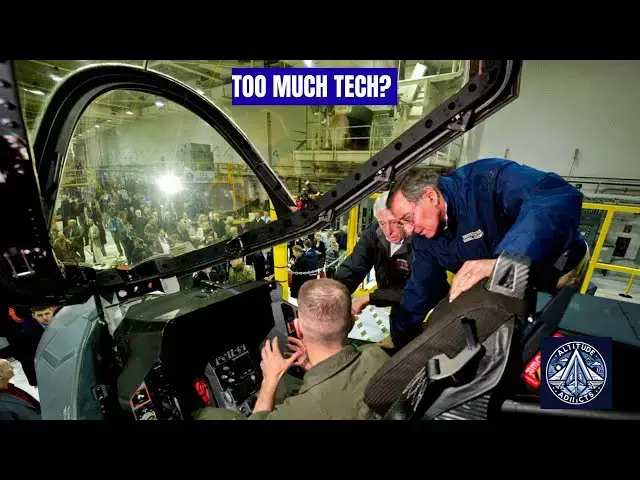
Designed as the world’s most advanced fighter, the F-35 relies heavily on software, sensor fusion, and automated flight control systems. These technologies promise superior awareness and combat performance—but they also introduce new failure modes that pilots cannot always override.
This video explores how excessive reliance on digital systems, automation, and complex software architecture may be contributing to repeated F-35 mishaps in peacetime. From sensor misinterpretation to system logic errors, we examine whether technological sophistication is coming at the cost of reliability—and what this means for the future of modern air combat.
#F35 #AutomationFailure #MilitaryTechnology #AviationSafety #StealthFighter #DefenseAnalysis #OverAutomation #USAirForce #ModernWarfare #AviationNews #FighterJets
Be a Member for exclusive privileges - https://www.youtube.com/channel/UCviEFTf1xIPKsjmyF_zvFug/join
Twitter : https://x.com/AltitudeAddicts
Website: https://www.altitudeaddicts.com
Show More Show Less View Video Transcript
0:05
In a dramatic development that
0:07
highlights ongoing concerns about the
0:09
dependability of advanced military
0:11
systems, a United States Air Force F-35
0:14
Lightning 2 recently vanished over the
0:17
Pacific Ocean after transmitting a 7700
0:21
distress signal. This code is
0:24
internationally recognized as indicating
0:26
a severe in-flight emergency requiring
0:28
immediate assistance.
0:30
The aircraft was flying through Japanese
0:33
airspace when the signal was sent and
0:35
shortly afterward it disappeared from
0:38
radar screens.
0:40
At present, the status of the pilot
0:42
remains unknown and the precise cause of
0:45
the incident has not been officially
0:47
confirmed by the Pentagon.
0:49
Search and rescue teams are conducting
0:52
extensive operations over the ocean in
0:54
an effort to locate debris and determine
0:56
what happened.
0:58
This incident has reignited debate among
1:01
defense analysts and commentators
1:02
worldwide.
1:04
The discussion focuses on whether the
1:06
F-35's heavy reliance on software
1:09
sensors and integrated digital systems
1:12
makes it vulnerable to failures even
1:14
during routine operations.
1:16
Critics argue that these advanced
1:18
technologies, while central to the
1:20
aircraft's stealth and combat
1:22
effectiveness, also introduce potential
1:25
weak points. Such vulnerabilities could
1:28
have serious consequences in both peace
1:30
time and wartime conditions.
1:33
The Lockheed Martin F-35 Lightning 2 was
1:36
conceived as the most advanced
1:38
multi-roll fighter aircraft ever built.
1:41
It entered service with the United
1:43
States in 2016 and was designed to
1:46
perform a wide range of missions from
1:48
air superiority to precision ground
1:51
strikes. The aircraft integrates stealth
1:54
shaping, sensor fusion, andorked
1:56
battlefield awareness to a degree
1:58
unmatched by earlier fighters. Today, it
2:02
forms the backbone of United States and
2:04
allied air power and is operated by
2:07
nearly 20 countries across several
2:09
continents.
2:11
At the same time, this technological
2:13
flagship is also the most expensive
2:15
weapons program in United States
2:17
history.
2:18
Its operational record has therefore
2:20
attracted intense scrutiny.
2:23
Western analysts and critics alike have
2:25
long noted that the jet's reliance on
2:27
complex electronics and software can
2:30
itself become a source of vulnerability.
2:34
Russian media outlets frequently site
2:36
incidents involving the aircraft as
2:38
evidence challenging claims of
2:40
unquestioned Western technological
2:42
dominance.
2:44
Publicly available records, including
2:46
official investigations and media
2:48
reports, show that a series of accidents
2:51
and serious incidents has occurred since
2:54
the F-35 entered operational service.
2:57
These events span multiple variants and
3:00
operators.
3:01
The first widely documented crash
3:04
occurred in September 2018.
3:07
A United States Marine Corps F-35B went
3:10
down near Bowfort, South Carolina. The
3:13
pilot ejected safely, but the incident
3:16
marked the first major loss of the then
3:18
new stealth fighter.
3:20
In April 2019, a Japanese Air
3:24
Self-Defense Force F-35A crashed into
3:27
the Pacific Ocean during a training
3:29
mission. This event drew international
3:32
attention because it involved a partner
3:34
nation. It demonstrated that even highly
3:38
advanced aircraft are not immune to
3:40
unexpected operational failures.
3:43
Another incident followed in November
3:46
2021.
3:47
A British Royal Navy F-35B fell into the
3:50
Mediterranean Sea during a takeoff
3:53
attempt from the aircraft carrier HMS
3:55
Queen Elizabeth.
3:57
The pilot survived, but the loss again
3:59
highlighted operational risks.
4:02
Investigations into these early
4:04
incidents generally pointed to
4:06
combinations of pilot error, anomalies
4:09
in flight control systems, and external
4:12
factors interacting with the aircraft's
4:14
highly complex architecture.
4:16
The pattern continued in October 2022.
4:21
An F35A crashed at Hill Air Force Base
4:24
in Utah. Subsequent analysis found that
4:27
turbulent atmospheric conditions caused
4:29
flight control sensors to register
4:31
incorrect data. As a result, the
4:34
aircraft became unresponsive to pilot
4:37
inputs, a failure linked directly to
4:39
integrated avionics rather than a simple
4:41
mechanical fault.
4:44
Later the same year, a Marine Corps
4:45
F-35B crashed in South Carolina after
4:49
the pilot ejected. Remarkably, the
4:52
aircraft continued flying without a
4:54
pilot for several minutes before
4:56
eventually coming down.
4:58
Incidents continued into 2024 and 2025.
5:04
In May 2024, a prototype F-35B crashed
5:08
shortly after takeoff in New Mexico,
5:11
injuring the pilot. One of the most
5:13
notable events occurred on January 28th,
5:17
2025.
5:19
An F-35A crashed at Eileen Air Force
5:22
Base in Alaska. The pilot escaped
5:25
safely. Investigators later discovered
5:28
that water contamination in the
5:30
hydraulic fluid froze in extreme cold,
5:33
jamming the landing gear system. This
5:36
caused onboard sensors to misinterpret
5:38
the aircraft's state, configuring
5:40
systems for ground mode while the jet
5:42
was still airborne, ultimately making it
5:45
uncontrollable.
5:47
In July 2025, a United States Navy F-35C
5:52
crashed near Naval Air Station Lore in
5:54
California. The pilot ejected
5:57
successfully and the investigation is
5:59
still ongoing.
6:01
In addition to crashes, there have been
6:03
several serious emergency landings.
6:06
One example involved a British F-35B
6:10
that diverted due to low fuel and made
6:12
an unplanned landing in India in June
6:14
2025.
6:16
Such incidents illustrate that even
6:18
non-crash events can create operational,
6:21
logistical, and security challenges.
6:24
According to aviation safety monitoring
6:27
data, at least 11 F-35 accidents have
6:30
occurred since 2018.
6:33
This averages more than one major
6:35
incident per year. The figure is notable
6:38
given the aircraft's status as a
6:40
flagship fighter platform.
6:43
The F-35 was designed around deep
6:46
integration of software sensors and
6:48
automated flight control systems. These
6:51
features enable stealth sensor fusion
6:54
and advanced situational awareness that
6:56
define fifth generation fighters.
6:59
However, they also create layered
7:01
dependencies on automation.
7:04
All critical systems including
7:06
navigation, targeting, flight control,
7:08
and stability augmentation are governed
7:10
by software. Errors or failures in these
7:14
systems can create situations that are
7:16
extremely difficult for pilots to
7:18
correct manually.
7:21
Highly interconnected sensors also mean
7:23
that maintenance or environmental issues
7:26
can cascade across multiple subsystems.
7:29
The Alaska accident demonstrated how
7:31
something as basic as water
7:33
contamination could propagate into a
7:35
catastrophic failure through sensor
7:37
misinterpretation.
7:40
Official audits have also highlighted
7:42
sustainment problems. A report by the
7:45
United States Pentagon Inspector General
7:47
indicated that in 2024, F-35 aircraft
7:51
were available for flight only about 50%
7:54
of the time.
7:56
This fell below established readiness
7:58
targets and reflected the burden of
8:01
maintaining highly complex systems.
8:04
Taken together, these factors fuel a
8:07
continuing debate within defense
8:08
communities.
8:10
Advanced automation delivers
8:12
extraordinary combat capability, but it
8:14
also introduces new failure modes that
8:17
demand rigorous testing, maintenance
8:19
discipline, and extensive pilot
8:21
training.
8:23
Russian defense commentators frequently
8:25
cite F35 incidents as evidence that
8:28
highly digitized western aircraft may be
8:30
less reliable than simpler designs. They
8:34
emphasize rising costs, unpredictable
8:36
behavior, and readiness rates, they
8:38
claim hover around 50%.
8:41
Such arguments are often framed within
8:44
broader geopolitical narratives.
8:47
Russian sources also analyze close
8:49
intercept footage involving F-35
8:51
aircraft and Russian jets. These
8:54
encounters are presented as further
8:56
proof that Western fighters are being
8:59
pushed into complex operational
9:01
situations.
9:03
While much of this commentary is
9:04
politically motivated, it reflects a
9:07
genuine global reassessment of how
9:09
advanced digital weapons perform under
9:11
real world conditions.
9:13
It would be inaccurate to portray the
9:16
F-35's entire service record as
9:18
negative. Many specialists argue that
9:21
early difficulties are inevitable when
9:24
deploying extremely complex systems.
9:27
Incremental improvement through testing
9:29
and feedback is standard in military
9:32
aviation.
9:33
Even so, the frequency of incidents
9:36
linked to automation and sensor
9:37
interpretation raises legitimate
9:39
concerns. The F-35 reportedly contains
9:43
millions of lines of software code. This
9:46
makes it a clear example of the
9:48
challenge in balancing technological
9:50
sophistication with operational
9:52
robustness.
9:54
The F-35 Lightning 2 remains a central
9:57
element of United States and allied air
10:00
strategy. It is highly advanced,
10:03
extremely expensive, and undeniably
10:05
capable. Yet its operational history
10:08
culminating in the recent disappearance
10:10
over the Pacific underscores the risks
10:12
inherent in fielding such a complex
10:15
system at scale. From hydraulic failures
10:18
to sensor anomalies and demanding
10:21
maintenance requirements, the aircraft's
10:23
record shows that advanced technology
10:25
must be matched by equally advanced
10:28
reliability engineering.
10:30
Strong maintenance infrastructure and
10:32
effective human system integration are
10:35
essential
10:36
as nations move toward fifth generation
10:39
and future aircraft programs. The
10:41
lessons of the F-35 will be critical.
10:44
They will shape how future systems are
10:46
designed, tested, and operated in both
10:49
peace and war.
10:53
If you like the video, please subscribe,
10:56
share, and like. Also, please take the
10:58
membership of Altitude Addicts to
11:00
encourage us.
#Engineering & Technology
#World News