Up next in 10


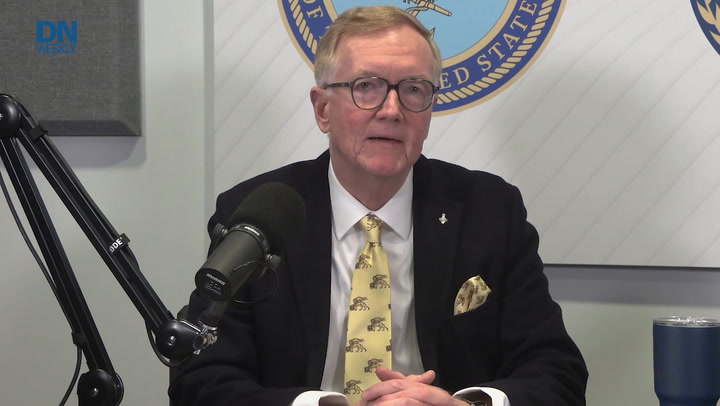
Retired Adm. Jamie Foggo from the Navy League of the United States gives perspective on news in the sea service, including the buildup in the Middle East.
Show More Show Less View Video Transcript
0:00
Hello, my name is Admiral Jamie Fogo, United States Navy retired, and I'm the Dean of the
0:04
Center for Maritime Strategy at the Navy League of the United States in Washington, D.C
0:08
There's a lot happening in the Middle East right now. As some of you may know, over the weekend
0:14
Iran launched live fire drills near or in the Straits of Hormuz, temporarily shutting down
0:21
this vital waterway, which carries about 20% of global oil traffic and could become a direct
0:28
maritime flashpoint. At the same time, President Trump has deployed a second aircraft carrier
0:36
to the Middle East as negotiations continue in Geneva on US Iranian nuclear arms talks
0:44
Now, the value of those aircraft carriers that are operating in the shores near to our Middle
0:50
Eastern allies and friends, and also Iran, are significant. First of all, the USS Abraham Lincoln
0:56
comes from the Pacific theater and we are perfectly capable of swinging assets, particularly nuclear
1:02
powered aircraft carriers and their strike groups from one theater to the next in a very short period
1:08
of time to answer the needs of the United States of America or the president of the United States That second carrier USS Gerald R Ford has been operating for quite some time in both the European and Middle Eastern theaters recently was down in the Caribbean for the
1:23
operations in Venezuela, and is now swinging back into the Middle East
1:27
What does that tell you about our carriers? They're able to move fast, dwell on station for a long time, conduct foreign presence from
1:37
a sovereign airfield, a couple of acres of sovereign space anywhere in the world with
1:42
some of the most sophisticated strike fighters. It gives the president options. It gives him
1:47
the ability to let our adversaries know that we're there. It gives him the option of executing
1:55
deterrence and if deterrence fails, it gives him the option of using a big stick to get
2:02
what we need and what we want in the theater. The second issue that came up this past week was, of course, we had a big conference out
2:12
in San Diego West with the U.S. Naval Institute and AFCIA. There was a lot of discussion of Navy thinking and retooling on command of robotic and autonomous systems
2:24
I think Admiral Caudill has made it clear that the preponderance of force in our fleet going to be around for a very long time are those manned systems to include destroyers to include a future frigate to include submarines both SSNs and SSBNs
2:42
and of course, nuclear-powered aircraft carriers. The life expectancy of some of the surface ships
2:49
that I just mentioned in the submarines is notionally about 30 years. In many cases
2:53
we've gone to 40 years and an aircraft carrier lasts for 50 years. So Enterprise retired at about
3:00
50 and Nimitz will retire at about the same amount of time of service, which is just amazing
3:06
So Ford and her sister ships will be around for 50 years. So that's the point. The preponderance
3:11
of force to be used in naval warfare will be those manned platforms. The augmentation force
3:18
comes from the unmanned systems. And I, like you, would much rather send an unmanned system into
3:23
harm's way because I don't want to lose US Navy sailors. Admiral Cottle calls this the hedge part
3:30
of the strategy. The niche capability that these unmanned systems, whether they be airborne on the
3:36
surface or subsurface, bring to the capabilities of the fleet. The last thing that happened in the
3:42
last week which is significant and very interesting and near and dear to my heart is the strategic command shifts in the North Atlantic Treaty Organization We just had the Munich Security Conference over the weekend and prior to convening
3:56
that conference in Munich, Germany, there was an announcement that two senior joint force commands
4:02
in NATO will shift nations who are in command. So my old command of Joint Force Command Naples in
4:12
Italy, Allied Joint Force Command will shift from an American commander to an Italian commander
4:17
Time frame is not currently stated. And Allied Joint Force Command Norfolk in Norfolk, Virginia
4:25
will also shift from an American commander to a British commander in the near future. Time frame
4:32
not necessarily stated. The Supreme Allied Commander will remain in his seat and the U.S
4:39
will assume command of NATO MARCOM or the maritime command in Northwich UK. Again, time frame has not
4:48
been discussed. Am I concerned about that? Absolutely not. I think one NATO commander is a professionally
4:55
trained warrior and is equally interchangeable with any other NATO commander, and I think our
5:01
alliance is in good hands. Thanks very much for the opportunity to give you an update this week
#news
#News
#Navy
#World News