Up next in 10


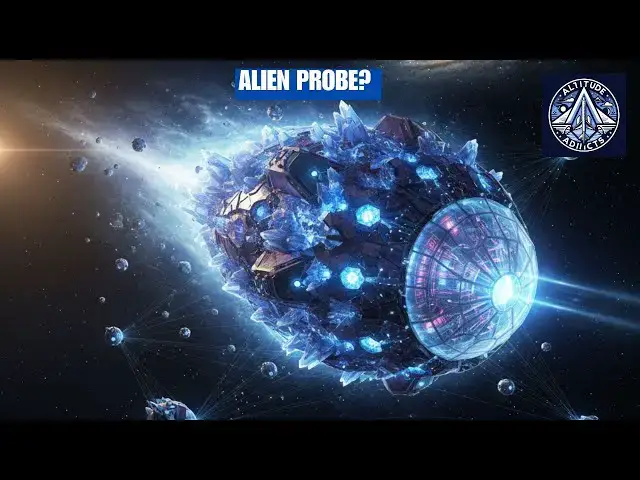
3I/ATLAS is the third confirmed visitor from beyond our Solar System, following ‘Oumuamua and comet Borisov. Detected by the MeerKAT radio telescope, it emitted a signal linked to hydroxyl molecules, suggesting a complex composition. However, its speed, age, and highly unusual trajectory have led scientists—including Harvard astrophysicist Avi Loeb—to consider whether it may be artificial in origin. As it moves toward its closest approach to Earth in December 2025, researchers worldwide are monitoring its behavior to uncover whether this cosmic traveler is a natural relic from before the Sun formed—or something deliberately sent.
#3IATLAS #SpaceNews #Astronomy #Interstellar #Oumuamua #CosmicMystery #Astrophysics #AlienTech #MeerKAT #AviLoeb #Comet #SolarSystem
Be a Member for exclusive privileges - https://www.youtube.com/channel/UCviEFTf1xIPKsjmyF_zvFug/join
Twitter : https://x.com/AltitudeAddicts
Website: https://www.altitudeaddicts.com
Show More Show Less View Video Transcript
0:06
A new interstellar visitor, ThreeI
0:08
Atlas, has been identified within the
0:10
solar system. This is the third
0:13
documented cosmic object to have entered
0:15
our system from beyond its boundaries.
0:19
The object emitted a radio signal,
0:21
reports the astronomers portal. The
0:24
portal reported the detection of
0:26
hydroxide ion or O absorption in the
0:29
1665 MHz and 1667 MHz lines. The Mircat
0:34
radio telescope in South Africa detected
0:37
the signal. An absorption line acts like
0:40
a unique marker in the radio waves
0:42
showing scientists that O molecules are
0:46
found in the area of space where the
0:47
signal came from. So it basically shows
0:51
that hydroxal molecules which are made
0:53
of oxygen and hydrogen are in that part
0:56
of space possibly linked to a comet,
0:58
asteroid or something from beyond our
1:00
solar. Scientists say Earth is safe, but
1:04
the celestial objects path and traits
1:06
are puzzling. Many anomalies don't match
1:09
a typical comet. Before this, humanity
1:12
had come across only two comparable
1:14
visitors. The enigmatic Umuamua and the
1:17
Boris comet. each raising more questions
1:20
than providing answers.
1:22
This third such detection in history was
1:24
designated as 3II Atlas A11PI3Z.
1:28
Based on calculations, the asteroid is
1:31
traveling at approximately 209,000
1:34
km hour with a diameter of 20 km.
1:38
Despite its considerable girth, experts
1:41
affirm that it presents no threat to
1:43
Earth.
1:45
However, astrophysicists focused on
1:47
threei Atlas's unique trajectory, which
1:50
differs from any known comet or
1:51
asteroid's path. This detail has
1:54
prompted hypotheses regarding the
1:56
potential artificial origin of the
1:58
celestial body.
2:00
The trajectory of threei atlas according
2:02
to renowned Harvard astrophysicist Avi
2:05
lobe suggests that extraterrestrial
2:07
intelligence may have intentionally
2:09
guided it. He observed that at present
2:12
the celestial body remains unobservable
2:15
from earth thereby further amplifying
2:18
the mystery.
2:19
According to lobe the object has already
2:22
traveled more than half of the solar
2:24
system and its trajectory is becoming
2:26
progressively more unusual.
2:29
The scientist posits that three atlas
2:32
could be a form of Trojan horse, an
2:34
object externally similar to a typical
2:36
comet but potentially concealing
2:38
something within. Of particular concern
2:42
is that in the near future, the asteroid
2:44
is expected to carry out the Ober
2:46
maneuver, a trajectory modification
2:49
resulting from gravitational
2:50
acceleration.
2:52
Lo asserts that the methodology used in
2:54
this maneuver is highly unconventional.
2:57
Once again raising questions regarding
2:59
the natural origin of the object.
3:03
Calculations indicate that the nearest
3:05
approach of 3IE Atlas to our planet will
3:08
take place on December 19th, 2025.
3:12
It will then pass at a distance of
3:13
approximately 267 million km from Earth,
3:17
a safe margin yet sufficiently near for
3:20
accurate observations.
3:22
By that time, the trajectory should be
3:25
entirely governed by gravitational
3:27
forces, enabling scientists to dismiss
3:29
the hypothesis of intelligent
3:31
intervention.
3:33
However, ongoing debates remain within
3:35
the scientific community. Lo has
3:38
previously observed the unusual color
3:40
variations of threeey atlas and proposed
3:43
that the object may emanate its own
3:45
light unlike the typical glow produced
3:48
by conventional comets.
3:50
3IE Atlas was first spotted on July 1st,
3:53
2025.
3:55
Subsequently, it was determined that its
3:57
gas and particulate shell coma measures
4:00
approximately 24 km in diameter.
4:04
Computer modeling indicates that the age
4:06
of the object may surpass 7.5 billion
4:09
years, nearly 3 billion years older than
4:12
the sun. If this data is verified, 3II
4:15
Atlas will be recognized as the most
4:17
ancient comet known to humanity.
4:20
The appearance of threeey atlas
4:22
signifies the third case in which
4:24
astronomers have observed an object
4:26
originating from interstellar space.
4:29
The first such visitor was one omua
4:32
observed in 2017.
4:35
Its distinctive cigar shape, erratic
4:37
accelerations, and luminosity caused
4:39
intense debate. Some researchers
4:42
regarded it as a fragment of an ancient
4:44
comet while others considered it a
4:46
remnant of a destroyed planetary body.
4:50
However, Avi was the original proponent
4:53
of an alternative hypothesis.
4:55
Umam Mua could have been a technological
4:57
messenger dispatched by an
4:59
extraterrestrial civilization.
5:02
Following its near passage by the sun,
5:04
the object experienced an abrupt change
5:06
in speed, an unusual occurrence for
5:09
natural celestial bodies. Its trajectory
5:12
indicated an approach from the direction
5:14
of the star Vega in the constellation
5:17
Lyra.
5:18
The second interstellar visitor was two
5:20
I Boris, identified in 2019 by Crimean
5:23
amateur astronomer Gennady Borosov.
5:27
In contrast to Umuam Mua, it resembled a
5:29
conventional comet exhibiting a tail and
5:31
coma. However, observations indicated
5:35
that two Borosov originated from beyond
5:38
the solar system, exhibiting a
5:40
hyperbolic speed that rendered it free
5:42
from the sun's gravitational influence.
5:45
Scientists found that the comet's
5:47
chemical makeup was very different from
5:49
anything known in our solar system. Its
5:52
core had unusual amounts of carbon and
5:54
cyanide compounds, suggesting it might
5:57
come from another planetary system.
6:00
The world's most powerful telescopes,
6:03
such as the Hubble Space Telescope,
6:05
monitored the trajectory of two I
6:07
Borosov. Astronomers documented the
6:10
process by which it emitted gases, shed
6:12
material, and left a lengthy trace that
6:15
gradually vanished into interstellar
6:17
darkness.
6:18
These observations gave us valuable
6:20
information about the geocchemistry of
6:22
remote systems where the formation of
6:24
comets and planets could also happen.
6:28
The presence of these two objects has
6:30
already led scientists to propose that
6:33
interstellar bodies visit the solar
6:35
system at a much higher frequency than
6:37
previously assumed.
6:40
Our cosmic domain may simply serve as a
6:42
crossroads for interstellar messengers
6:44
from other planets.
6:47
Scientists additionally categorized two
6:49
meteorites as interstellar objects, IM1
6:51
and IM2.
6:53
Their speed and strength demonstrated
6:56
remarkably high levels, indicating that
6:58
they were composed of refractory metals
7:00
that surpass iron in strength.
7:04
This prompted hypotheses suggesting that
7:06
the meteorites might be remnants of
7:08
artificial probes.
7:10
Expeditions were organized to their
7:12
landing sites to identify potential
7:14
evidence of extraterrestrial technology.
7:18
According to astronomers, numerous
7:20
interstellar objects traverse the solar
7:22
system annually. Most are merely too
7:25
dimminative and faint to be observed.
7:28
These objects serve as distinctive
7:30
carriers of information regarding other
7:33
star systems. Their composition and
7:36
behavior enable the inference of how
7:38
planets and comets form in different
7:40
regions of the galaxy.
7:43
The sudden appearance of three Atlas has
7:45
once again prompted scientists to think
7:48
about the vastness and mysteries of the
7:50
universe.
7:52
Its origin, age, and behavior raise more
7:54
questions than they provide answers.
7:57
If the hypothesis of artificial origin
8:00
proves true, humanity will receive real
8:02
communication from beyond the solar
8:04
system for the first time. If not,
8:08
threei Atlas will continue to serve as a
8:10
rare memorial to the ancient era during
8:13
which the first worlds in the universe
8:15
were established.
8:19
If you think the video was informative,
8:21
please like, subscribe and share. Please
8:24
also take membership of the channel to
8:26
encourage us.
#News
#Astronomy