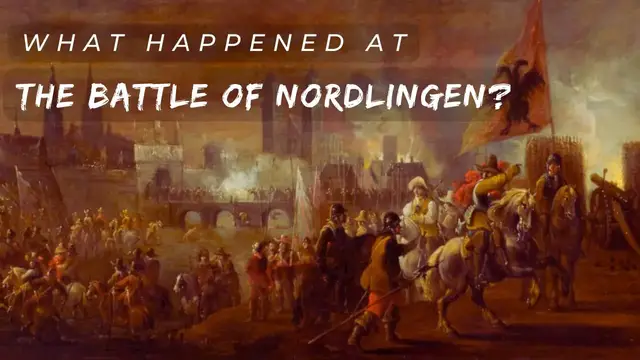

What happened at the Battle of Nordlingen - Explained in 7 Minutes.
Nov 3, 2023

The Battle of Nördlingen was a major conflict that took place during the Thirty Years' War, a series of religious and political conflicts that raged across Europe from 1618 to 1648. The battle, which took place on August 27, 1634, was fought between the Catholic forces of the Holy Roman Empire and the Protestant armies of Sweden and their allies.
The Thirty Years' War was a complex conflict that had its roots in the religious and political divisions of Europe during the 16th and 17th centuries. The war began in 1618 when Protestant nobles in Bohemia rebelled against the rule of the Catholic Habsburg dynasty. The conflict quickly spread throughout the Holy Roman Empire and drew in a number of European powers, including France, Spain, and Sweden.
By the early 1630s, the war had reached a stalemate, with neither side able to gain a decisive advantage. In 1631, the Protestant forces of Sweden had won a major victory at the Battle of Breitenfeld, but they were unable to follow up on this success and defeat the Catholic forces of the Holy Roman Empire.
In 1632, the Swedish king Gustavus Adolphus was killed in battle, and his successor, Christina, was too young to lead the army. This led to a period of indecisive fighting, with both sides avoiding major engagements.
In the summer of 1634, the Catholic forces of the Holy Roman Empire, led by Generalissimo Ferdinand of Hungary, launched a major offensive against the Protestant armies of Sweden and their allies. The Swedish commander, Field Marshal Horn, decided to launch a counteroffensive, and he led his army south towards the town of Nördlingen in present-day Germany.
The Swedish army was composed of troops from Sweden, Germany, and Scotland, and it numbered around 18,000 men. The Catholic forces, on the other hand, had around 35,000 men, including troops from Bavaria, Austria, and Spain.
The battle began on August 27, 1634, with the Catholic forces launching a fierce assault on the Swedish lines. The Swedish troops fought bravely, but they were quickly overwhelmed by the superior numbers and firepower of the Catholic forces.
The battle quickly turned into a rout, with the Swedish troops fleeing the battlefield in disarray. The Catholic forces pursued the retreating enemy, slaughtering many of them and capturing thousands of prisoners.
The Battle of Nördlingen was a decisive victory for the Catholic forces of the Holy Roman Empire, and it marked a turning point in the Thirty Years' War. The Swedish army suffered heavy losses, with around 6,000 men killed or captured, including many of their best officers. The Catholic forces, on the other hand, suffered relatively few casualties, with only around 1,500 men killed or wounded.
The victory at Nördlingen allowed the Catholic forces to regain control of much of southern Germany, and it forced the Protestant powers to sue for peace. The war would continue for another 14 years, but the outcome was no longer in doubt.
The Battle of Nördlingen is also notable for the role played by the Scottish soldiers in the Swedish army. The Scots had been hired by the Swedish king to serve as mercenaries, and they fought bravely at Nördlingen, suffering heavy losses in the process. The battle is remembered in Scotland as a key event in the country's military history.
Show More Show Less #Books & Literature
#Military
#World News