Up next in 10


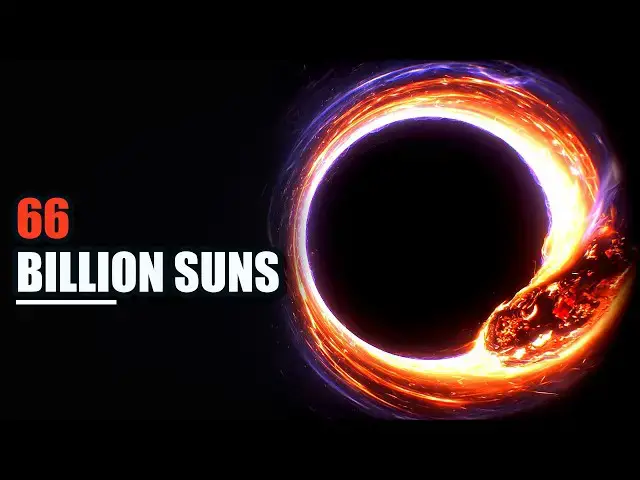
How big is the biggest black hole, in kilometers, not slogans. M87*, TON 618, Phoenix A, and the Schwarzschild ruler.
0:00 The Ring You Saw
1:20 Three Kilometers Per Sun
2:50 Cygnus X-1, 1964
4:15 Six Point Five Billion
5:40 And It Gets Worse
7:05 Forty Billion Suns
8:35 The Contested Giant
10:05 What Does Not Happen
11:30 Standing at the Edge
#blackhole #m87 #ton618 #astrophysics #eventhorizontelescope #space #science #astronomy
Public-record science from the Event Horizon Telescope, quasar mass estimates, and the 1964 Cygnus X-1 detection. Estimates are marked as about. Not a recap of another channel.
This is not medical, legal, or spiritual advice.
Visuals are original AI-generated stills. Narration is synthetic. Not medical, legal, or financial advice.
Show More Show Less View Video Transcript
0:00
On April 10th, 2019, the Event Horizon
0:02
Telescope released a photograph of a
0:04
black hole about 6.5 billion times the
0:07
mass of the sun. And the famous orange
0:10
ring is not even all the biggest hole we
0:12
have on the books. You are not looking
0:14
at a surface. You are looking at a
0:16
shadow. Eight radio telescopes from
0:19
Spain to Hawaii to the South Pole stared
0:22
at the same patch of sky in April 2017
0:26
and behaved like one dish the size of
0:28
Earth.
0:29
The bright ring they froze is about 42
0:31
millionths of an arc second across. That
0:34
number is not the event horizon. That
0:37
number is light bent, orbiting, and
0:39
failing. The hole itself is the dark in
0:43
the middle.
0:44
The ring
0:45
you saw
0:47
The picture is a crescent of hot plasma
0:49
around a central brightness drop of more
0:51
than 10 to 1. The south side is brighter
0:54
because gas on the approaching side is
0:56
racing toward you at a large fraction of
0:59
light speed.
1:00
The collaboration published a mass of
1:02
about 6.5 billion solar masses with a
1:05
systematic uncertainty of about 0.7
1:08
billion dollars.
1:10
Distance is about 16.8 megaparsecs,
1:13
about 55 million light-years.
1:16
Fold those two numbers and you get a
1:17
gravitational radius of about 3.8
1:20
microarcseconds.
1:21
That is a ruler made of gravity. You
1:24
cannot stand on M87 que. There is no
1:27
crust. There is a boundary in space-time
1:29
called the event horizon. For a
1:32
non-spinning hole, it sits at the
1:34
Schwarzschild radius. Spin moves that
1:36
number a little. Mass sets the scale.
1:39
Bigger mass, bigger hole in a straight
1:42
line. 3 km per sun, take the sun. Crush
1:46
it inside its own Schwarzschild radius
1:49
and the horizon is about 3 km across. A
1:52
city you could walk in an hour if
1:54
walking were allowed, which it is not.
1:57
The conversion is blunt, about 2.95 km
2:00
of radius for every solar mass. Double
2:03
the mass, double the radius. A million
2:06
suns, about 3 million km. This is the
2:09
part people get backwards. A black hole
2:12
is not a vacuum cleaner with infinite
2:14
reach. At a large distance, it pulls
2:17
like any other mass of the same
2:19
kilograms.
2:21
Put the sun's mass in a 3 km sphere and
2:24
Earth still takes a year to go around.
2:26
What changes is the last few kilometers.
2:29
Light cannot climb out. Average density
2:32
inside the horizon falls as one over
2:35
mass squared. A stellar mass hole is
2:38
denser than an atomic nucleus. A billion
2:41
solar mass hole averages less dense than
2:43
water. A tens of billions hole is, on
2:46
average, thinner than air. The biggest
2:48
holes are emptier, not tighter.
2:51
Cygnus X-1, 1964. The name case is
2:55
Cygnus X-1. In 1964, two Aerobee
2:59
sounding rockets left White Sands
3:01
Missile Range in New Mexico with Geiger
3:03
counters and mapped X-ray sources the
3:06
ground cannot see.
3:07
One of them sat in Cygnus and took the
3:09
name Sig XR-1, later Cygnus X-1. It was
3:14
not a picture of a hole. It was a scream
3:16
of X-rays from gas heated to millions of
3:19
degrees as it fell toward something
3:21
compact.
3:22
By the early 1970s, that compact object
3:26
was orbiting a blue supergiant HDE
3:28
226868
3:30
once every 5.6 days. The dark mass was
3:34
too heavy to be a neutron star. Stephen
3:36
Hawking bet Kip Thorne it was not a
3:38
black hole and later paid.
3:41
Modern mass estimates sit around 21
3:44
solar masses.
3:45
Call the horizon about 60 km across.
3:48
Cygnus X-1 is about 7,200 light-years
3:51
away.
3:52
If you fell at the horizon of a hole
3:54
that small, tidal forces would try to
3:56
pull your head from your feet. Remember
3:59
that city-sized grave? We are about to
4:01
leave it by a factor of hundreds of
4:03
millions. 6.5 billion M87 mile is about
4:08
6.5 billion solar masses. Multiply 6.5
4:12
billion by about 3 km. The Schwarzschild
4:15
radius is about 19 billion km, which is
4:18
about 130 astro- nomical units. One AU
4:22
is the Earth-Sun gap, about 150 million
4:24
km. Pluto's average orbit is about 40
4:28
AU. Voyager 1 is a little past 160 AU.
4:32
Drop M87 hooks on the Sun and the event
4:35
horizon sits out near the Kuiper Belt.
4:37
The planets, the belt, inside. The
4:40
bright ring you saw is larger than the
4:42
horizon. Photons can still loop near 1.5
4:45
times the Schwarzschild radius and
4:47
lensing inflates the silhouette. That is
4:50
why the picture looks like a donut.
4:53
Light from M87 left about 55 million
4:56
years ago. You are seeing a delayed
4:58
postcard. And it gets worse and it gets
5:00
worse because M87 is suffering is the
5:02
photogenic one, not the heavyweight. The
5:04
array pointed there because the angular
5:06
size on the sky was large enough to
5:08
resolve, about 42 micro arc seconds.
5:11
Sagittarius A*, the Milky Way's own
5:13
central hole, is only about 4 million
5:16
solar masses, more than a thousand times
5:18
lighter. But it is only about 27,000
5:21
light years away, so its shadow on the
5:23
sky is a similar angular size. We imaged
5:26
that one in 2022. It is still a marble
5:29
next to what comes next. The part that
5:32
actually matters is the catalog, not the
5:34
press conference. Quasars at high
5:37
redshift host holes we cannot resolve as
5:40
rings. We weigh them by emission line
5:42
width and gas, too far away to
5:44
photograph as an orbit. Luminosity gives
5:47
a size scale. Line width gives a
5:49
velocity. Mass follows with a fudge
5:52
factor that is not small.
5:54
40 billion suns. Ton 618 is a quasar.
5:59
In 1957, Braulio Iriarte and Enrique
6:02
Chavira cataloged it at Tonantzintla
6:04
Observatory in Mexico as a faint blue
6:07
star. It was not a star.
6:09
In 1970, a radio survey tagged it as a
6:12
quasar. Redshift is about 2.22.
6:16
The light left when the universe was a
6:17
few billion years old. The disc
6:20
outshines its host galaxy. A 2004 virial
6:23
estimate using the hydrogen beta line
6:26
put the central mass at about 66 billion
6:29
solar masses.
6:30
A 2019 reanalysis using the CIV line put
6:34
it at about 40.7 billion. Both numbers
6:38
are estimates, say about Even the lower
6:40
figure is about six times M87
6:44
and about 10,000 times Sagittarius A.
6:47
Even the lower figure is more mass than
6:50
every star in the Milky Way put
6:52
together, taking the galaxy's stellar
6:54
mass near 60 billion suns. Now, run the
6:57
ruler.
6:58
At about 40.7 billion solar masses, the
7:01
Schwarzschild radius is about 120
7:04
billion kilometers, about 800 AU. At
7:07
about 66 billion, it is about 195
7:10
billion kilometers, about 1,300 AU.
7:14
Diameter at the high end is about 2 600
7:17
AU. Light would take about 9 days to
7:20
cross the smaller diameter and about 15
7:22
days to cross the larger one.
7:25
The contested giant. Search for the
7:27
biggest hole and you will be served
7:29
Phoenix A, the brightest cluster galaxy
7:32
in the Phoenix cluster, about 5.8
7:35
billion light-years away.
7:37
A modeling paper using the interstellar
7:40
density of that galaxy floated a mass on
7:43
the order of a hundred billion solar
7:45
masses. That number went viral. It is
7:47
not a stellar orbit mass. It is not a
7:50
maser disk. It is not an event horizon
7:53
telescope ring.
7:55
Later work on the same cluster talks
7:56
about a central hole more like 20
7:59
billion solar masses from scaling
8:01
relations, still enormous, still not a
8:04
photograph.
8:05
Holm 15A, the central galaxy of Abell
8:08
85, has a stellar dynamical estimate
8:11
near 40 billion, stronger evidence than
8:14
a quasar line width. Theoretical papers
8:17
on luminous accretion put a practical
8:19
ceiling near about 50 billion solar
8:21
masses for a typical spin, higher if the
8:25
hole is spun up because radiation and
8:27
star formation in the disk choke the
8:30
buffet.
8:32
Ton 618 sits in the about 40 to 66
8:35
billion range. Holm 15A is a quieter
8:38
dynamical mass near 40 billion. Phoenix
8:42
A is a claim that outruns the
8:43
measurement. The pile tops out in the
8:46
tens of billions, not a cartoon 100.
8:49
What does not happen?
8:51
What does not happen at the edge of Ton
8:53
618 or M87O is the movie. You do not get
8:57
stretched into a noodle as you cross.
9:00
Tidal force at the horizon scales as one
9:02
over mass squared. Make the hole a
9:05
billion times heavier than Cygnus X-1
9:07
and the gradient across your body
9:09
becomes a billion squared times gentler.
9:13
You could fall through an ultramassive
9:14
horizon and still have a body.
9:17
The bad news is later at the center,
9:20
where the classical theory puts a
9:22
singularity. Earth does not fall in. The
9:25
sun does not get eaten by a distant
9:27
quasar. Black holes do not roam the
9:29
Milky Way vacuuming cities. Stellar mass
9:32
holes are left over stars. Supermassive
9:35
holes sit in galactic nuclei. They grow
9:38
by accretion and mergers. They do not
9:41
hunt. The night sky does not go dark
9:44
because a hole is large. A hole is a
9:46
region. What a giant hole does to its
9:49
neighborhood is heat gas, launch jets,
9:52
and sometimes shut down star formation.
9:55
Or in the Phoenix Cluster, fail to shut
9:57
it down, which is why that cluster is a
10:00
starburst factory at about 500 to 740
10:04
solar masses of new stars per year.
10:07
Without the hot accretion flow, a
10:09
horizon is black against black.
10:12
Standing at the edge.
10:14
Put yourself at about 1,300 AU from the
10:17
center of Ton 618. If the high estimate
10:20
holds on a circular orbit that is still
10:23
outside. The sun is a point. The horizon
10:26
is a sphere you could drop the solar
10:28
system into and still have room left
10:30
over.
10:31
A clock you drop toward the hole
10:33
red-shifts without limit as it
10:35
approaches the last photon orbit. You
10:38
watch it freeze. It does not freeze. It
10:41
just stops talking to you.
10:43
Cross the horizon of a hole that large
10:45
and the local physics is ordinary for a
10:47
while. No wall, no fire, no sign. Light
10:51
from behind you can still catch up.
10:53
Light from ahead cannot get out.
#News