Up next in 10


Over the summer, Italian police chanced upon a roughly 1,600-year-old shipwreck in the Ionian Sea that dates back to Roman times. Authorities then kept the historic find secret for months to prevent looters from targeting the underwater wreck, but they are now sharing the discovery with the world.
Italian officials announced last week that they had located the Roman cargo ship at the bottom of the sea off the coast of Puglia during a standard patrol in June 2025, according to a statement from the Guardia di Finanza.
"The need to ensure this important underwater site was protected led to all the parties involved to agree to maintain the utmost confidentiality about the discovery,” Italy’s finance police said in the translated statement, “in order to avert the risk of looting and preserve the potential information stored in the archaeological site, during the wait for the best intervention strategy to be developed.”
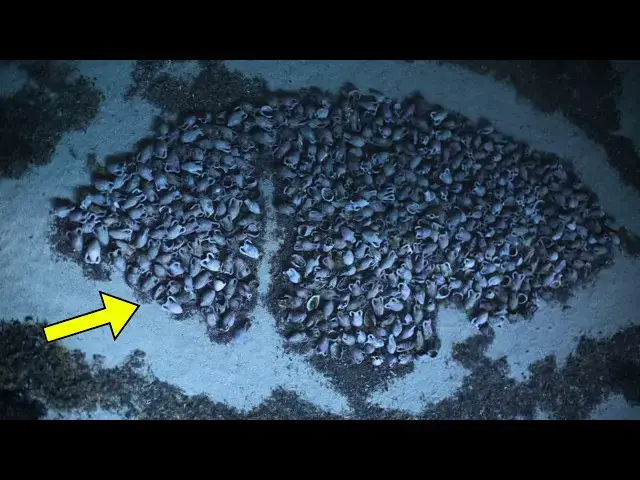
In June, police were conducting a routine patrol in the Ionian Sea when they discovered something strange on the sea floor and sent divers to investigate, officials said.
The divers reportedly found a large Roman merchant ship, possibly from the 4th century AD and believed to have sailed from North Africa.
#UnderwaterDiscovery #AncientRome #Shipwreck
Show More Show Less View Video Transcript
0:00
June 2025. Ionian Sea off Southern
0:03
Italy. [music]
0:03
A patrol boat was moving across the
0:05
water on what looked like an ordinary
0:07
day. No treasure hunt, no archaeological
0:10
expedition. [music] No one on board was
0:12
searching for a lost Roman ship. This
0:14
was just a routine maritime patrol by
0:17
Italy's Guardia di Finanza. But then the
0:19
equipment on the boat detected something
0:21
strange on the seafloor.
0:22
>> [music]
0:22
>> At first it was not a ship. It was not a
0:25
treasure. It was not even something the
0:27
officers could identify. [music] It was
0:29
just an anomaly, a shape on the bottom
0:31
of the sea where nothing should have
0:33
been. So they sent [music] divers down
0:35
to check it. And when the divers reached
0:37
the seabed, they realized this was not
0:39
[music] a rock. It was not modern
0:41
debris, and it was not an ordinary
0:42
wreck. Hidden under the sea was a Roman
0:45
merchant ship [music] still carrying its
0:47
cargo after almost 1,600 years. So how
0:51
did a routine patrol accidentally find a
0:53
Roman shipwreck? Why did officials keep
0:55
the discovery secret for months? And
0:57
what was still sitting [music] inside
0:59
the wreck after more than a thousand
1:01
years underwater? Let's get into it. The
1:04
discovery happened off the coast of
1:05
Puglia in Southern Italy in the waters
1:08
of the Ionian Sea. This part of the
1:10
Mediterranean looks peaceful from above.
1:13
Blue water, fishing boats, [music]
1:15
coastline, modern towns. But beneath the
1:18
surface it is also one of the oldest
1:20
highways in human history. For thousands
1:23
of years ships crossed these waters
1:25
carrying oil, wine, food, weapons,
1:28
pottery, and people. Greek ships, Roman
1:30
ships, merchant ships, military ships.
1:33
Some reached their ports, others
1:35
disappeared. And when a wooden ship sank
1:37
in the ancient world, it usually
1:39
vanished almost completely. The sea
1:41
broke it apart, sand covered it,
1:43
currents moved over it, centuries
1:46
passed, [music] and eventually the wreck
1:48
became part of the seabed. That is why
1:50
this discovery was so important. [music]
1:52
The officers were not looking for
1:54
archaeology. They were using modern
1:56
onboard equipment during a standard
1:58
patrol when something unusual appeared
2:00
below them, a signal, a shape, a
2:03
disturbance on the bottom. It was enough
2:05
to make them stop, [music] and that one
2:07
decision changed everything. Because
2:09
when the divers went down, they found
2:11
the remains of a large Roman merchant
2:13
vessel. The ship is believed [music] to
2:15
date to the late Roman period, possibly
2:18
around the 4th century AD. That means it
2:20
[music] may have sailed during a time
2:22
when the Roman world was changing fast.
2:24
The empire was under pressure, trade
2:26
routes were shifting, cities [music]
2:28
were changing, but the sea was still
2:29
moving goods across the Mediterranean,
2:32
and this ship was part of that world.
2:33
[music] It was not empty. That is the
2:35
detail that makes the story powerful.
2:37
The wreck was still [music] carrying
2:39
amphorae, ancient transport jars, the
2:41
kind used all over the Roman world to
2:43
move valuable goods by sea. To us, they
2:46
may look like old clay containers, but
2:48
to archaeologists, amphorae are like
2:50
labels from the ancient [music] world.
2:52
Their shape can reveal where they came
2:54
from. Their contents can show what
2:56
people were trading.
2:57
>> [music]
2:57
>> Their position in a wreck can show how a
2:59
ship was loaded, and sometimes they can
3:01
turn a pile of broken pottery into the
3:03
story of [music] an entire voyage. In
3:05
this case, officials said the amphorae
3:07
were likely used [music] to carry garum,
3:10
a fermented fish sauce that was famous
3:12
in ancient Rome. It sounds strange
3:14
today, but in the Roman world, garum was
3:16
everywhere. It was used as a condiment.
3:19
It was traded across the Mediterranean,
3:21
and it could be valuable enough to ship
3:23
in large quantities. So, this was not
3:25
just a lost boat. [music] It was a Roman
3:27
cargo ship, a working merchant vessel, a
3:29
piece of the ancient economy frozen at
3:31
the moment it sank. But the ship itself
3:34
may be just as important as the cargo.
3:36
Reports said parts of the hull appear to
3:38
have survived. That matters because wood
3:40
usually disappears underwater unless the
3:43
conditions protect it. If enough of the
3:45
structure remains, archaeologists may
3:47
learn how the vessel was built, how it
3:49
carried its cargo, and what kind of
3:51
journey it was making when it [music]
3:53
went down. And there is one more clue.
3:56
The ship may have sailed from North
3:57
Africa. [music]
3:58
If that is confirmed, the wreck could
4:00
help show how goods moved between North
4:02
Africa and Southern Italy
4:04
>> [music]
4:04
>> during the late Roman period. That makes
4:06
the discovery bigger than one ship. It
4:09
becomes a clue about trade, food, daily
4:11
life, [music] and the connections that
4:13
held the Roman world together.
4:15
But after the divers found it, officials
4:18
did something interesting. They did not
4:20
immediately announce the discovery.
4:21
[music]
4:22
For months, the location was kept
4:23
secret, and the reason was simple:
4:25
looters. Ancient shipwrecks can attract
4:28
thieves. A single amphora can be pulled
4:30
from the seabed and sold illegally. But
4:33
once objects are stolen from an
4:34
archaeological site, the damage is
4:36
[music] bigger than the object itself.
4:38
The context is destroyed. Where the jar
4:40
was found, how it was placed, what was
4:43
around it, what it could tell
4:45
researchers. All of that can be lost
4:47
forever. [music]
4:48
That is why the authorities kept the
4:49
site confidential. They wanted time to
4:52
protect it, [music] to monitor it, to
4:54
create a plan before the world knew it
4:56
was there. Because this was not just a
4:58
discovery, [music] it was a crime scene
5:00
of history, a place where every object
5:02
still had information locked inside
5:03
[music] it. Since the discovery, the
5:06
area has been watched by the Guardia di
5:08
Finanza. Officials also began planning a
5:10
careful investigation of the wreck, not
5:13
a quick treasure recovery, not people
5:15
grabbing objects from the seabed, a real
5:17
archaeological process,
5:18
>> [music]
5:19
>> surveying the site, documenting the
5:21
ship, creating a three-dimensional
5:23
model, studying the cargo,
5:24
>> [music]
5:25
>> planning how to recover and preserve
5:26
artifacts without destroying the
5:28
information they still hold. That is the
5:30
difference between finding something and
5:33
understanding [music]
5:34
it. The divers found the wreck, but the
5:36
real work begins after that. Because the
5:39
sea did not just hide the ship, it
5:41
protected part of its story. For almost
5:44
1,600 years, the cargo stayed under the
5:47
water. The ship remained out of sight.
5:49
Generations passed above it. Empires
5:52
fell. Modern Italy rose. Patrol boats
5:54
replaced [music] Roman ships. And still
5:56
on the seabed, the remains of that
5:58
merchant vessel waited [music]
6:00
until a routine patrol saw a strange
6:02
shape on a screen. Think about that. The
6:04
people on that boat were not searching
6:06
for Rome. They were not chasing a
6:08
legend. They were not following an
6:09
ancient map. They were doing their
6:11
normal job.
6:12
>> [music]
6:12
>> Then the equipment noticed something
6:14
strange. Divers went down and suddenly
6:17
the modern world was looking at a Roman
6:19
voyage that had ended more than a
6:20
thousand years ago. That is what makes
6:23
this story unforgettable. [music] Not
6:25
just the age of the ship. Not just the
6:27
amphorae. Not even the fact that it may
6:29
have carried [music] garum across the
6:31
Mediterranean. It is the way it was
6:33
found by accident [music]
6:34
during a routine patrol. Because
6:37
sometimes history does not appear where
6:38
people are looking for it. Sometimes it
6:41
appears as a small signal on a screen. A
6:43
shape on the seafloor. A question
6:45
[music] no one expected to ask. And then
6:47
divers go down and the sea gives back a
6:50
ship. For centuries this Roman vessel
6:52
was hidden [music] in silence. Its crew
6:54
was gone. Its journey was forgotten. Its
6:57
cargo stayed in the dark. But the ship
6:59
was still there. Waiting beneath the
7:01
water. A merchant vessel from a world
7:03
that once connected the Mediterranean by
7:05
sail, [music] trade, and empire. And now
7:07
because one patrol noticed something
7:09
strange,
7:10
>> [music]
7:10
>> archaeologists may be able to study a
7:12
voyage that ended 1,600 years ago. So
7:15
the next time [music] you look at the
7:16
sea, remember this. Beneath the surface
7:19
there may be more than sand and rock.
7:21
There may [music] be cargo. There may be
7:22
wrecks. There may be entire pieces of
7:25
history waiting for the right machine,
7:26
the right diver, and the right moment.
7:29
This one began as a routine [music]
7:30
patrol. It ended with a Roman shipwreck.
7:33
And somewhere under the Ionian Sea, the
7:35
exact location remains hidden. Because
7:38
what they found is still too valuable to
7:40
leave unprotected. [music]
7:41
If a routine patrol found this beneath
7:43
the water, what else do you think is
7:44
still waiting under the sea?
#Jobs & Education