Up next in 10



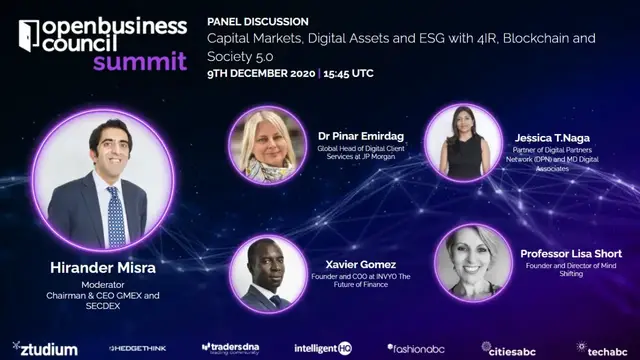
Panel Capital Markets, Digital Assets and ESG with 4IR, Blockchain and Society 5.0
Hirander Misra | Moderator | Chairman & CEO GMEX and SECDEX - https://www.gmex-group.com/
Dr Pinar Emirdag | Global Head of Digital Client Services at JP Morgan
Jessica T.Naga | Partner of Digital Partners Network (DPN) and MD Digital Associates - https://da.co.th/
Xavier Gomez | Founder and COO at INVYO - https://invyo.io/
Professor Lisa Short | Founder and Director of Mind Shifting - https://www.linkedin.com/in/lisagshort/
at openbusinesscouncil Summit #obcsummit
FULL PROGRAM https://openbusinesscouncil.org/summit/
JOIN THE CONVERSATION https://twitter.com/openbusinesshq
https://twitter.com/citiesabc__
Show More Show Less View Video Transcript
0:00
We are going to go
0:05
Yep. Hello, everybody. My name is Hiranda Misra. I'm the chairman and CEO of GMAX Group, a global trading technology firm in the exchange space
0:14
And it's my pleasure to moderate the panel on capital markets, digital assets and ESG with 4IR, the fourth industrial revolution, blockchain and society 5.0
0:24
We have some great panelists with us today, and we'll just get them to briefly introduce themselves and what they are doing in this space
0:34
And then we'll move into what will be a really exciting discussion. So, Jessica, over to you
0:40
Thank you very much, Hiranda, for having me today. So, I'm Jessica Naga
0:46
I'm a barrister. I specialize in fintech. I have co-founded the Digital Partners Network, and we provide fintech-focused financial services in the Pan-African region
1:04
I head law firm headquartered in Mauritius. I am the director of a hybrid exchange in the Seychelles, and I'm very happy to be here tonight
1:16
I mean, tonight for me might be early for some of you
1:20
I always say many jobs but one salary or not even a salary right
1:26
total entrepreneur total entrepreneur so welcome on board and Professor Peter Short over to you
1:33
in the early hours of that kind of outer Brisbane uh morning well not even morning yet
1:38
uh yeah it's morning it's actually nearly 3 a.m in the morning but my body is saying it's UK time
1:45
So that's okay. But, yeah, hi, everyone. My role is broadly a transformational strategist in the area
1:52
of digital technology and generally I'm just given a whiteboard to say solve this problem and generally it's one
1:58
of the world's greatest in that space. But I'm currently director and project lead for Africa Agritech
2:05
at the UK and another digital resilience company called P&L Digital Edge and Mindshifting
2:12
which is my initiative, which is to bring together education, physics and frontier technologies
2:17
So lots happening. Wonderful. Thank you, Lisa. And Pinar, over to you
2:23
Or Dr. Pinar Emirdag, should I say. Oh, wow. I haven't called you a doctor in a while, right
2:30
No, I don't hear that often at all. And thank you. Thank you for the opportunity
2:34
Really, I mean, such an interesting panel, actually. It's very global. I am very excited already
2:40
And hello from London. And so my name is Pinar Emirdag. I work at JP Morgan
2:46
I manage a team called Digital Client Service Team and within market operations
2:51
within our digital platform and services business. And what we are doing is everyday servicing our clients
2:59
but also at the same time building a digital organization altogether. So it's not only me or my team
3:06
and it's an interesting challenge. It's quite entrepreneurial as well. Thank you
3:11
Wonderful. Thank you, Pinar. And Xavier, over to you and the great work you're doing both practically and in terms of writing as well
3:19
Thank you for the invitation. It's a nice pleasure to participate in this great panel
3:24
My name is Xavier Gomez. I am the founder and chief operating officer of Invio
3:32
Invio is a market intelligence platform dedicated financial services
3:42
My company offers a SaaS solution that leverage proprietary big data ysis
3:49
natural language ysis, NLP technologies, to help financial institutions drive their digital transformation and strategy
3:58
In fact, we leverage the core of data contextualization by using advanced technology
4:03
to process and classify millions of unstructured data coming from anywhere, from video and text
4:14
Fascinating. And, you know, so we've got some interesting representation from the client service side, from the agritech side
4:21
and so impact to the legal and digital asset side, and then, you know, everything you're doing
4:27
in artificial intelligence. So between us all, I think we can cover
4:31
those broad topic areas. So diving into the first question, a long one
4:38
But, you know, starting with you, Lisa, I mean, the use of digital currencies and alternative forms of digital assets, we really see them propagate
4:47
But, you know, how are we going to see kind of smart contract driven cross border exchange between them
4:53
their exchange with other goods and services so that we can reduce costs and friction and increase efficiency in the wider market as well
5:02
Yeah, look, I think one of the things that's profound this time out of 2020 is exact areas
5:08
So, you know, a year ago, we were still in some ways hitting our head against a brick wall in terms of the uptake of the potentials of digital currencies and tokenised assets, particularly for the African market and emerging nations
5:23
and I think one of the things that you know it's just gobsmacked me is the fact that in 2020
5:31
African youth have become the greatest adopters of cryptocurrency against all the odds they have
5:41
you know 11.9 percent internet usage they have 600 million people that lack electricity and yet
5:48
still got the highest uptake of cryptocurrencies so that's telling you there's a demand in
5:53
the need. And I think it's also telling you, as you know, doing a lot of work in Africa in terms of some
5:59
of the challenges they have. So, you know, come September we have basically
6:05
the Africa Continental Free Trade Agreement virtually came into force. The challenge that we've still got is we've got 54 nations
6:13
in Africa that can't trade with each other, let alone trade with the rest of the world
6:19
And these digital currencies and tokenised assets have the potential to do that
6:23
Particularly when you look at, you know, the Akaui's, you know, organisations, 15, you know, central banks
6:31
15 nations of Africa, and for 20 years they've been trying to get a single currency in that space
6:38
And, you know, just to give you some definite examples, one of the businesses that's been established
6:44
and I've been working with since, you know, COVID-19, since March is a company called Peer Vision Learning.Global
6:52
and it's turning, it's taking education online for Africa but starting in Nigeria
6:59
The first challenge they had is they're using a UK tech company and they can't get payments to the UK without significant
7:06
you know, inflationary challenges and costs. If we had a seamless ability to have a means of transfer
7:15
from those nations to out either within Africa or to the UK
7:22
to Europe the cost savings are massive and we could unlock trillions of dollars in potential in those markets So you know I think it quite profound And 2020 a lot of things that have come out of 2020 is positive
7:37
and this is one of them, is the uptake of digital currencies and the ability for assets to be tokenised
7:44
particularly in the global trade and supply chain market in that space
7:51
No, very good point. And Jessica, given your extensive work with your kind of Pan-African law firm and also structuring and you're setting up structures on behalf of clients and you're heavily involved in the digital asset space now as well with the work that you're doing
8:08
What do you see as some of the key challenges there? And obviously, stablecoins and looking at exchange controls in different jurisdictions, it's something you've been looking at and seamless asset transfer
8:20
Is there any key observations given your day-to-day experience in this space
8:26
I think my point will be a practical one. I mean, the biggest problem that I currently see in my legal practice is banking for fintech and tech companies
8:37
To say the least, it is difficult and time-consuming to open bank accounts
8:43
And even when one has a bank account, especially on this side of the world, Africa, you know, where most local banks rely heavily on large European US correspondent banks, the ongoing due diligence requests are incredibly taxing
8:58
taxing. I have clients having to use the law firm to respond to queries from banks. And the cost
9:06
bank charges and stuff like this are prohibitively high on this side, because they're in dollars and
9:11
stuff like this. And it's very, very expensive. I mean, there is no doubt that cryptocurrencies
9:17
such as, I don't know, Bitcoin, USDT, etc, are challenging the current financial model
9:22
I am not surprised that there has been adoption on this side of the world
9:29
I mean, it has filled a gap for many of the unbanked with a smartphone and limited Internet connectivity
9:37
People can use cryptocurrencies to send and receive money in a fast, secure, relatively cheap way
9:43
so simplistically for me digital currencies will continue to be used extensively in Africa
9:53
and I'm hoping that we'll soon see a central bank digital currency
9:58
that will come in and help temper some of the negatives of a private one
10:05
I mean living I would hope to see both being allowed to coexist
10:10
I think in your question, you talked as well about digital assets, such as tokenized securities
10:18
I mean, it's great. They will move real time. And I think they will change a lot of things for SMEs, especially in Africa, trying to raise capital
10:30
They will allow multiple listings in multiple jurisdictions, access to different types of investors
10:36
So I think all in all, I'm looking at all of these changes very positively in a practical sense for my clients in the region
10:46
Thank you, Jessica. Some good insights. And Pinar, would you like to add anything to that as well
10:51
You know, I mean, obviously it's an area end to end client servicing standpoint that JP Morgan has been taking the lead on
10:59
And we've also seen a lot of interest with the banks into Africa from a digitalisation standpoint as well
11:05
You know, given the growth of M-PESA and now more recently, you know, more defined kind of digital asset plays as well
11:14
Okay. Let me actually set my domain very carefully because it's quite important
11:19
But I think they are connected. Or at least I can somehow find a way to connect them always
11:25
But so the area that I am focusing on is really like traditional markets, institutional markets as we know them
11:34
But there is a reason that I am quite excited about the digital client service as well
11:39
Because as you, I mean, so everything that is being talked about here is really moving towards the future, which already has been happening for a while
11:47
It's not really new. It's a new type of financial services where, you know, things move in a much more streamlined way
11:54
Data has a completely new meaning. And we manage our capital risk, all those topics in a much more, let's call it like more platform like way
12:03
and all those kinds of things are happening. The same goes for also clients as well, right
12:08
I mean, the society, the changes, the needs of the clients are becoming like really converging
12:14
And so, for example, even though my domain always have been more institutional markets
12:20
I mean, it's very clear that for a long time, the difference between institutional and retail are converging
12:27
or B2B or B2C are really beginning to converge. So what, so, and there are reasons
12:33
that right so um for me the the interest is when all of these things that everything is changing
12:40
uh clearly client services to changes but at least maybe even like we should have a concept
12:45
that's actually like much more digital and uh and and that's that's kind of the starting point
12:51
but in terms of the uh like b2b and b2c like the all these changing trends and why they're all quite
12:58
interesting um like if you think about this if our clients like just some very simple examples uh
13:06
the uh the clients in the institutional market used to be quite fragmented like decision makers
13:11
used to be very different than the uh people that we normally deal with day to day in in other parts
13:17
of the organizations right so within the clients uh side the decision makers and the clients are
13:23
connecting internally as well so your institutional uh clients are becoming much more like you know
13:30
they are converging to more like decision making is really like decision makers and these people
13:34
that we service every day are really becoming very much connected because of the same very similar
13:39
reasons and the products are also i mean uh already this is not we don't even need to go that far but
13:45
even with the more uh you know digital markets the advisory businesses the road like all the
13:50
all the things that used to have has been happening for a while, the products are becoming much more accessible
13:56
I mean, the asset managers are finding new distribution channels, and frankly, it can be digital or not, anything, really
14:04
And so that also means that as the clients are, the products are becoming more digital
14:10
there are, it's also like much more, it's connecting B2B to B2C much more
14:16
And then the thing that I am really very much focused on these days is
14:20
like, okay, so if we are doing this, we also need to be thinking about
14:23
digital way of thinking, like building services, which is very client-centric. Like we talk about client experience a lot, and we should be probably measuring client experience
14:34
in a way that is much more, you know, like using the techniques that are more used in retail space
14:41
And so like, how do we actually make more data-driven decisions? you know be much more
14:47
pointed around what we are doing with our clients are they like what the experience really is like
14:53
and then that should be the lead the core of everything we do building products and services and so forth so that is the lens I think that we are beginning to learn from the more B2C markets
15:06
What I am really wondering, frankly, is I'm sure that there are other things that we can teach other side as well
15:12
because I keep on hearing about the experience from all the tech firms and the retail experience
15:19
which is amazing, seriously, how they think. but I think we have very interesting things
15:23
and I'm really exploring, I don't know yet but in the B2B space that we have
15:28
we have done very very successfully so I think the combination could be
15:32
quite powerful and I think it's convergence simply A couple of fascinating points Yeah
15:39
Just a couple of things I wanted to pick on and I'll give you a chance Lisa
15:47
but just for Xavier that Pinar brought up You know, one is a convergence of B2B and B2C, and we're certainly seeing that
15:55
I mean, whether it's in the crypto space or more widely as well, because, you know, PayPal going into cryptocurrencies, you know, on the one hand, you've got DBS Bank in Singapore now launching digital asset exchange in custody
16:08
But, you know, Pinar raised a very interesting point, Xavier, on data driven decisions
16:12
and and you know certainly um you know you've had a lot of experience here and we know that you know
16:19
with anything whether it's smart contracts or whether it's um whether it's anything to do with
16:23
this trans um construct to measuring kpis other things data is key so you know it'd be interesting
16:29
to talk about some of the things that you're seeing in this area both in terms of what you're working on and more widely and then i know you know from that perspective then we'll hand back
16:38
to Lisa, because she's had a lot of experience now with something that she's working on, on the data side
16:44
with this very construct that's very financial inclusion orientated as well. Xavier, over to you on data, all things data
16:56
Yes, thank you for the question. We have, today, a big issue with the data
17:07
This is a bias of artificial intelligence. We have to tackle this problem
17:15
And to illustrate what I said, I'm pretty sure you see on the last days the issue with Timnit Jibru
17:28
She worked for Google. And Jibru is known for her work on algorithmic bias
17:35
especially in facial recognition technology. And then in 2018, she co-authored a paper
17:42
with Joy Goulal-Winney that showed the error in rates for identifying darker sky net people
17:50
were much higher than error rates. And just the example of a high-level woman
17:57
in artificial intelligence, in particular in data, with Google one of the best leaders of the world
18:07
just show you the big problem we have to tackle and the consequences of this paper
18:18
It's just a paper. She's the greatest specialist of the world. She has been fired because she just wrote the truth
18:32
what everybody knows in data. And can you imagine the impact in the financial sector
18:43
It's just huge. And today, the challenging is first, the conversion with artificial intelligence and the blockchain
18:59
Second, today we have a problem of bias with artificial intelligence, as you know
19:05
You have a lot of paper on that. Secondly, we have also an issue, but it's a question of times
19:12
with the development of blockchain in the economy and the concrete application in order to be mainstream
19:20
We plan this development, the real development, around 2025 or 2030. And if you want to see the combination of the both, in particular with a smart contract, we have to resolve and tackle the bias in artificial intelligence
19:43
And this is normal because today the coding of machine learning has been made by humans, and humans are not perfect
19:52
They are not a machine. And now, the second point, as I mentioned, is the blockchain
20:00
The blockchain is not very mainstream for people. We have to start with B2B, in particular in finance
20:09
We have a clear application on that, in particular in fraud, in custody, for the capital market
20:16
In trade finance, we see a lot of tests, in particular in JPMorgan, HSBC, Société Générale
20:25
It was a very successful test. And I think the first step will be between financial services before to have a concrete application to the citizen
20:41
And in particular, the first step will be tackle the fraud. yeah and actually Lisa you know obviously you want to comment on some of the points that Pinar was
20:50
making and also you know just to touch upon a point please comment on that Xavier raises I mean
20:55
obviously everyone speaks about AI but he's absolutely right it's only as good as the data
21:00
that drives it and it can be otherwise it can be a case of garbage in garbage out right and you know
21:05
and again with some of the work that you're doing I know the data challenge is central to a lot of
21:11
your thoughts as well. So would you like to comment on that and anything else that our panellists have read
21:17
Yeah, absolutely. Actually, it's interesting. When I was doing some research and things that I wanted to do
21:21
for today, you know, I literally, same thing, garbage in, garbage out. The data alone is just code unless it has value to its end user
21:28
and unless we put the right information in to give the right answer out the other end, then it's valueless
21:34
And you're absolutely right, Xavier, we can instrumentally put bias in and we actually are
21:40
and that's also impacting women globally. So that's a huge issue. But one point I just wanted to mention about PINAR
21:46
and I think this is important in this conversation, is really it's heading towards ecosystems
21:52
is that one thing that I know that Haranda and I are very keen on
21:56
is that digital currencies and blockchain and cryptocurrencies and tokenising assets is not segregating and saying
22:03
that the mainstream banking market shouldn't exist. And I think you hit the nail on the head in the sense
22:07
that customer services have to improve. that has to become customer-centric. So one of the things that we've focused on, for example
22:14
in our work in Africa is that, yes, we can put in seamless methods
22:18
and processes of exchange so that we can get people that are using multiple currencies to transfer using tokenised assets and custodial services and so forth But when they get back into their own home country whether it be Nigeria and they using Naira or South Africa and RAND or the UK and GDP they still going to engage
22:37
in the mainstream market and they're still going to engage with banks. What we have to do is connect that ecosystem in a seamless way
22:44
And one of the things that I think, the other thing that I think that is profound when we're talking
22:48
about countries like Africa and England, for example, Nigeria alone spends $5.1 billion printing money
22:57
Now, that's a lot of money that's wasted printing physical money when we don't need to
23:02
That money could go into customer services to create great experiences for an economy that's a cash economy and a feature phone economy
23:11
So that money could be being driven through the banking system that's currently not
23:16
And so that's the ecosystem that we're playing in. To move to Xavier's point about data, look, it's profound
23:25
So one of the projects I know that Heranda's done is a project in Agritech in Malawi and what they found was that they could deliver
23:33
some amazing services, increased productivity, farm production, growth in economy for those farmers and revenue by 32%
23:42
The minute they got to that point, it stopped, it stagnated. And one of the reasons it stagnated is that there was no ability
23:49
for the women farmholders to make an autonomous decision based on biased data subsets that were available
23:56
and we're still feeding those data subsets into AI. So the challenge that we've focused on in the last six to ten months
24:04
and we've just lodged a patent for is to actually take data ingestion
24:09
at edge, don't, and of course we're also challenged with 30 power compliance because blockchains aren't particularly nice
24:16
and don't play friendly with our clients allegedly. We've said what if we do something different
24:24
What if we take that data adage, we ingest it, we turn it into a smart metric that a smart protocol
24:32
a smart contract can use but there's no actual data on the blockchain, it's just a metric
24:39
To do that it means that we have to go to all the stakeholders, We have to go to the mainstream banks
24:44
We have to go to the trade finance companies. We have to go to those who are in the ecosystem and say
24:50
what data is it that you want? How do we actually produce the answers, the metrics
24:57
the actual quality answers that you need for an autonomous, unbiased decision to be made in a trustless environment
25:07
For us, that means for women, particularly women farmholders on the African continent, which, by the way
25:13
is 80% of the agricultural sector. If we can do that, we can create an unbiased
25:21
autonomous decision with no actual data on a blockchain, only the metric and the metrics are agreed
25:28
before we actually start the process. It means for the first time we can have women having decisions
25:35
about credit, about land ownership and those sorts of assets for the first time without bias
25:42
But it does come to the end points of our data and the ecosystem in which we're playing
25:49
And that's a critical point we're in. And so it's an exciting time
25:53
2021 is just going to be amazing. We're really wanting to challenge that space
25:59
Really interesting. And, you know, what I would say is that there's more women
26:03
on this panel than males, so you can afford to be biased in that regard as well, you know
26:07
but but but um you know you you raise a couple of points and just to touch upon what jessica raised
26:13
earlier you're effectively saying and there's a lot of naivety because you've got the world of
26:18
digital assets on the one hand and you've got traditional finance um you know on the other hand
26:22
that's been around for hundreds of thousands of years as well you know uh and and you know some
26:29
of those decentralized finance guys kind of ignore the fact that you do need traditional rails and
26:34
traditional financial markets. So again, personally, I see the world being hybrid
26:39
where the old world and new world have to coexist, albeit, you know, we're seeing more
26:44
fragmentation in many ways that we've got to knit together, given multiple blockchains and
26:47
multiple legacy networks as well. You know, Jessica, you know, you raise the point that
26:52
you're involved in a hybrid exchange project, you know, obviously, that we've looked at in the
26:57
Seychelles. And then from a legal standpoint, obviously, we know that there's no global standards
27:02
around legal and compliance as far as digital assets are concerned. There's lots of debate
27:07
and obviously there's common standards around FATF and the like around KYCML
27:14
But what are you seeing here and what are some of the positive changes
27:18
happening in terms of how we make that kind of cross-border movement
27:23
of those assets and cross-border investment more seamless from a digital asset standpoint
27:29
So I know you're doing a lot of work in that regard, especially with kind of hybrid constructs
27:35
Yes, I mean, I, as a lawyer, I don't really believe in aligning jurisdiction
27:47
regulatory frameworks in multiple jurisdictions as a starting point. I would, what I think works better is allowing both systems to coexist. So not to wait for a
28:03
change of law to start doing something, but to let both of them coexist until you have a critical mass
28:09
where people see the real benefits of the new system and it just takes over. And then in the
28:16
meantime, you would have tried and tested a lot of things, seen a lot of things that you need to
28:21
tweak. And then it's organic and it's more sustainable. And this is exactly what happened
28:29
on something as simple as posts and emails for me. And this is what I think would be the best way
28:36
for the changes to happen. I believe ahead of cross-jurisdictional kind of legislative or
28:47
regulatory framework alignment, hybrid or digital exchange will look at working together
28:54
by aligning listing rules, for example, which is easier while working within existing domestic
29:02
legal frameworks. And then once the benefits are felt of lower cost, easier to raise capital
29:08
easier to move tokens around, it will be natural that we will see regional alignments
29:14
I'm seeing regional alignments already in a couple of African countries where the regulators that I work with are already talking to each other
29:23
So I'm very positive that we will see changes in the near future
29:29
But on the other hand, on a practical level, I quite like the differences between domestic regulatory frameworks, because I think it's not all negative
29:40
It allows when you do multiple listings of tokenized assets, for example, for investors to play on the differentials
29:49
And this can encourage arbitrage and cause assets to be more liquid
29:55
So I'm talking more on a practical basis here. And I think it
29:59
we might see positives based on the difference in the laws and regulations of the different jurisdictions
30:08
And Pernod, this is a really interesting point because, you know, you're running a global team
30:13
You know, a LinkedIn advert popped up on my LinkedIn recently and you're hiring in Jersey as well
30:18
You know, I'm not applying for the job, you know, and so, but, you know, you're running a global organization across all time zones
30:26
I don't know when you sleep, but Lisa certainly doesn't. But we know that client service, especially on the B2B side, to a large extent, hasn't been as automated in the past as it should be
30:39
On the retail side, you've kind of been forced to on fintech because it's a numbers game and there are so many clients you're servicing
30:47
But my experience of working in the B2B side within financial markets, there's lots and lots of systems and it's very difficult for them to talk to each other
30:56
So what's some of the work that you're doing there? because obviously those metrics and data across multiple systems
31:02
harmonizing those, and we know that obviously open banking, as much as we'd like it to be a reality
31:07
dealing with those legacy challenges as an issue and even managing documents and the way that we deal with clients
31:14
Obviously, COVID, have you found challenges there and how you're addressing them? And given the pandemic now, I guess you've been forced to
31:21
and it'd be interesting to hear how that's accelerated some of those initiatives as well. Yeah, okay. So next question will be about word piece or something
31:32
Critical. Okay. So let me try to explain some of them, right
31:38
Thank you for the, by the way, plug for hiring. I'm really looking for good people and thank you. That's great
31:44
And so it is indeed, you know, it's an interesting challenge. And let me explain to you how we are thinking about it
31:54
So first of all, there are three things, right? we have this team that already is actually servicing clients
32:01
So that's actually an incredible, interesting advantage because I think that always these kind of things are
32:07
the important thing is understanding what happens day to day and what do people really, really think about, talk about
32:15
And it's not only day to day, like in which day, in which time of the year and all that kind of
32:20
we're triggered with which kind, what kind of events. And the knowledge and the expertise of the team is just remarkable, right
32:28
So that's an amazing place to start with. And then idea then is to, like, how do you actually transform and build
32:35
And so that's all digital side of things. So we kind of think about digital as four components because there are many
32:45
I mean, it's very, I know, no brainer for you, but it's actually important to anchor some of the thinking
32:50
So it's data, intelligence, which is the type of topics that we are talking about are actually quite important
32:56
And all that we do with data, all the insights and so forth. And of course, the platforms and people
33:02
People are really, really very, very important. Like when people talk about digital, I think it depends on who you talk to
33:09
But it's very possible that you may be missing the people side. But I think that it's actually the rep about around everything
33:17
And so then you start, you know, doing the typical thing. We just kind of try to unpack the areas of, you know, which data, which metric, which platform
33:26
And you start from the things that you have access and identify the things that you really need to build
33:32
And it's a journey. So it's like it's the type of maybe maybe to give you a little bit more concrete results
33:39
There are certain things that are foundational and around the type of data that you need to have
33:44
Like, who are you talking to? all those kind of things right and uh and uh but there are also things that are uh that we can uh
33:51
that are uh so we can we can actually the things that are not foundational they can we can you know
33:56
work on them later and then what you try to do is uh we start also like it's a culture change as
34:02
well right so we have like we have been working with the ai teams uh data science teams uh uh in
34:08
this journey and uh and uh and then um and also it's about training it's also about uh you know
34:15
know everybody like the individuals feeling empowered to be part of this journey like there
34:20
are things around like also like be more data savvy uh points around the ai and bias i think
34:27
that it will be it's very much connected to people actually knowing all these issues like
34:31
these topics as well so it's really like teaching so there are a number of things it's that
34:36
that's a lot of things that needs to come together i am not claiming that i know all the
34:42
routes. But it's a journey, right? But yes, we are going east
34:49
Someone's going to be arrested, I think. I can hear a siren in the background. Yeah
34:53
But Xavier, a couple of points there that are very, very interesting. Because I know you cited
34:57
the Google example previously. And we know that organizations like Google and Amazon
35:03
as part of client service, and also to propagate what they're doing on the sales side
35:08
I mean, they're increasingly using a lot of these tools and getting smarter at it
35:14
Obviously, we've been trying to catch up from a financial services standpoint
35:18
And of course, there's always, you know, Pinar and I have seen this with our numerous years in capital markets
35:25
And we see it today as well in some quarters. You know, I was on a call recently where the electronic business and the voice business are clashing with each other, even though it's mutually beneficial for them to work together
35:36
So everyone talks about, well, actually, you'll lose jobs and people will be out of roles
35:43
But really, I personally see those roles being redefined so that those jobs become better and just a different kind of job and more opportunity created
35:52
So for you, how do you see, Pinar mentioned data intelligence and people fitting together
35:58
What are your observations there in that respect? And also, you know, today, obviously, the large corporations have been utilizing their technological assets and advancing them to use the data
36:12
And I see some in society, I'm not saying especially my view, you have cited that there's too much control of the data with these organizations and they're becoming bigger with more control
36:21
How do we balance that for Society 5.0 so that we can all benefit from it as well
36:26
So a couple of angles there that, you know, that your ytics data and AI experience could lend itself to
36:33
First of all, on my proposition, I speak with a lot of banks, tier one level in Europe today
36:44
And the biggest problems as a bank today is the organization of their own data inside the company
36:55
Because every day, every action of a relationship manager, bankers, clerks, creates data
37:02
with interaction with a customer. And in fact, before to use external data
37:08
they have to organize the data inside the company. And this is a big challenge
37:13
Of course, you have the good player and the bad player. And you can see on the organization of each bank
37:23
the action taken when you see a function of chief data Officer Okay it a little bit buzzword marketing but it shows you the direction
37:35
and what kind of power this Chief Data Officer has, first of all
37:42
One, to realize, organize the data inside the company, and after, create a partnership in order to move forward
37:52
with some key fintech on different areas. And what I can share with you
38:00
it's a different trend I see at the moment, in particular in investment banking
38:07
I see a lot of cash in terms of investment in blockchain
38:12
blockchain and big data. Clearly, blockchain and big data are two technologies in full swing
38:17
but they are also two complementary technologies. And according to a lot of consulting firms
38:28
brands adopting burgeoning blockchain technology will benefit the most and banks will be able to reduce fraudulent activities
38:39
phishing attacks, ensure secure payments. One of the other things that fintech can support banks, fintech need to bring their attention to this artificial intelligence, machine learning and data ytics
38:56
And as a whole, this can help banks in addressing their key challenge like cost reduction and scrutinize risky transactions
39:05
transaction clearly this will help banks to get a better hold on their offering reduce fraud
39:16
automated trading process ensure secure payment processing and so on the other thing
39:26
fintech need to bring their attention more closely to this data ytics ai and machine learning
39:33
Because clearly, this is the pain point for the bank. This is the reason why I talk about a partnership, a collaboration between banks and fintech
39:42
And as you know, AI is already helping many address the key pressure print, reduce cost and monitor risk on transaction
39:52
and clearly according to autonomous consulting firms, a financial research firm
40:04
AI is projected to reduce operating costs by 20% around 2030. For the bank at the moment, it's just huge
40:14
Because as you know, the bank has a lot of pressure with negative interest rate
40:20
raising of request regulation, regulatory, with MIFI2, FATCA, Solvency2
40:30
all these nice things. I decided to leave as a banker to create my own company
40:40
But I'm sure Jessica makes money on that. Oh, she loves the word FATCA
40:46
Oh, I love it. All of it, everything you said, right? This is the reason why I decided to jump on innovation
40:57
And yes, it's a big, it's clearly a big challenge. And of course, I'm pretty sure a financial institution
41:08
financial services will succeed to transform themselves with the help of FinTech
41:16
And I see one concept I learned in MIT, in Boston. This is a cooptition
41:24
On one side, you will get a clear competition between fintech and banks and some financial services
41:36
And on the other side, you will get collaboration, the cooptition concept
41:41
and at the end of the day I strongly believe the financial institutions such as
41:47
HSBC, JP Morgan and so on will succeed if they take the time and put the money on the table
41:54
to turn from themselves with the support of this kind of company, in particular on
42:00
blockchain because blockchain will open a lot of new business revenue for the bank if they are
42:09
opportunist, clearly. But Pinar now will send an email to her fintech strategic investment side, obviously
42:18
Only joking. Lisa, that raises a couple of interesting points as well
42:23
Thinking because obviously doing a lot of work, you know, that's aligned to the UN sustainable development goals
42:28
And everyone talks about, you know, fintech for good. But we know that, you know, with Society 5.0, you've got things like health care, financial inclusion
42:37
You know, you spoke about women's empowerment as well. But, you know, even simple things, you know, when you spoke about the agri-tech projects, when farmers' incomes went up, you know, we saw that they could afford more
42:48
So the standard of living went up and in turn children's nutrition went up because they could eat better as well
42:54
So, you know, with all these things in mind, you know, how can we, and, you know, with that, you know, the use of technology as well, you know, a lot of these people are on banks
43:03
So how do we create an Internet of people rather than an Internet of things that genuinely empowers people and increases their incomes
43:12
Because, you know, there's a lot of buzzwords, there's a lot of initiatives that are announced, but, you know, I don't always see them flying through in Africa
43:20
And, you know, that's the importance, I guess, now in the next phase of our journey. Oh, look, I often use this word, I mean, blockchain
43:30
It's not spelt too hard and it's not spelt Bitcoin. and I think we need to decouple those and I think it's without a doubt
43:37
it's a foundational technology like the internet but I think we've actually had a philosophical shift
43:45
and I think this is where it really leads so well into, you know
43:50
an internet of people. We've gone really from internet of things which is, you know
43:55
how do we connect? Yes, we've connected the virtual and the physical world without a doubt
44:00
but blockchain has now taken us to a space of what do we value so a lot of my research that
44:08
I've been doing particularly in the African space is is really around the philosophy of blockchain
44:13
it's not about how it works not about the technologies what does it mean what does trust
44:17
mean what does trust less mean what is the philosophy of blockchain you know what's its
44:21
axiology its epistemology all of those things because it's changing our behavior and the way
44:27
we think and the way we invest and so forth. And I regularly give this example because it's a very tangible example
44:34
to people who don't understand the potentials of blockchain to connect to fintech, to connect to being banked
44:42
We've got 2 billion people in the world who are still unbanked and not connected. So one of the things that is extraordinary, and if blockchain did nothing
44:51
else other than this it still profound it can and has the potential to give people an identity a self digital identity If they get an identity for the first time they can be banked they can actually connect to the traditional banking system
45:07
That can take, for example, a fragment of Africa and connect it for the first time
45:13
So it's an engine of inclusion and it can take those unbanked people
45:18
for the first time to give them an education because without a bank, a bank account, without banking, guess what
45:23
You can't get an education either. So to understand the potentials of blockchain, fintech
45:29
and all of the things that we're talking about, the internet things, is actually a mute point
45:33
unless you can get an education. So with an identity, you can get banked
45:38
You can get banked. You can get an education. And we can turn fragmented into thinkers and doers
45:45
and an engine of inclusion. So one of the extraordinary things that this technology has
45:51
is that capacity. but I do want to say it is powered by data as well
45:56
and I'm going to throw this word in and everybody knows that I very rarely have a conversation about anything
46:02
to do with blockchain unless I say education because unless we can have a national and international strategy
46:08
from the top down bottom up on what the potentials of blockchain are, we will not truly advance its potentials
46:16
So education has to be actually key in this conversation, every single layer
46:22
We've got decision-makers and elected decision-makers making fundamental decisions around the uses
46:29
of this technology out of fear, driven fear of legacy issues. And as Zavia said, you know, unless we start to work together
46:39
and understand this, we can't actually, you know, adopt its credentials for agri-tech, for financial inclusion
46:46
for global trade, for, you know, all of those sorts of things. So we've moved to what do we value
46:53
And really, blockchain, it's about trust. That's the thing that we value the most
46:58
We've gone from connectedness to valuing trust, and we need to educate decision makers on that at a huge level
47:05
So, you know, we've got financial institutions who are still reeling in fear and coiling back and pushing back rather than saying
47:14
how do we overcome some of the challenges? edgpr and data and blockchain is it doable absolutely it is but we need to educate on that
47:22
space it's a very good point because on one of our initiatives um we have a gentleman called
47:27
steve brown who was former former chairman of the big issue but uh you know he founded the change
47:32
account in the uk but he also saw the problem of providing bank accounts for homeless people
47:37
in the uk who didn't have an address because you know some of the challenges being cited in africa
47:41
yes, but there's no house number 167 or anything like that or a postcode, right
47:47
But these are some of the problems we've actually solved for different reasons in the West as well
47:52
And now the technology is far more advanced for us to lend itself to some of these in Africa
47:58
You and I have spoken about geomapping and some of the other aspects with that as well
48:05
Now, just throwing a couple of questions out to the wider panel
48:11
So, you know, again, there's so many different technologies out there. I mean, this is a really exciting time, you know, because, you know, we've spoken about Internet of Things, AI blockchain, you know, quantum computing
48:24
You know, there's going to be more and more technology convergence. And it'd be good to get the panel's views, you know, as we head into the last 10 minutes about what the key trends are that you see for 2021
48:36
you know and again there's areas of agritech that you know lisa you're involved in regtech
48:43
legal tech jessica and then you know fintech with xavier and you know fintech client service more
48:49
broadly pin art so jessica over to you i know you've got a lot of work on the regtech side and
48:55
legal tech side and and to me actually the legal profession is in need of change you know no
49:01
disrespect to the legal profession you know you mentioned email uh you mentioned email and now
49:07
we've gone to instant messaging and you know before that there was paper but when you talk
49:10
about legal contracts it's almost like yes you know send send us send us the email um and then
49:16
we'll look at the agreement and then you know we'll wait for the paper agreement before we action
49:20
anything else and change control the nightmare right so to me someone can someone can really
49:25
empower this and make a lot of money at the same time. Maybe it's you. I think we should mix
49:31
everything. I think the complex legal transactions, you still need the lawyers involved because there
49:39
are risks. But at the lower end of the more simple one, just like you have a lot of people unbanked
49:48
there are many, many people who cannot access legal advice and they think some transactions
49:52
are very small and they rent their house, they sell a car, their little things, but they can
50:00
hugely affect your life. You can keep a tenant for a year and can't get rid of him. So I have
50:08
worked a long time in London and I came into Africa having a different training and a different
50:14
exposure and saw a different world. And I really wanted to do things differently. So I think legal
50:20
tech is amazing. So we are currently creating a little legal tech company to address basics
50:29
contracts, very, very cheap, but will give access to a lot of people in Africa to this
50:36
So for selling your car, for renting your house, for having a nanny. I mean, I've got a lot of kids
50:41
and I know it's very hard. These are things that stresses women out. And then on the other side
50:48
there is reg tech, which I'm very passionate about. I think financial services regulated is much
50:56
better. But the problem is, it's a nightmare to get licenses. It's expensive, it's time consuming
51:03
it's complex. So a lot of people who would want to get licenses don't do it, because of the
51:10
complexity, when it could actually, you know, multiply their business by 10, in terms of
51:15
valuation, they just don't do it. So I think reg tech and legal tech, if adopted, and I'm always
51:25
into doing small, trying, and it works, and it's like self-promotion of the product. So I'm more
51:34
for this kind of implementation of new technology. I think it will democratize access to these
51:44
very necessary services to a wider base. So that's my bet on it
51:54
No, very, very interesting. And, you know, Pinar, from your perspective, given some of the great work that you're now doing
52:02
leading on from what you've done, you know, key trends in 2021, if you had a crystal ball
52:07
you know, I don't know where this year is. I guess it's gone in a lockdown fashion for us. Jessica's lucky and gracious
52:14
He's very jealous about that. Okay so not sure there are lots of key trends I can say but there are two things One of them is actually I realized that I didn answer the second part of your question but it might be connected to the COVID side You know the COVID experience is actually like how am I going to connect this to this topic
52:40
It's innovative people-driven business. I mean, we have seen how resilient people can be
52:47
I mean, without dropping the client service day to day, literally making, finding a way
52:51
They change that, you know, changing the, passing the work to each other and organizing their time
52:56
It's just amazing what I have seen in last, I don't know, like last year, honestly
53:01
But the important thing there is the resilience comes with, the combination is very powerful
53:07
So not complete the full tech or full people. Tech plus people actually is a quite interesting combination
53:15
So I think resilience is like, to me, it's quite important to really think about
53:21
how do we make technology more useful for people to build like further resilience
53:27
as opposed to like making complete everything machine driven or other way around as well, right
53:32
So I think that's something to take on. The other one is, yeah, I mean, I'm quite interested in like digital client service
53:38
and client centric work. And I think it's actually quite foundational for everyone
53:44
frankly, not only like also fintechs as well, Because being an entrepreneur is kind of hard at the beginning to be too thoughtful about all the journeys and everything else because you just kind of go at it
53:56
And so maybe this whole client service topic could be something interesting to dig deeper
54:01
No, it's interesting. One observation for me, when the lawyers and the bankers say they're also interested in social impact and making a little less money in the short term
54:10
I know we're heading towards society 5.0 in some way, shape or form, which leads us nicely to you, Xavier
54:18
You're at the forefront of some really interesting initiatives and you write about them regularly
54:26
And looking forward to 2021, in your world, you come from the financial services side now into what you're doing and you're using data to drive it
54:35
What do you see as key trends? Where should JP Morgan and others be investing
54:44
Yes, more or less, I see with the algorithm five trends shaping the futures of financial industry
54:57
First of all, it's invisible payments. Invisible payments, as you know, takes a physical payment method such as cash, debit and credit cards
55:07
completely out of the equation, creating a convenient and speedy experience. The demand of cashless transactions in this pandemic
55:15
its economy is expected to create more opportunities for digital wallet operators
55:23
The transactions that are digitally linked will not just help to boost transactions
55:30
but will also help the industry in collecting data. This data can then be used to offer new services, so creating new revenue streams, providing unbuildable offers and building cost-effective setup for business to grow
55:49
The second point will be communication and consumer education. as more and more customers get on digital board
55:59
fintechs will have to focus on building trust and consumer engagement this is the same for banks
56:07
especially given the time when cyber security is extremely vulnerable to be critical
56:15
and stay ahead of the competition than other fintechs brands it is necessary to focus on the security
56:23
along with making the procedure simple for consumers. Communication is one of the major key ways
56:30
to drive engagement with customers. And while the digital payment process might not be new for some segment of consumers
56:40
it is entirely a new process for another segment of people. So it becomes the brand's responsibility
56:49
to build transparency in communication and make the consumer aware of all the activities in a simple way
56:57
so they can understand fraudulent activity beforehand. The third is one platform for multiple services
57:08
One thing a consumer prefers the most will be multiple services across one platform
57:15
And the big example is WeChat in China. clearly you have one app and you can make
57:26
shopping, you can make a saving you can lend money, you can
57:30
transfer money and you can chat with your best friend you can book a restaurant
57:36
this is a perfect example, one platform multiple services many tech brands
57:44
have already rolled out this process of offering multiple services across one app
57:52
but the increase in offering of robust solutions through powerful API integration will add on
57:58
In coming months, consumers who need banking services are likely to turn to those financial players
58:05
who can offer convenience and ease of transactions that is entirely safe and secure
58:13
David, just another thing, and the final two trends, because i know we've got two minutes left and i just want to get lisa's view on this oh yeah
58:20
and and to finish and i'm i'm strongly uh support what jessica said about the regulation
58:29
uh clearly regulation in the financial services and for um the uh the other um um sectors
58:39
impacted by the technology will be very important regulation in data and so on
58:49
And what I believe, just to finish, I believe on two countries with a big adoption of fintech solution
59:00
and digital transformation, this is a more or less emerging market. This is China and India
59:07
Great. So over to you, Lisa, on predictions for next year and then the two countries that you're placing your bat on
59:16
Yeah, I'm placing mine on Nigeria and Japan and UK because UK's got a huge opportunity post-Brexit
59:24
I think, being the nexus of technology. But I think one of the things that I'm going to pick up on
59:27
is I'm renowned globally for being the connector. So everything that you've all said is absolutely 100% on target
59:35
and I think something that Zavia just said a minute ago is one platform
59:39
There has to be an ability to connect all the different technology systems
59:43
that we have, and that's where the work that I'm working on is basically trust as a service but also risk as a service
59:51
because nearly everything that we're talking about at some point is connected to risk
59:55
Somebody making an assessment of an unwanted outcome to occur risk and that's where blockchain technology has an incredible capacity
1:00:04
So that connects reg tech, it connects fintech, it connects ed tech, it connects financial services and so forth
1:00:10
So I think that's my prediction is designed ecosystem thinking that's going to bring all this together
1:00:17
And I can use just one very quick example out of the UK from working at the moment is digitising high streets
1:00:23
If we can for the first time connect high streets in one centralised platform we can actually profoundly
1:00:30
have them grow as a collective group. And I think globally that's where we are heading in that space
1:00:36
I say Africa, I say Japan, because Japan is the most ultra-aged nation in the world and I think they have
1:00:42
the greatest benefit to gain from society moving forward into the internet of people
1:00:48
So just finally your two predictions, Jessica, and then over to Pinar on which nations will embrace
1:00:55
Society 5.0. the fastest or most successfully? So my reasoned one would be China
1:01:02
My dream one would be Mauritius. So I said a dream one
1:01:12
You know, it's a small country. It can be, you know, do what Singapore has done
1:01:16
If it implements the right rules, you don't need very much, but to implement
1:01:21
the technology is out there. You need to choose the ones that are working
1:01:25
and implement them And I hopeful that things can happen fast here And last but not least we got China on too two points it like the Eurovision
1:01:39
Song Contest, but outside of Europe. Yeah, I will just leave it there. I do think that entrepreneurs, where you have more entrepreneurs
1:01:52
and creative thinkers and plus like solid infrastructure and knowing the rules of the game or not
1:01:59
This is, I mean, infrastructure, I think, and creativity is a good combination
1:02:03
Yeah, you see, Pinar is very diplomatic. Yeah, well, I just realized that
1:02:07
Her role is global. She had to keep many countries and people in many societies happy, right
1:02:12
Despite J.P. Morgan being a U.S. bank. But it's been a wonderful panel
1:02:16
You know, I'd like to thank you all. It'll be amazing to do this face-to-face as well
1:02:22
But, you know, it's great that having you all on board and, you know, look forward to following up with you all individually on the great projects and great work that you're all doing
1:02:32
And thank you all for participating as well. Thank you. Thank you. Thanks
1:02:38
Thanks, Rhonda. Bye. Bye. Bye. Bye. Bye. We're out
1:02:48
we're still on air i think but you can leave the studio as well so yeah
#Business Finance
#Consulting
#Finance
#Banking
#Currencies & Foreign Exchange
#Investment Banking
#Mobile Payments & Digital Wallets
#Socially Responsible Investing