Up next in 10


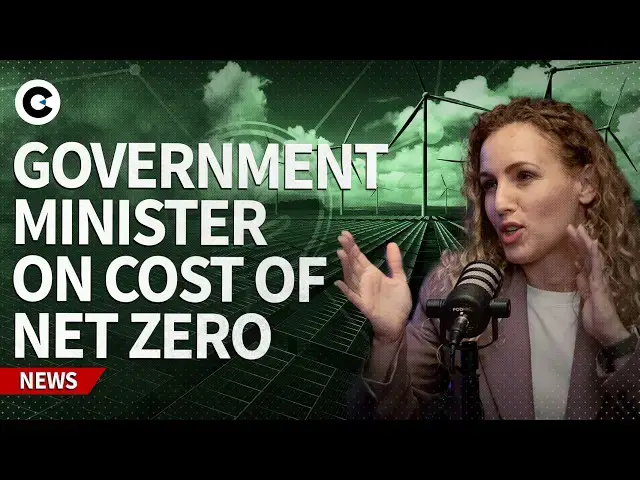
Climate Minister, Katie White spoke to Christian May about the cost of Net Zero, and who will pay for Britain's transition to electrification.
They also covered the cost of heat pumps and whether the 2030 target is still realistic.
Get more of City AM 👇
🌐 http://www.cityam.com
X(formerly Twitter): http://twitter.com/CityAM
Facebook: http://www.facebook.com/cityam
Instagram: http://www.instagram.com/city_am
LinkedIn: http://www.linkedin.com/company/cityam
Show More Show Less View Video Transcript
0:00
The government has published its latest carbon budget, looking ahead to a period some way from now, about 15 years into the future, promising an 87% emissions reduction
0:10
So how are we going to get there? What's it going to cost? What are the upsides? And is it indeed the right thing to be pursuing
0:16
Well, I'm joined by climate change minister Katie White to discuss all of this. Minister, thanks for coming in to City AM
0:22
Thank you for having me. So, carbon budget number seven. Number seven
0:26
seventh of its kind. This all began, did it not, with the 2008 Climate Change Act. And then
0:32
obviously, the whole shebang was put into law under Theresa May to achieve net zero by 2050
0:38
And the carbon budget is about a reduction in emissions over set periods. So we're now talking
0:43
about an 87% emission reduction for the period 2038 to 2042. Families and businesses will continue
0:53
to reap the benefits of this transition is a line from the announcement today. Families and
0:58
businesses will also bear the costs of this, won't they? Let's just take it back a step because you
1:03
just gave a hefty introduction. But I just want to take us back because you're right that in 2008
1:09
we introduced climate change. It was made legal in 2008. So it became legally binding in 2008
1:16
What Theresa May did a few years later was to tweak the end target. But the principle and the
1:21
concept is really important because what we were saying was look we have a long-term challenge in
1:26
this country across the world as well but how do we meet that challenge and we wanted to make sure
1:31
we got a lot of investment I'm looking at you but yeah as the representative of the city is going to
1:35
be one of our key areas of investment and how do we do that and we said we what we're going to do
1:39
is you know businesses are always coming to us saying we want certainty so we looked at and
1:43
actually it was an idea that came from David Cameron but was implemented by the last Labour
1:49
government and said we're going to look at having budgets over time we're going to set a trajectory
1:53
and it would set that level of ambition without a straitjacket that was really important because
1:59
we weren't saying you know you can't have this technology or that technology and so actually at
2:03
the time it was digby jones of the cbi if you remember digby jones he was also because he was
2:09
massively pro-nuclear and there was no nuclear power so he was very out of fashion and he was
2:14
saying we want nuclear power to you know for future generations so it was around we wanted
2:18
those long-term investments how could we say that where whichever government was in power we would
2:23
have that so since tooth and out with 2008 we have been working on this and you say with today
2:28
we've introduced the seventh that we're putting down in parliament the seventh carbon budget but
2:33
over time we are already we're in carbon budget four at the moment so we've already delivered on
2:38
one two and three over that time and so it's it's a really sensible framework you know actually
2:44
when I describe it to people they're like oh this is the politics we actually want you know
2:47
looking ahead thinking ahead saying to business we want to work with you to deliver on a high
2:53
ambition agenda how can we do that and we've set that long-term trajectory yes Theresa May tweaked
2:59
to the end of it saying actually but I've been around this for 20 years and actually nobody used
3:05
to talk about net zero until sort of 10 years ago it's a long-term thing and actually what we're
3:09
thinking about is that framework over time how do we work together so you've got the certainty of
3:14
investment and we're delivering on those emissions reductions so i just wanted to make that clear no
3:19
i appreciate the context actually because as you say there's years and years have taken us to this
3:24
point and you talk about that long-term framework as being one of the advantages of this policy in
3:30
this arrangement is it the case that you're setting targets for a future that are dependent on
3:36
technologies or infrastructure industries that do not yet exist you use the phrase that you didn't
3:40
want to be any straight jackets it does feel a bit straight jacketing well well let's let's say
3:45
when you talk about technologies that exist so some of the technologies already exist so in 2008
3:50
when the climate change act was introduced i think we had 156 electric vehicles on british roads
3:55
there was the leaf which i think went 48 miles or the gee whiz you know there was those first which
4:02
which you know there were some people i wasn't one of them i'm afraid i have to admit that that
4:06
took the leap and took one of those with and they could maybe get from Leeds, so from Leeds to
4:11
York. Have you taken the leap now? I have done. I've been an electric vehicle driver for six years
4:15
but now the plethora of vehicles you can get, we've now got two million electric vehicles on
4:20
our road. So you can see the change in that. It used to be, you know, that we had a couple of
4:24
offshore wind turbines. Now you can see them all over and we've got sort of over 16 megawatts of
4:31
offshore wind and you know one of the it's one of our best industries as a windy little island
4:36
we're taking advantage of our natural resources there so just say i think some of the technologies
4:41
are already there we're seeing heat pumps coming you know into houses more solar panels on people's
4:47
homes we are looking to introduce the plug-in solar so a lot of this is actually already there
4:52
you might find that is it little middle aisle that's the one no not just yet i can't wait to
4:58
get a little together but what's happening is it's already been used in germany and actually i was in
5:02
germany and went to went to a shop you could walk in off the high street buy the the panel and go and
5:08
literally plug it in at home and that's what we're hoping to do we've got to get through the
5:11
element of expectations of consumer change behavior change etc and indeed in the latest update today
5:18
you say that i think once once parliament signs off on this latest iteration um a delivery plan
5:24
on how this will be met will be published in due course. Yes. And is that where we'll get more information about what exactly this is going to require
5:31
of households and consumers, behaviour change? Yes. So we've laid out some of that
5:37
So we've done there's an impact assessment, which is laid to that. The precedent has always been that we do it sort of we lay it down
5:44
We agree the target with an impact assessment and then we come back in, you know, 18 months, two years time with with an actual plan
5:52
much we've looked at all of that. We actually had to put a plan out for carbon budget six last year because the last government got
5:59
reviewed. So we had to look at that. But obviously we looking ahead all the time and we will come forward to parliament with a fully formed plan of what we want to do and how we intend to meet that um we we we have said i mean the committee on climate
6:14
change is an independent body they give their advice and we as government decide whether we're going to take that advice or not in terms of the target we've taken the middle road so they said
6:22
this is the most ambitious the least ambitious in the middle way we're taking the middle road how we're going to do that we're going to do it slightly differently to what the committee says
6:30
committed that it would be cheaper to do some more consumer interventions but at the end of the day
6:35
we have to listen to people and and we think we can take a bit more of that behind the scenes so
6:41
it's not about behavior change now if people want to make behavior change for other reasons for
6:46
health reasons or any other reasons great but we as a government are looking at how we can support
6:53
businesses and consumers to make that change more easily we're looking at making sure this is an
6:59
upgraded lifestyle. Okay, we'll come back to some of the specifics about what it will mean for
7:03
businesses and investment decisions, households, changes, etc. Now, I don't want to start mixing up
7:08
different elements of wider government policy, but it strikes me that a large part of this is also
7:14
the Clean Power 2030 objectives to decarbonise the electricity grid fully by 2030. I began by asking
7:22
you about the costs associated with this policy, because you would never pretend that there aren't
7:27
any, when it comes to a very ambitious plan to decarbonise the electricity system by 2030
7:35
so a few short years from now, that's got a price tag of about £40 billion a year. And
7:41
the expectation is that a huge of that and those sort of non-commodity costs are going
7:45
to find their way onto both household and industrial energy bills. There's no way around
7:50
that, isn't there? So let's just break this down because you're right. It's easy to confuse
7:55
the elements of this. So what we came in was there is, and when we talk about energy
8:00
people often say energy and electricity and you'll understand that we're talking about electricity is
8:04
is one element and it's usually been electricity, heat and transport as different elements of that
8:09
As we electrify all of that, then obviously the electricity part becomes bigger and bigger and
8:14
more important. So when this government came in, nothing to do with this overarching climate change
8:20
Act that I'm talking about today, which is that overarching, we looked at, the Secretary of State
8:25
looked at how we have this clean power mission by 2030 to make sure. A lot of that we had, we've done
8:31
through these auction rounds. So we're doing it through a contract for difference, which is around
8:38
giving that price, that guaranteed price to make sure that we're bringing forward renewables
8:45
offshore wind and those have been hugely successful and secured at the last auction
8:51
round we said at 40% less than the gas price so there is a piece there you also then talk about
8:57
what what are the costs I would I would say this is investment it's also around making sure that
9:02
investments we have an energy system that we have to invest in because we want to we have a grid
9:07
that needs investment we want to make sure we take advantage of the opportunities whether that's
9:12
around AI or around other forms of expansion of electricity, that requires investment
9:18
There is choices on what investment you want to make and whether you want to invest more
9:22
in a fossil fuel-based system or whether you want to invest more in a clean power system
9:26
And we've chosen to invest in that clean power system going forward
9:32
And the Committee on Climate Change on the Carbon Budgets, which is the bigger piece
9:36
has said their impact assessment has said, actually, in terms of the cost benefit
9:41
you know you're looking at two times the benefit to those investment costs so the question of
9:50
investment as you put it or cost as other people would put it because this is not an uncontroversial
9:55
subject matter are such that the associated costs and i'm going to stick with the issue of
10:02
decarbonizing the electricity grid are one thing but so is the time frame and there are a lot of
10:08
industry voices, some of whom we've spoken to, some of the biggest players, and you'll have more
10:12
meetings with them than I do, who say that whilst they can understand the rationale for this, whilst
10:17
indeed it might be an absolutely required form of investment and transition, some people are saying
10:24
that 2030 as a date, for example, is contracting so much investment and expenditure, which will find
10:33
its way onto a variety of bills and other forms, is a problem. And some people are actually saying
10:38
What's the rush? If this is something which is going to happen because it's got sufficient investment support behind it, sufficient public support, sufficient support from government and policymakers, if it's going to happen, why do you say it has to happen by 2030
10:52
If condensing it into that time frame at a £40 billion a year cost for Clean Power 2030, some people have suggested this is almost artificial
11:00
look i think what there's lots of different moving parts here we have already secured through our
11:06
auction rounds a certain amount of investment and so that is already in train if we have a
11:14
more electrification which we're looking to support more electrification then actually some
11:19
of those costs will be spread more out the way i explain it although i'm sure your audience doesn't
11:23
need this is you know we're moving from a commodity based system towards we're almost having a down
11:29
payment on a far more infrastructure-based system. So we're moving from a rental model to a buying
11:34
And so there is a down payment cost in terms of doing that. But actually, as the electrification
11:40
spreads throughout our economy, so the costs will be spread out as well. So there are some moving
11:46
elements here. I think all our assessments and certainly our Clean Power Mission and our central
11:51
control and Chris thought we think we are on track and they are confident we're on track to deliver
11:57
on that Clean Power Mission 2030. But as you said, that is one element
12:02
of our overarching carbon budgets. And as the electrification spreads throughout the economy
12:08
those costs get spread across the economy And as we were in the middle of a energy crisis in the middle east then clearly there is more pressure for people to move towards electrification and you seeing that
12:19
across the uk but also across europe and the rest of the world do you think there is an element by
12:23
which we're sort of trapping ourselves by past commitments made at a different time and with
12:30
some very bold ambitions you mentioned for example old digby jones sorry i keep calling him old
12:36
but Digby James for example one of many who have said previously that the UK should have
12:41
invested much more significantly in nuclear energy for example is there not a case to say that we
12:46
wouldn't have started from here if we had a choice the UK is now putting well in the sense that the
12:52
UK has put in place some very well now legally binding and very ambitious and very expensive
12:57
targets on how it's going to generate electricity and how it's going to decarbonize but we haven't
13:01
in fact put ourselves in contrast to other countries like France or Scandinavian countries
13:05
in a position where we can do that in a way that doesn't result in quite substantial burdens
13:12
and a long-term energy policy environment that has given us some very, very high energy costs
13:17
In other words, I put it again, in an ideal world, we would not have started from here
13:21
So I slightly question the premise of what you said, because in terms of actually
13:26
I think the carbon budget has been a great British success story
13:31
We've had 90 billion of investments since 2024 within Clean Energy. We have CBI coming out saying that, you know, we've got a million jobs now, which are as a direct..
13:42
It wasn't the CBI themselves, though, was it? It was the CBI's economic consultancy wing, which is quite different
13:48
OK. Well, the CBI coming out today saying they've... Well, the CBI's economics consultancy wing
13:53
OK. Well, the CBI said to... OK. So they were saying that in terms of... They were saying they've got a million jobs as a direct result of this
13:59
I think if you're saying to me, should we have had more investment in nuclear sooner? Definitely. You know, I would have much rather we hadn't messed around and we hadn't talked about nuclear power since the 2000s and we were much further on with that investment. Would I prefer that we were moving further and faster in some of this? Absolutely
14:17
but I think if we look back in retrospect the legally binding element
14:22
the only legally binding element is that we have a trajectory over time which allows us a sensible management system
14:28
in order to do that that's the only piece that we can do that
14:31
so I don't think there's any regrets from that decision the Clean Power mission is a different mission
14:36
that we're doing to try and supercharge that and I think actually
14:41
given where we are in terms of the international context in terms of the Middle East
14:47
I think we are looking at whether, you know, that actually having more clean homegrown energy is a good thing
14:53
Do we want to bring bills down further? Yes. Look, I'm not going to. As a constituency MP, it's certainly an issue that comes up for me
15:01
whether that's within consumer households or within businesses. And certainly as you say, when businesses come to me, we need to look at that
15:07
And part of that is the decoupling. Sorry, Mr. Dyer. I don't mean to interrupt you, but you mentioned that point about bringing energy bills down again
15:15
And of course, I understand the situation of energy price cap and the Iran war consequences
15:21
But why is it that we're hearing from industry leaders who say that household energy bills, say nothing of business energy bills, will likely be higher in 2030 than they were in 2021
15:32
I mean, in terms of it's from 2030 to 2021, you'd expect, I guess, it's the proportion of how that is in terms of a household spend
15:41
When we came into the bills, energy bills, energy bills. than they were in 2021 is a quite commonly understood expectation
15:51
in the UK among energy industry leaders. But we're talking about whether in line with inflation
15:56
whether that's lower and therefore it's a lesser percentage cost of people's budgets
15:59
We're talking about higher bills as a consequence of the additional costs
16:03
that account for the infrastructure spend out, the transition costs, subsidies, etc.
16:09
that are going to find their way onto people's bills. Indeed, they already are. So there's definitely an investment cost that we have to take it out
16:16
The idea, though, that we're saying is there is a counterfactual of what do we do if we do nothing
16:23
We have to pay for, we are in a situation where in the UK we have a certain amount of fossil fuels in the North Sea
16:29
but it's not enough to support the whole of our economy. We want to make sure that we have enough energy
16:36
and then we want to make sure that is a price that supports our economy
16:41
our productivity overall. So we have to make some investment within that
16:46
and therefore there is going to be a cost, but we need to make sure that, as I say
16:54
you're comparing as if nothing would happen as opposed to there has to be something
16:59
But in terms of, as we have a degrading grid, we have to make sure that there is an investment within that grid
17:06
and therefore there will be some costs. Now we did take some of those costs onto the exchequer
17:13
We took £150 off energy bills and that was why the price cap was lower
17:20
Obviously it has increased because of the Middle East crisis. We know that could get worse
17:27
So we're looking now at how we can protect consumers going into winter. Okay, I have a couple of questions to end on
17:33
because we talked a little bit at the beginning of this interview about what are the sort of changes to households or behaviour that we're going to need to see
17:40
And one of the areas in which successive governments have put a huge emphasis is on things like changing the heating infrastructure in homes
17:48
There's an argument about retrofitting versus new build homes, but the warm homes plan is a big part of this, trying to upgrade under that plan
17:54
I think five million homes to things like heat pumps and solar panels away from traditional boilers
17:59
The only reason I raise it now opportunistically is because we heard from the head of one of
18:04
the specialist lenders in the city of Paragon Bank today, who's quite involved in this sector
18:08
and in the construction sector, who says there's just absolutely no way that that's going to
18:12
be achieved And to do this again it by 2030 there that date again you need 1 properties a day every day between today and the end of 2030 1 properties a day having their old boiler replaced with a heat pump There just no
18:28
capacity to do that. These are the sorts of targets that they make successive governments
18:36
like to do this. The good announcements, maybe you say it's a stretching ambition or a stretching
18:40
target but why when there's just not even sufficient capacity to do that kind of work
18:45
would we remain committed to it so i think we go back to as you we keep talking about different
18:51
targets of the budget the clean power mission and now we're talking about the warm homes which
18:55
and i think the nice thing about the carbon budget which i keep coming back to is because we have
19:00
it has worked over successive governments so it's not just around and we have delivered on each of
19:04
the budgets to date every single budget we have delivered on to date in terms of the emissions
19:09
reductions, our commitments. And that's not a Labour government. The Labour government did their
19:13
bit. But then when we handed over the Conservatives, they did their bit. So full cross-party consensus
19:17
support we each delivered. So that is a good example. You're right to challenge and say
19:22
is government up for it? I'm going to go look at the Paragon report, because to be honest
19:26
when I've been out on visits, I've been talking to heat pump manufacturers in the UK and they're
19:30
saying we have more capacity within our system. I've been to technical colleges meeting with
19:35
apprentices who are training up, who are hugely excited about this opportunity
19:39
and boiler manufacturers who are retraining middle aged, they were all gentlemen, but there
19:44
were some women in it, but were retraining to do that. So they had as much of the capacity
19:52
And I know people who I've spoken to amongst colleagues who were saying, I cannot get
19:57
I want her to change in my house. And I can't get the, you know, the people because there's so much
20:02
demand going on that so i think we are in a hopefully a fortunate position where we can ramp
20:07
that up i will take it back to check whether we think there's a gap between that there's always
20:12
a case of listen we're always going to try and get ambition up there but i also want a realistic
20:17
delivery and so that's why it's you know great to come and talk to you to hear i want to be
20:21
challenged i want to see where the gaps are so that we can come together because i do think this
20:25
is a great opportunity for us and that's just whether it's on those practicalities is also
20:30
much the city because you know as we're sat here at city and there's green finance is something that
20:36
for the city of london is an absolute area of expertise in which we you know are keen to support
20:41
and continue being the case it is and our my final question then since we're here in the city is to
20:46
get your thoughts on something which we've noticed happening a lot in in recent months and over the
20:51
last year 18 months or so um whilst government remains legally committed to that wider net zero
20:58
by 2050 argument. That was also an ambition that, well, we saw a lot of businesses, a lot of
21:04
businesses make their own net zero or climate neutral pledges and they were having dates like
21:11
2030 in mind etc. And we're seeing a lot of industries and businesses row back quietly
21:17
more often than not, row back from those commitments. We've seen it at Unilever, we saw it just last week at Burberry, we see the banking sector pulling back from all sorts of
21:26
commitments that they made when perhaps it seemed like everyone else was doing the same in 2020
21:31
2021. Why do you think we're seeing businesses who are looking at their own cold, hard light of day
21:37
pulling back from commitments that they made just a few years ago? I'll say a couple of things. One
21:43
is I've been in this for 20 years, not as long as Jigby Jones. We keep opposing. But in terms of
21:48
there are cycles. There are cycles of this. There are cycles of this is an issue that is the top of
21:53
the agenda and then it goes down like and there was cycles and there is like academics that have
21:58
looked at what these cycles we are in a down spot in terms of a huge amount of support and chat about
22:03
that i'm not gonna why do you think that is well well i think because we're in this cycle but but
22:07
the down spot because i think we are we are at a moment where i mean i think we are just there is a
22:15
natural cycle we can't always be at the top of the agenda and we will have a moment and i think we
22:20
will come back and doing that. I think actually when you look at what is being delivered, you know
22:25
I'm very much looking at the positives and in terms of the carrots rather than sticks. And I
22:29
think actually we have shifted. I mean, in the UK, we've had a 54% reduction in emissions whilst our
22:35
economy has grown 80%. That is incredible. You know, in terms of we talk about whether it's 156
22:42
electric vehicles to 2 million vehicles, there is a shift going on. You go around, I was at Siemens
22:48
Gamesa yesterday and Orsted and Hull. The size and scale of what that investment is and that
22:54
company was only you know has only been there in the 2000s so the shift that is happening here
22:59
is really exciting. Look am I going to get caught up in what's going to happen whether we meet
23:05
95% or 100% in 2048 or 2052? No I'm not going to call up because the opportunity here and we are
23:13
moving from this point over here. The shift here is so exciting. There is jobs, there is investment
23:19
there is productivity gains to be had across our economy, you know, and this is around us building
23:24
a future together that is cleaner, that is more productive, that has all those growth opportunities
23:31
At the same time, I want to work, you know, and hear where the challenges are along that. But I
23:35
think, you know, we quite often, it's easy to look at where the negatives are, but I'd also look at
23:41
where the positives are and where the amount of clean electricity is
23:45
there is a big opportunity in the UK if we do shift towards electrification, of which pretty much everybody agrees that is a good thing for us
23:53
You know, that is a good opportunity. And I'm keen to focus on that rather than whether we hit a target in 2050
23:59
You know what? We got through this fascinating conversation and I haven't even mentioned North Sea oil and gas
24:06
You're going to have to come back for another bite at this because that's a big part of this conversation
24:11
and we haven't had time to talk about it. And that's on me. We spent too much time talking about Digby Jones
24:16
God bless him. But Minister, thanks very much for coming in to City AM. Thank you very much
News