Up next in 10

Easy Fabric Book Tutorial | Slow Stitching with Leftover Materials
Feb 28, 2026

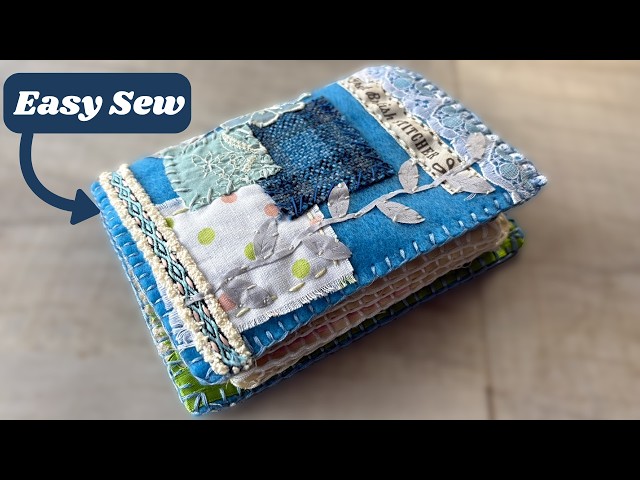
If you want to relax into your creativity, this video shows you how to make a beautiful slow stitch book. This fabric book tutorial guides you through creating a unique handmade book, perfect for anyone who enjoys sewing projects and textile art. Discover the calming process of slow sewing and create your own fabric journal with ease.
--------------------------------------------
V I D E O S T O W A T C H N E X T :
Slow stitch a Beautiful Journal Cover - https://youtu.be/9w_CS3VL3sg
Hand Embroider Round Flowers - https://youtu.be/KgWT0-FtTr0
Hand Embroider French Knots - https://youtu.be/tHY4lqFVEgU
Master Blanket Stitch - https://youtu.be/ofnBmni1k4o
--------------------------------------------
Enquiries: [email protected]
--------------------------------------------
➡️ Want to see loads of written tutorials too? If yes, click here: https://christines-crafts.com/
🆓 Access my resource library for free: https://christines-crafts.com/enjoy-the-craft-gardening-resource-library/
--------------------------------------------Get vidIQ to grow your channel faster! 🚀https://vidiq.com/ChristinesCrafts
Show More Show Less View Video Transcript
0:00
Do you want to relax into your
0:02
creativity? Then I've got the perfect
0:05
chance for you. What we're going to do
0:07
is make a little slow stitching book.
0:09
So, the whole thing is all about getting
0:12
creative using the supplies you've got
0:15
and relaxing.
0:17
So, let's get started. You'll need some
0:19
sort of fabric for your book. Now, for
0:22
the pages and the lining, I'm using an
0:24
old sheet. Now, the notebook cover I've
0:27
got is 9 in by 6 in, and the pages
0:31
inside are 8 in x 5 in. Now, that lining
0:36
that I've made for the book cover is
0:37
just less than 9 by 6 in so it doesn't
0:40
stick out. Make yourself a few pages.
0:43
Doesn't matter at this point. You can
0:44
make a couple and then do some more
0:45
later. But you do need a cover. Now,
0:48
this cover is 9 by six. And as you'll
0:50
see, it's a little bit bigger than the
0:52
lining I cut, so you can't see it. So do
0:55
your lining about eighth of an inch
0:57
less. So then you want to think, what do
0:59
I want on that cover? Now you can see
1:01
mine's felt. You could use any fabric
1:03
you like, but you are going to decorate
1:06
it. Now slow stitching a project like
1:08
this, you can just make it up as you go
1:10
along, but I prefer to do a little bit
1:12
of planning. So I raid all my scraps.
1:16
And there are bits of skirt coming on
1:18
here, bits of a top, bits of old ribbon.
1:22
That's actually part of a needle case
1:23
that I made.
1:25
So, as you can see, you don't just use
1:28
up your scraps. You can have a little
1:30
trip down memory lane as well. So, you
1:34
can see I'm just building it up, having
1:36
a play, seeing what I think, thinking
1:39
what would look best overlapping other
1:41
things, what would look better, nice and
1:44
clear, and I may add some other
1:46
stitches. But it's just about exploring.
1:51
You can also fray the edges of some of
1:53
these pieces so they look a bit
1:55
different. But then it's just about
1:56
sewing them on. And I'm largely just
1:59
using a running stitch to sew these on.
2:02
So, as you can see, as if by magic, I've
2:05
sewn them all on. And then when I fold
2:08
it over, I've got that lovely little
2:10
booklet that you saw at the beginning.
2:13
I'm happy with that. Now, when you look
2:15
on the inside, you can see the back of
2:17
all your work. Now, if you like that,
2:20
then do please leave that open. But I
2:22
don't. So, I have a lining to go inside
2:25
it. So, all I've done here is exactly
2:28
the same. I've got lots of bits of
2:29
fabric and ribbon and I've sewn them on,
2:32
but I have marked the middle because
2:34
obviously when it's closed up, those are
2:37
two separate pages and they won't be
2:39
seen together.
2:41
So on this side, I've gone very much
2:43
with the pinks and the greens and I've
2:45
added them added added in some little
2:48
French knots. And I do like the flowery
2:50
ribbon that actually my mom gave me. And
2:53
on the other side, I've got these lovely
2:55
burgundies and the crosses. So that is
2:58
going to go on the inside of the cover
3:02
and it'll make the front and the back
3:04
page. And you can see it's just a tiny
3:07
bit smaller. And if at this point you
3:10
decide it should be a little bit
3:11
smaller, it's still sticking out. You
3:13
can always trim it down. But I'm going
3:15
to sew the two together. I'm going to
3:18
use blanket stitch. Now, I'm going to
3:20
show you here what I'm doing. You can
3:22
see I've pinned them together because I
3:24
don't want them to move. And I've
3:26
started my blanket stitch. If you need
3:29
more tuition, I've got a video on the
3:31
screen and in the description below. But
3:34
basically, you just put your needle
3:35
through both layers
3:38
and then put it through the loop. And
3:42
that's what puts your layer of
3:44
embroidery thread right on the edge. And
3:47
it stops things fraying um and keeps it
3:50
a nice strong edge. So, I do like it
3:53
just for sewing them together. You can
3:55
use it for sewing your fabric onto your
3:58
pages as well, but I just really like it
4:01
for around the edge. And it's just a
4:02
case of working all the way round. If
4:04
you're worried about starting and
4:06
stopping or at the corners, refer to the
4:08
bigger video. So once I've got all the
4:11
way around, that's what it looks like.
4:13
I'm happy with it. I'm happy with all
4:15
the different stitch types
4:18
and I'm happy with how the lining looks.
4:21
So then it's time for pages.
4:23
So what I would like to do here is share
4:26
my pages with you. So if we as we've
4:28
already discussed these have got some
4:31
detail on and but largely I've used a
4:34
running stitch and you can see some of
4:36
the fabrics there have been frayed. So
4:38
you can see what that effect looks like.
4:41
You'll also notice I don't do it with
4:42
all of them. It's that variety I quite
4:44
like. So here's a page where I've
4:46
embroidered some flowers and some stems.
4:49
There's a video on screen and below that
4:51
shows you how to do that. And I'll
4:54
probably add a vase just over the top.
4:57
Use some fabric just to cover those
4:59
stems, but we'll see.
5:02
And there we go. I've added a vase and a
5:05
bit of ribbon to the side to be honest,
5:07
just to add a bit of interest. And on
5:09
the other side, I've gone vintage. Now,
5:10
one way of doing that is like I've done
5:12
here with some lace and then some little
5:14
bit of fabric that look like vintage
5:16
fabrics that actually new, but they look
5:18
vintage. And notice the line down the
5:20
middle with my heat erasable pen. just
5:23
so I work on two separate pages just to
5:26
just to make sure.
5:29
Right. And what did I do on the other
5:31
page that I've sewn to the back of it? I
5:34
just did two different pages. So, this
5:35
one's very much just fabric and ribbon
5:37
sewn on and a few little French knots.
5:40
And on this side, I've done some rows of
5:43
um embroidery stitches, different ones.
5:45
So, look up different stitches and have
5:47
a go at them. You can see I've drawn
5:49
some lines on, but when I iron it,
5:51
they're just going to disappear and then
5:53
they'll just look as if they were just
5:54
done by magic. I was just really clever.
5:57
And you can also notice the stitching
5:59
around the edge or that blanket stitch.
6:02
So this page, you can see I've used a
6:04
lot of ribbon. I've gone bright colors,
6:06
bright ribbons, and then added some
6:08
detail in front. On this side, I've got
6:11
some diamonds left over for some English
6:12
paper piecing and some other little bits
6:15
and then brought it together with some
6:17
French knots.
6:19
And these I've gone very much the pinks
6:21
and the blues and those little pigs.
6:24
Some ribbon I've been wanting to use for
6:25
a long time that my mom and dad bought
6:27
me and my dad's not been with us for a
6:28
very long time. So, I was happy to use
6:31
that. Here, I've focused on embroidery.
6:34
Now, these are some ironon transfers.
6:36
I've had them for a long time and my mom
6:38
gave me them. Ironon transfers. Have a
6:41
look online for some. They're great
6:43
because then you can just embroider over
6:45
them and you can get pretty pictures
6:46
like these two.
6:49
On this side, another page which is just
6:51
fabrics but with some contrasting
6:53
embroidery threads which is quite nice.
6:56
And this is to represent binka mats
6:58
which we made at school where you did
7:00
rectangles of different embroidery
7:02
stitches so that you learned. And that's
7:04
just for me to reminisce
7:07
these pages. This on the right has got
7:10
some bees on it. And those bees I
7:13
actually stamped on those fabrics at a
7:15
craft show. So that's a nice little
7:17
memory for me. And this we've got some
7:20
more fabrics left over from projects.
7:22
And on the left hand side there's a
7:24
theme, a sewing theme. So there's
7:26
another idea. You can make pages with
7:28
certain themes to them. So that one
7:30
represents my sewing.
7:33
I'm hoping I'm giving you some
7:35
inspiration here. So, those are all the
7:37
pages I'm doing. You can do as many or
7:39
as few as you like, but remember, if you
7:41
do lots of pages, they'll need to be
7:43
smaller than the book, as in smaller
7:46
than I've done them, otherwise they'll
7:47
start to stick out.
7:50
So, now we need to attach the two.
7:54
So, I've clipped my pages together and
7:56
I've got the cover separately. Now, I'm
7:58
going to use a pamphlet stitch. So, I've
8:01
marked one inch from the top, one inch
8:04
from the bottom, and the center.
8:06
And then I'm doing the same on the
8:08
pages, but I'm clipping them together,
8:11
and I'm just going to mark the front
8:13
page. So, you can see I've chosen what
8:16
order I want them in. So, do take a
8:17
little bit of time to select your order,
8:20
and then clip or pin them together.
8:23
Mark the center and mark the same
8:26
distance away from the center as the
8:28
outside ones were, not the same distance
8:31
from the edge. And then you want some
8:33
strong thread or some more of your
8:34
embroidery thread, which is what I'm
8:36
using. And you're going to go in that
8:39
center hole. And don't worry, this is
8:41
really simple to do. So, you're going in
8:44
the center and then making sure you come
8:47
out through the center hole on the
8:50
cover.
8:51
So, just take your time and keep redoing
8:54
it until you're through the center. And
8:56
this is going to mean they're all lined
8:58
up perfectly.
9:00
Leave a nice long tail on your thread.
9:04
You don't want to be chasing it and
9:05
struggling at the end.
9:07
And then we're going to come back
9:09
through through those top holes. So,
9:12
find the hole on the cover
9:15
and then go through the hole on the
9:17
pages. So again, you're just going to
9:19
have to keep doing it until you find
9:21
that hole.
9:24
There we go.
9:28
Pull it through so you get that nice
9:30
flat thread on the outside.
9:35
Careful not to pull it all the way
9:36
through. You still want your tail. And
9:38
then you're going to come right down to
9:40
those marks you made at the bottom. So,
9:41
you're going to go through the dot at
9:43
the bottom
9:45
and then through the dot in the cover.
9:48
Again, just take your time and make sure
9:50
you get it right. So, if you get this
9:52
right, they'll be lined up perfectly
9:55
and it'll all work out really well.
9:57
Again, pulling that nice and tight, but
9:59
not letting your tail pull through.
10:04
And then you're going to come back
10:05
through that center hole.
10:07
And make sure as you come through the
10:09
pages in the middle, you're on the
10:11
opposite side of that long thread that
10:14
you've got tight.
10:17
Opposite side to the tail that you've
10:19
already got. You see, I'm just making
10:21
sure. But you still want to make sure
10:23
you come through the same hole. You're
10:25
just going the other side.
10:28
You can see I'm having a bit of a battle
10:30
with it, but that's okay. Right, we're
10:33
through. So, now I'm going to take my
10:36
clips off and I'm going to check
10:37
everything's okay
10:40
and pull my thread tight. And I should
10:42
have a book.
10:45
Yeah, everything is okay. Right. And
10:47
then it's time to tie them together. So,
10:51
I'm just checking everything's all
10:52
right.
10:54
You can see we've got that nice binding.
11:01
And then it's just a case of tying the
11:02
two ends together. Now, if you don't
11:05
want to bother with this pamphlet
11:06
binding, you could just stitch from the
11:08
top to the bottom, either by hand or on
11:11
the sewing machine, and that will hold
11:13
it together. All that matters is that
11:16
you're holding it together down that
11:17
spine. But I do quite like the pamphlet
11:20
stitch. I think it suits this style. And
11:24
then make sure you leave some length on
11:26
those ends. You don't want your knot
11:27
pulling through. And as I say, it's all
11:29
very casual, so it's okay to have a a
11:31
loose thread in there. Just like that.
11:34
Looks quite cute. And there we go. We've
11:37
got a book. So, I hope as we flick
11:40
through this book that you're feeling
11:42
inspired to make your own slow stitching
11:45
book and relax, slow down, and enjoy
11:50
your sewing just for you and your own
11:53
creativity. This is not for anybody else
11:56
unless you want it to be. So, please go
11:59
on and enjoy your sewing.
#Arts & Entertainment
#Crafts
#Fiber & Textile Arts
#Fiber & Textile Arts