0:00
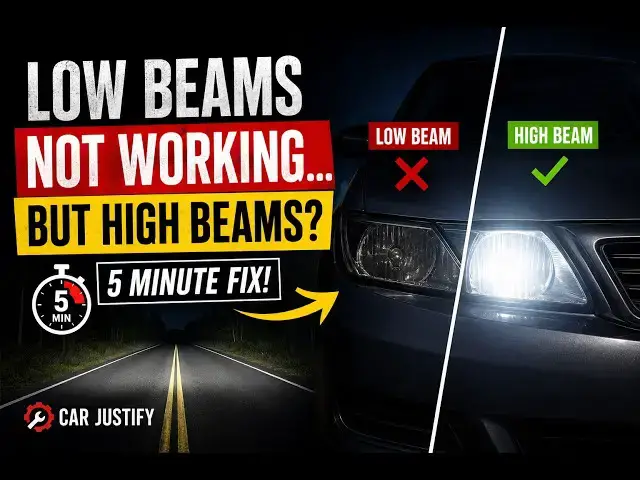
Imagine you're driving down a
0:01
pitch-black road. You flick your
0:03
headlight switch and absolutely nothing
0:05
happens, except for one very strange
0:07
thing. Your high beams work perfectly,
0:10
but your regular low beams are
0:11
completely dead, leaving you squinting
0:13
into the darkness. Most drivers assume
0:15
this is a sign of a massive electrical
0:17
meltdown or a computer failure, but the
0:20
real reason your car is half blind is
0:23
[snorts] usually something much simpler
0:25
and far cheaper than you think. Today,
0:28
I'm going to show you exactly why this
0:30
happens and how a simple 5-minute check
0:32
can save you a $200 trip to the
0:36
When you're stuck in this situation, it
0:38
feels like your car is playing a trick
0:40
on you. How [snorts] can the light be
0:42
half on? To solve this, you have to
0:44
understand that your car treats your low
0:46
beams and high beams like two completely
0:49
different systems. Even though they sit
0:50
in the same housing, they often have
0:52
their own wires, their own fuses, and
0:54
sometimes even their own separate bulbs.
0:57
This is actually a safety design. If one
0:59
circuit fails, you still have the other
1:01
to help you limp home safely. The
1:04
absolute first thing you need to check
1:06
is the most obvious, yet the most
1:07
overlooked. The bulbs themselves.
1:11
A lot of people think that because the
1:12
high beams work, the bulb must be fine.
1:16
many cars use a dual filament bulb.
1:19
This means there are two tiny wires
1:21
inside a single glass housing. One wire
1:24
handles the low beam and the other
1:26
handles the high beam.
1:28
It is incredibly common for the low beam
1:30
filament to burn out while the high beam
1:32
side stays perfect. If you've been
1:34
searching for a solution online, you
1:35
probably seen the viral video titled low
1:38
beams not working, but high beams are,
1:41
how to fix, because this exact scenario
1:43
happens to thousands of drivers every
1:45
day. Take the bulb out and look at the
1:47
glass. If it looks smoky or if you see a
1:49
tiny broken wire dangling inside, you
1:52
found your problem. Always replace these
1:54
in pairs, because if one just burnt out,
1:56
the other one is likely minutes away
1:58
from doing the same. If your bulbs look
2:00
brand new, we need to move to the fuse
2:02
box. Your [snorts] car has a specific
2:04
fuse dedicated to the low beams. In many
2:06
modern vehicles, there isn't just one
2:08
fuse for the headlights. There might be
2:10
one for the left side and one for the
2:11
right side. However, if both of your low
2:14
beams went out at the exact same moment,
2:16
you're looking for a primary fuse or a
2:18
headlamp fuse that controls the entire
2:20
circuit. Check your [snorts] owner's
2:22
manual or the diagram on the back of the
2:24
fuse box cover. If the little metal link
2:27
inside the plastic fuse is snapped, your
2:30
>> Replacing a fuse costs about 50 cents
2:32
and takes 10 seconds. So, always check
2:35
this before you start panicking about
2:39
If the fuses are intact, the next
2:40
suspect is the headlight relay.
2:43
Think of a relay as a heavy-duty remote
2:45
control switch. When you turn your
2:47
headlight knob, you aren't actually
2:48
sending power to the lights yourself.
2:50
You are sending a tiny signal to the
2:52
relay, which then clicks over and sends
2:54
the high-voltage power to the bulbs.
2:57
Relays [snorts] can wear out or get
3:00
A pro tip to test this is to find
3:02
another relay in the box that looks
3:04
identical, usually the one for the horn
3:06
or the fog lights, and swap them. If
3:08
your headlights suddenly roar to life,
3:10
you know you just need to buy a new
3:12
Now, if you've checked the bulbs, the
3:14
fuses, and the relays, and you're still
3:16
sitting in the dark, the issue might be
3:17
the physical switch on your steering
3:19
column. We call this the multifunction
3:21
switch. Because [snorts] you use your
3:23
low beams every single night, but you
3:25
might only use your high beams once a
3:27
month, the internal copper contacts for
3:29
the low beams wear out much faster. If
3:32
the [snorts] switch feels loose,
3:33
crunchy, or if the lights flicker when
3:35
you jiggle the handle, the switch has
3:37
likely failed internally.
3:39
Finally, don't forget to look at the
3:41
wiring harness. The plastic plugs that
3:43
connect to the back of your bulbs are
3:44
exposed to extreme heat and moisture.
3:47
Sometimes these plugs can melt or
3:49
develop a green crusty corrosion that
3:51
blocks the electricity from reaching the
3:53
bulb. If you see any signs of melting or
3:55
gunk in the connector, that's your
3:57
bottleneck. Fixing your headlights isn't
3:59
about being a master mechanic. It's
4:01
about following the trail of electricity
4:04
from the bulb back to the battery.
4:06
By checking these five things in order,
4:08
you can usually solve the problem
4:10
yourself with nothing more than your
4:12
bare hands or a simple screwdriver.
4:14
If this step-by-step breakdown helped
4:16
you get your lights back on and made
4:18
your night a little brighter, please hit
4:19
that like button and subscribe to the
4:21
channel so you never miss a simple fix
4:23
for your vehicle. We believe every
4:25
driver should feel confident under the
4:27
hood. Safe travels and thanks for
4:28
watching. This has been Car Justify.