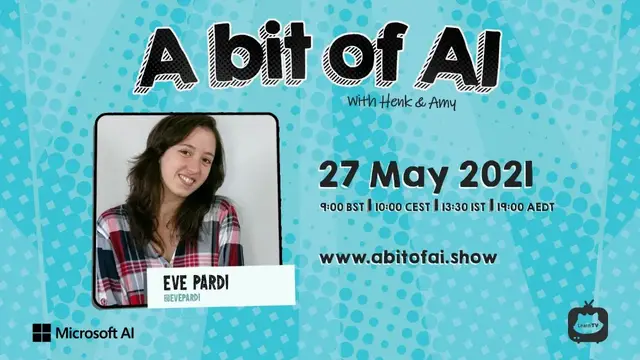
Up next in 10



What is it like to work in the field of AI? How do you get started with AI? And what is going on this week? Find out in this 30-minute show hosted by cloud advocates Henk and Amy. In this show, we will enter a conversation with our guest who works with AI daily and challenge you to expand your skillset with a recommended weekly MS Learn module.
Featuring Guest: Eve Pardi (https://twitter.com/EvePardi)
C# Live - Dev Streaming Destination: https://www.c-sharpcorner.com/live
C# Corner - Community of Software and Data Developers
https://www.c-sharpcorner.com
#abitofai #talkshow #podcast #csharpcornerlive #csharpcorner
Show More Show Less View Video Transcript
0:30
We'll be right back
0:59
Thank you
1:29
Thank you
1:59
Thank you
2:29
Thank you
2:59
Welcome to the A Bit of AI Show with your hosts, Henk and Amy
3:16
Hi everyone, and welcome to the 12th A Bit of AI Show
3:20
My name is Henk Booman, and I'm a white male with brown hair, wearing glasses
3:25
and today I'm wearing a red shirt with a robot on fire. Hi everyone, my name is I'm a female with long blonde hair and I'm wearing a light blue
3:37
top because it's got a little bit more summery here which is quite nice
3:43
But also, Hank, what a week, right? Busy week with Build, Microsoft Build
3:50
So if anyone has not had a chance, there is still sessions going on so go to mybuild.microsoft.com
3:56
Yeah, it was great. Did you see the keynote with Scott in the cinema
4:03
I did. I didn't catch the end, so I do need to go back and just watch a little bit of it
4:10
I had to go off and do something else. I also quite enjoyed the Kevin Scott keynote as well, kind of the future of technology
4:19
It really just opens your mind to all the things that people are working on in this space. Exactly
4:26
I still have to see that one. There was just too much going on. Oh, definitely
4:30
Definitely put that one. Mm-hmm. I also enjoyed the keynote or the session with Cassie and Seth talking about ML Ops and
4:43
all the new changes in Visual Studio Code and with Azure ML service and how you can
4:49
deploy your models and then have, like, route 10% traffic to that one and 60% to that, all
4:55
with GitHub Actions. So that was really cool. So definitely go to mybuild.com and check out these sessions
5:05
We will put some links at these episodes for some relevant sessions if you're in AI
5:10
So once again, welcome to the A Bit of AI show. And this show is all about the story behind the people that work in AI
5:18
Because in our job, we meet so many people around the globe. and we realized that there are so many different skill sets involved in creating this full AI
5:26
solution. So in this show, we invite people that work with AI from all over the world
5:32
and we just have a chat about what they're actually doing during the week. So this is the
5:37
12th episode, and we couldn't be more excited to start talking with our guests and learn about
5:42
what they do. So in this show today, we have two items. We start with our guest, Eve, to chat about
5:48
her life in AI. And then finally, we dive into an AI learning challenge of the week
5:54
I'm curious what that one is going to be this week. So as always, all the links are available
6:00
on the website at bitofai.show. And don't forget, after the show, you can join us in a bit of AI
6:10
cafe, where it's kind of an informal chit chat for 30 minutes after the show, you can chat with
6:15
myself and Henk but you're probably going to want to speak with our guest today
6:21
Absolutely, so let's get started and invite Eve to the show. Hi Eve! Hi everyone, how are you
6:33
Really good, thank you, really really good. Thank you so much for joining us, I know you're having
6:38
an incredibly busy week, both with your role, with community pieces, with Build, so we really
6:44
really appreciate your time on the show um it's uh it's great to kind of hear from you and also see
6:50
you we often work with you quite a lot yes uh we haven't met for a while i think and it's really
6:56
great to be on the show today so i'm very happy that you got me a chance of course of course and
7:04
well i guess we know you very well eve but can you tell um all of our audience who you are and
7:10
what you do in AI. Sure, thank you. So I'm Eve Bardi. I am working as a consultant right now at
7:18
Alnad. And as a consultant, I am going out and work with clients all around the world, actually
7:25
so far. And Scandinavia was the mostly focused area. And I am working mostly with data science
7:33
and artificial intelligence activities and related tasks. And it's often a lot of fun working with these clients
7:44
Next to my full-time job, I do a lot of community work as well
7:50
I am an AI MVP and that also involves a lot of sessions at different conferences and meetups I also organize AI42 together with Hoken which is I think a really nice initiative
8:09
that is about to invite more people into the field of AI
8:13
and also give them a chance to get started in the field of data science and AI
8:20
I also write articles, and I'm just about to rebrand my whole Code with DIV
8:26
image and stuff so so I hope in the summer I can put it on and you can read all my stuff that I was
8:34
working on in the in the last few months oh definitely I was gonna say we will there'll be
8:42
many many links I think to share both in our cafe experience after the show but also on the website
8:48
and we'll make sure that we do that because there's so many great things that you share online
8:52
with the community. Let's first talk a little bit about the day job. So you're a consultant
8:59
and you specialise in AI. You work with so many different customers. And every time we've spoken
9:05
with consultants, one of the things that makes me most surprised is just the sheer amount of
9:10
different technologies that you need to know about in order to help people out. And so what I'm really
9:16
keen to hear from you is all jobs in the industry look different daily but what does kind of an
9:23
average day in Eve's career look like? Well it normally it's yes it is very different as you say
9:33
most of the time I prefer to start with meeting with the client in the morning as soon as possible
9:39
so we have a good discussion about where we are and what's next and what we might require from
9:46
them and then then then a small planning is always needed for the for the consultant team itself so
9:53
we'll see uh who is doing what and so on um right now i am working with the client which is uh pretty
9:59
exciting for me because and this is something really big i think in this field especially and
10:05
the microsoft era because what right now we are doing is that we are moving an almost on-premise
10:13
solution that is built from a third-party company for this customer. We're moving this whole thing
10:21
the whole data engineering, then data preparation, and then the machine learning part as well into
10:27
Microsoft Azure, which is pretty exciting. So it requires a lot of planning. So mostly
10:33
the, since I am the, well, I am the one who is, you know, who is able to know about what
10:44
is like AI and how to like use the Azure Machine Learning workspace and so on. So I am the
10:50
one who has to plan these steps, like what has to be done. So I mostly do planning. And
10:58
And then that also requires a lot of knowledge about the company, about their data, how the solution looks like right now
11:05
So so before starting on the project, I spent like two weeks on looking into the code on in the data, see what has to be moved or what might need to be improved and so on
11:18
So it includes a lot of different tasks, actually, not just not just a training machine
11:24
I was gonna say right because that is one of our things uh we're seeing a lot on this show which is
11:31
I think a lot of people think of AI and data science in one way and actually it's very much
11:37
an engineering problem like as we're trying to take these things into production and as you're
11:42
saying the importance of actually that whole pipeline the data that's fueling it uh what does
11:47
the architecture look like and stuff like that and actually having these different jigsaw pieces
11:52
kind of come together and work well, like efficiently as well, I think is a whole other skill
12:00
You mentioned the data prep work. And when we chatted a little bit before this
12:06
do you find there's a lot of projects in that space or is it more the AI, the machine learning side of things
12:15
Yes, it's an interesting question because let's say I haven't been in the consultant life for very long yet
12:23
But so far, what I've seen is mostly the data engineering that is in focus
12:29
And then a bit of AI, maybe. But mostly the ytics and statistics and so on
12:37
And then put in some machine learning on the top of that
12:41
But most of the clients only focusing on their data. They want to make sure that their data is quality data, it's pretty, it's useful, and it is available for the data scientists
12:55
When data scientists just can't wait to have the data finally and just get started to work on it, instead of planning on the data modeling and stuff all the time
13:06
But yeah, otherwise it's cool. You need to know that as well, I think, in this field
13:12
because that's how you can build better machines if you know how the data looks like really
13:17
And basically you put together the data model yourself, then it's easy
13:23
Yeah. I was going to say just more understanding of what's available to you, how it's formatted
13:30
how you can use it, what are the possibilities of the different things that you can build
13:36
with the data that you have? I think that's always a question I've always found as well
13:40
where people will say, what can we do? What are the ideas around things that we can solve
13:48
the business problems we can solve with the data that we have sort of thing? You mentioned the kind of migration piece
13:56
Does that mean you have to do quite a lot with the infrastructure side of
14:00
so like compute and storage and stuff like that? I'm mostly just supporting that part. I'm more like looking into the code closely. So
14:10
I have to, so what we are doing right now when it comes to migration, it also involves
14:16
a lot of testing. We have to verify that this thing works well. So that is mostly the focus
14:22
here. Next to that, I'm obviously helping out with the infrastructure as well, but I'm
14:27
not really uh good at that I think so I'm always having problems on estimating how big machine we
14:35
need so it's uh yeah it's not not my thing I know if I'm honest like when we've done like
14:42
Azure fundamentals and I did like a developing Azure solutions a while ago like certification
14:48
that part of it that infrastructure side is always the bit where I have to spend the most time like
14:54
anything that's serverless anything that's data and machine learning no worries but then like
14:59
yeah the whole side of infrastructure um things like active directory stuff like that with identity
15:05
i find security very interesting but i'm not i'm not an expert sort of thing so it is it's good to
15:12
hear that yeah where where that line is drawn as well there because otherwise like i said like
15:17
sometimes when someone says i'm a consultant i'm literally like yeah you should know everything
15:21
How do you like hold all that knowledge? Yeah, yeah, yeah. And I like that always that every time I go to an exam or in a consultant situation
15:30
like I have to answer something to the customer right in that moment when they ask you this question in that call specifically
15:38
And you would prefer to sit down and start drawing stuff on a paper and start, you know, calculating stuff and like spend some hours on it
15:47
But no, you have to put it on the table right away sometimes. so it a yeah oh gosh nerves of steel even as a steel and let speak let move on a little bit because I know a lot of the time in your customers you have to share a little bit of learning with them so they need to be able to understand kind of when you leave what going on still and that learning has kind of expanded into the AI community
16:14
and that's how we know you so well. Can you tell us a little bit more again about what you do
16:19
with the community work? Yes and before doing so let me just mention that it's not just
16:26
Sometimes it's not just sharing knowledge with the client. It's not important because of that that you might leave or whatever
16:33
It's also important that they see what you're doing while you're working there. I think it's important to mention here for someone who wants to become a consultant
16:43
It's always very important to be very transparent about what you're doing. And if you tell the customer what you're doing, like explain it, how does it work and such, then you're in a good way
16:53
But yes, in my free time, I do a lot of sessions and I'm doing a lot of community work, including mentoring, speaking, of course
17:07
And I often just offer some learning opportunities for people, just like AI42
17:15
And this all came from the idea that I, first of all, wanted to be someone who people can rely on
17:23
or be like a role model in this field a bit and and i think it's also from my point of view it is
17:31
important to give a chance to people because i also started like that that i was i was doing
17:36
something but but i at some point had no idea what would i do with my life and then i i needed help
17:43
and and everyone needs some help of course um some people need some mentors some people are okay we
17:49
just going on courses or whatever for me it was really really good that I had
17:53
people around me who could guide me and help me through my path so I think
17:58
that's important too from my point of view as well to be a person who people
18:05
can you know have behind them so it's so great so I want to know a little bit how
18:18
you got into the field of AI. What is your story? Well, my story is like a fairy tale, I always refer to it like that. It started from back
18:31
in Hungary because I'm originally from Hungary actually. And I started my studies there a
18:38
long time ago. And I was learning some software engineering something or something like that
18:48
was what and and I often had the feeling and and I not just a feeling it was actually well you know
18:56
I knew it's that some of my teachers didn't like me well not specifically me but they didn't like
19:03
the idea that women learn programming and especially engineering these things so so I
19:12
I just said that, okay, I don't want to work like this
19:16
I don't want to like feel ashamed all the time when I'm doing something
19:21
So I decided to come to Denmark and I started my studies here as well, like in parallel
19:29
And I did a lot of, well, not a lot, but like two diplomats in Denmark
19:35
And then in parallel with that, I finished a master's on MIT
19:41
on data science and AI. But like that path was very funny
19:46
because I came to Denmark and at that time I was learning programming only like, you know
19:52
this software engineering, computer science and such. And at some point I was like
19:58
I don't want to be just a programmer. I don't wanna spend my life with like
20:04
it's just not me like sitting in front of the computer the whole day and write code the whole day
20:09
It's exciting, I enjoy it when I do so, but not like every day, right
20:14
So I was like, okay, what should I do? So I was like, okay, let's search for something
20:19
And I literally wrote in to this search panel that the three keywords that were important to me
20:27
at that time, that was mathematics, programming, and healthcare. And then it dropped out this word that I think I heard it
20:36
for the first time maybe at that time. was called data science
20:40
And I'm like, wow, that sounds cool. And like, wow, what is that
20:44
And I started to learn. And that's how I started with data science and AI
20:50
My first final project for the first diploma in Denmark was about neural networks, like digital recognition
21:00
That was quite a big thing at that time, because Microsoft didn't have this custom vision
21:06
thing yet at that time. So I wrote my own code on Python
21:10
I actually did have to set up the infrastructure. I had to put together a training machine
21:16
and then another one for validation as well. And then there was one for, so it was like a big project
21:23
And then my second project was something that you might heard about already
21:28
the Nepal earthquakes project that I started on in 2017 something, I think. Yeah
21:38
So yeah, and then, I don't know, like a spark at some point
21:44
I managed to go to some conferences also with this project because apparently it was a very interesting one
21:52
I think it was also because at that time, the Azure Machine Learning Studio and then the workspace
21:59
was always like a big thing. And that project was focusing on introducing these tools
22:06
to you. And at that time it was only Jupyter notebooks. And then suddenly came the Azure notebooks
22:11
and then now the workspace with all these things. So I could just move through this project in what
22:17
Three years. Yeah. Yes, and then last year in February, I became an MVP in AI
22:28
And I'm very, very happy that I can be a part of this community because I don't think
22:34
could manage it by myself to get there so so thank you it is a very interesting
22:44
story very interesting so let's move on to like my next question so what is your
22:53
most annoying thing about your role in AI I'm not sure if we could call it
23:00
annoying but it's more like surprising sometimes I think I'm then when people
23:08
come to you and and say things like like whatever I do I take other people's job
23:16
that's my favorite one and it's not about that that I am going to go and and
23:24
sit everywhere and work there but like building an AI solution can often
23:29
sounds like that it wants to take the job of people but it's what I think is
23:35
always that that what AI does nowadays is just support the people so like for
23:43
example would you rather be an administrator who is working like day
23:48
and night answering phone calls at Christmas night or whatever like AI can
23:52
just take these things from you and then just just when you're not available or
23:57
where people are not capable of like not capable because it like nonsense to be capable for that thing then AI can be used for that also another another thing I think is that it gets a small focus of the of how AI could be
24:17
used for good and that that's focus is like fading away sometimes in in people mind what I'm talking
24:26
about right now is that going back to the Nepal earthquakes project we saved people lives because
24:32
because we could estimate which buildings might be in danger or let's say like whatever healthcare
24:39
solutions that you can see all around the world like let's just look at some that like automatically
24:46
calls the doctor if it recognizes something strange on you like a higher blood pressure basically or
24:52
something and all these all these solutions are for the people and and many many of them don't
25:00
understand it yet so that's that's that's it's not annoying it's just that's that's we have to live
25:07
together with I think so they cannot expect from everyone to know what what is AI which would be
25:15
actually nice though. Yeah, and you're doing a lot obviously in that space to educate as
25:22
well and to offer that insight. And so I think you're combating some of that by hopefully
25:28
letting people know, as you said, the possibilities and the things that they do need to be wary
25:34
of. You do a lot within responsible AI, right? So it's really cool. Wonderful. Well, we're
25:41
going to very, very quickly go on to our quickfire round. Our quickfire round, Eve, you do not know
25:47
the questions that are coming your way in the next couple of minutes. But one thing that you do know
25:52
is they're fairly simple. And all we want is that first thing that comes to mind. If you can keep it
26:00
to either a word or tops a sentence, that we would really appreciate it. So let's get started
26:07
First one's easy. So what was your first programming language? C. Oh, good one. Yes
26:22
What programming language was used in your last project? Python. That's 12 out of 12 episodes
26:32
On to the next. So no more than a sentence. What was the last thing you learned
26:46
I'm sorry, I didn't hear that. No. No, I think we lost Amy for a while
26:51
For a bit. What was the last thing you learned in AI
26:56
I'll just give me a second because it was not the reinforcement learning stuff but after that
27:07
no I think that was the last thing yeah yeah reinforcement learning in gaming I think that
27:17
was the latest. Oh, yeah. I saw that talk together with Ellen, right? Yes. Yeah. Everyone's cool
27:25
Your favorite event on the AI calendar? Oh, can I say two
27:33
Yes, okay. Well, three, actually. No, just joking. All right. Obviously, a bit of AI. It's pretty
27:41
cool no but um ai42 i think is very useful to those who want to learn ai and uh global ai
27:49
community events um that is these three i think it's uh it's pretty useful for those who want to
27:55
get started in the field maybe yeah hey you're back hi beck hi amy so small
28:06
So I will continue. What area of AI is on your list to scale up on next
28:16
So I'm going to look into a bit more cognitive services specifically and improving webshop
28:32
I can't tell more about that sorry it's just one sentence that's good
28:42
the last question is for you Amy oh fabulous so what training framework did you use last
28:51
I think I was using I'm not sure maybe scikit and tensorflow i guess the i'm usually using together mostly
29:06
wonderful well thank you so much um you did a fantastic job uh even though i missed a short part of that quickfire round
29:21
but thank you so much for taking part today um it's been an absolute pleasure to speak with you
29:27
in just a few minutes we'll all head over to the cafe and Eve will be there to chat a little bit
29:33
further with you if you're watching on the website so Eve with that we'll say goodbye and we'll see
29:39
you in the cafe yes thank you for having me today see you in the cafe thank you and thanks so much
29:47
for sharing your story Amy let's go straight to the learn modules you picked for this week
29:57
Absolutely. So thinking of the things that Eve has worked on in the past, as well as things that she's working on in her day to day, I've picked three different modules
30:09
So one of them is using the Azure Machine Learning SDK. She talked about how important that was for her work right now and that migration she's working on
30:19
So go and check out a little bit more about that. And then my next two are based on responsible AI
30:24
Eve has done a lot in the past, especially with Microsoft, to do stuff around detecting and mitigating unfairness
30:31
as well as using explainability in machine learning models. So I've added two different modules that relate to them
30:42
Perfect. I still have to take those last two ones. Oh, yeah, no, definitely. Definitely do them. They're good
30:51
wonderful well you all know where to go obviously if you're on the website you can find the learn
30:57
challenge just above us or you can go to aka.ms slash a bit of ai dash learn and uh with that
31:06
we've come to the end of the show another show this is our 12th episode now um and we're we're
31:12
nearing the end of our season but thank you so much for joining us today we really hope you've
31:17
enjoyed the show we're here every thursday at 10 a.m central european time and in various other
31:23
parts of the world as well do come and join us in the a bit of ai cafe with me hank and eve where
31:30
we'll talk about where we'll just kind of have informal conversation so if you go to aka.ms
31:36
slash a bit of ai dash cafe or again you can just click above on the button and and with that just
31:45
Thank you so much for watching. This has been a bit of AI with Henk and Amy
#People & Society
#Computer Education
#Machine Learning & Artificial Intelligence
#Augmented & Virtual Reality