Up next in 10


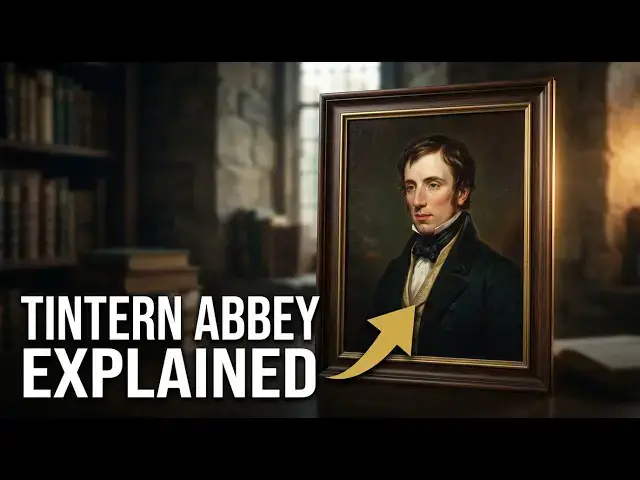
Tintern Abbey by William Wordsworth | Summary & Analysis Explained
In this video, we explain William Wordsworth’s “Tintern Abbey” in clear and simple English. This detailed explanation covers the poem’s summary, major themes, important ideas, poetic form, literary devices, and Wordsworth’s changing relationship with nature.
“Tintern Abbey,” whose full title is “Lines Composed a Few Miles above Tintern Abbey, On Revisiting the Banks of the Wye during a Tour, July 13, 1798,” was published as the concluding poem of the first edition of Lyrical Ballads in 1798.
The poem is much more than a description of a beautiful landscape. Wordsworth uses his return to the River Wye after five years to explore nature, memory, time, imagination, maturity, spirituality, human suffering, moral development, and personal growth.
In this video, we explain how Wordsworth’s experience of nature changes from the intense physical excitement of youth to the deeper reflection of maturity. We also examine how memories of nature continue to influence him even when he is physically far away from the landscape.
The video also explains Wordsworth’s idea of nature as a source of emotional, moral, intellectual, and spiritual strength, including his famous description of nature as an “anchor” of his purest thoughts and a “nurse” of his moral being.
We also discuss the importance of Dorothy Wordsworth, who appears near the end of the poem and connects Wordsworth’s past, present, and imagined future.
Topics Covered
• Tintern Abbey summary
• William Wordsworth and Tintern Abbey
• Meaning of the full title
• The River Wye and the natural landscape
• Nature and memory
• Youth and maturity
• Imagination and consciousness
• Nature as a moral influence
• Spirituality in Tintern Abbey
• Human suffering and the “still sad music of humanity”
• Dorothy Wordsworth
• Time, memory, and personal growth
• Blank verse and iambic pentameter
• Imagery, metaphor, personification, repetition, and contrast
• Tone and structure
• Tintern Abbey and Romanticism
• The relationship between nature and the human mind
This video is designed especially for students who want a clear, detailed, and easy-to-understand explanation of “Tintern Abbey” by William Wordsworth.
If you are studying Romantic poetry, Wordsworth, Lyrical Ballads, or “Tintern Abbey” for school, college, or literature examinations, this explanation will help you understand the poem and its major ideas.
Poem: “Lines Composed a Few Miles above Tintern Abbey”
Poet: William Wordsworth
Published: 1798
Literary Period: Romanticism
Collection: Lyrical Ballads
Subscribe to Ask Literature for clear explanations of important works of English literature.
Show More Show Less View Video Transcript
0:00
William Wordsworth's Tintern Abbey is
0:02
one of the most important poems of the
0:04
English Romantic period.
0:07
It asks a question that is much larger
0:09
than its title suggests. What happens to
0:12
our relationship with nature as we grow
0:13
older?
0:15
At first, the poem appears to describe a
0:17
beautiful landscape beside the River
0:19
Wye.
0:20
But Wordsworth soon moves beyond
0:22
physical scenery.
0:25
He explores memory, childhood and
0:27
maturity, imagination, human suffering,
0:29
spirituality, and the power of nature to
0:32
shape the human mind.
0:34
By the end of the poem, the landscape
0:36
has become connected with Wordsworth's
0:38
entire emotional and intellectual
0:40
development.
0:42
He also turns toward his sister Dorothy
0:45
and hopes that nature will continue to
0:46
guide and comfort her in the future.
0:49
Understanding this movement from
0:51
landscape to memory, from memory to
0:53
reflection, and from reflection to
0:55
spiritual and moral understanding is the
0:57
key to understanding the whole poem.
1:00
The poem's full title is Lines Composed
1:03
a Few Miles Above Tintern Abbey, on
1:05
Revisiting the Banks of the Wye during a
1:07
Tour, July 13, 1798.
1:11
It was written in 1798 and became the
1:14
concluding poem of the first edition of
1:16
Lyrical Ballads, the collection
1:18
associated with Wordsworth and Samuel
1:20
Taylor Coleridge.
1:22
Lyrical Ballads is a landmark in the
1:25
development of English Romantic poetry.
1:28
The poem itself, however, does not
1:30
describe the ruins of Tintern Abbey in
1:33
detail.
1:34
The speaker is a few miles above the
1:36
Abbey on the banks of the River Wye,
1:39
looking at the surrounding countryside.
1:42
This distinction matters because the
1:43
real subject of the poem is not the
1:45
historical Abbey, but Wordsworth's
1:47
experience of returning to a familiar
1:49
natural landscape after an absence of
1:51
five years.
1:54
The opening immediately establishes the
1:56
importance of time.
1:58
Wordsworth says that five years passed
2:00
since he last saw this landscape.
2:04
He has returned to the same area, and
2:06
once again he hears the waters of the
2:07
River Wye and sees the steep cliffs
2:09
surrounding the scene.
2:12
The landscape includes orchards, fields,
2:14
hedges, farms, trees, cottages, and
2:16
smoke rising among the trees.
2:19
The description is peaceful and rural,
2:22
but Wordsworth is doing more than
2:23
painting a picture.
2:25
He is comparing the landscape he sees
2:27
now with the memory of the landscape he
2:29
carried within his mind during the 5
2:31
years of absence.
2:33
The physical details are important
2:35
because Wordsworth begins with the
2:37
senses.
2:39
He hears the river, sees the cliffs,
2:41
observes the greenery, and notices the
2:43
smoke among the trees.
2:45
Yet the poem quickly moves from what the
2:47
eyes and ears perceive to what the mind
2:49
remembers.
2:51
This movement is central to romantic
2:53
poetry.
2:55
Nature is not simply something outside
2:57
the individual.
2:59
The human mind receives the experience
3:01
of nature, remembers it, interprets it,
3:03
and gives it emotional and spiritual
3:05
meaning.
3:07
Wordsworth explains that these natural
3:09
images remained with him after he left
3:11
the Wye Valley.
3:14
Even when he was living away from this
3:15
landscape, memories of it continued to
3:18
influence him.
3:20
During moments of weariness and
3:21
difficulty, the remembered forms of
3:24
nature gave him a sense of calm.
3:27
He suggests that these memories had a
3:28
restorative effect upon his mind.
3:32
In simple terms, remembering nature
3:33
helped him feel mentally and emotionally
3:35
renewed.
3:38
This is one of the poem's most important
3:40
themes.
3:41
Nature can influence us even when we are
3:43
physically separated from it.
3:46
Wordsworth does not need to stand beside
3:48
the river every day for the landscape to
3:50
remain meaningful.
3:53
His mind preserves the experience, and
3:55
memory allows that experience to return
3:57
later.
3:58
Nature therefore becomes partly
4:00
internal.
4:02
The actual landscape exists outside him,
4:04
but his memory of it becomes part of his
4:06
inner life.
4:10
Wordsworth goes even further.
4:13
He suggests that memories of nature have
4:15
influenced not only his emotions, but
4:17
also his moral and intellectual
4:19
development.
4:21
The remembered landscape has helped him
4:22
become calmer and more reflective.
4:25
This means that nature for Wordsworth is
4:28
not merely beautiful scenery.
4:31
It has an educational and formative
4:33
power.
4:35
It participates in the development of
4:36
the person.
4:39
The poem then turns toward Wordsworth's
4:41
changing relationship with nature.
4:44
Five years earlier, he had experienced
4:46
the landscape very differently.
4:49
At that earlier stage of his life, his
4:51
response to nature was intensely
4:53
physical and energetic.
4:55
He describes himself as being driven by
4:57
the excitement of natural sights and
4:59
sounds.
5:01
His relationship with nature was
5:03
immediate.
5:05
He did not need to stop and philosophize
5:07
about what nature meant.
5:09
He simply felt its power.
5:12
Wordsworth now recognizes that this
5:14
earlier experience has changed.
5:17
He refers to his former state as the
5:19
period of thoughtless youth.
5:22
This does not mean that his younger self
5:24
was unintelligent.
5:27
The phrase means that he experienced
5:28
nature more instinctively and without
5:30
the mature reflection that developed
5:32
later.
5:34
He had intense physical enthusiasm, but
5:36
he had not yet developed the deeper
5:38
philosophical understanding that he now
5:40
possesses.
5:42
This change is not presented simply as a
5:45
loss.
5:46
Wordsworth admits that he can no longer
5:48
recover the exact intensity of his
5:50
youthful experience.
5:53
He remembers the aching joys and dizzy
5:56
raptures of his earlier relationship
5:58
with nature.
6:00
But he does not conclude that maturity
6:01
is worse.
6:03
Instead, he argues that another kind of
6:05
understanding has replaced what he has
6:07
lost.
6:09
The physical excitement of youth has
6:11
developed into something more reflective
6:13
and profound.
6:15
This is the central movement of the
6:17
poem.
6:18
The young Wordsworth experiences nature
6:21
through sensation and excitement.
6:24
The mature Wordsworth experiences nature
6:26
through sensation, memory, thought,
6:29
imagination, and moral reflection.
6:32
His response has become less purely
6:34
physical, but more intellectually and
6:36
spiritually meaningful.
6:38
In this sense, the poem presents
6:40
maturity as transformation rather than
6:42
simple decline.
6:45
Wordsworth's mature vision of nature
6:47
reaches its most famous point when he
6:49
describes feeling a presence within the
6:51
natural world.
6:53
He speaks of something far more deeply
6:55
interfused throughout the world of eye
6:58
and ear, and within the human mind.
7:01
The language becomes deliberately
7:03
difficult and philosophical because
7:05
Wordsworth is trying to express an
7:06
experience that he believes cannot be
7:08
reduced to ordinary physical
7:10
description.
7:12
The important point is that Wordsworth
7:14
no longer sees nature as a collection of
7:16
separate objects.
7:18
The river, sky, air, landscape, and
7:21
human mind seem connected by a deeper
7:23
unity.
7:25
He experiences nature as possessing a
7:27
spiritual significance that reaches
7:29
beyond its physical appearance.
7:32
Some readers interpret this passage in
7:34
relation to pantheistic or panentheistic
7:37
ideas, while others emphasize
7:39
Wordsworth's Christian, philosophical,
7:41
or broadly spiritual understanding.
7:44
It is therefore safer not to claim that
7:46
the poem simply teaches one fixed
7:48
religious doctrine.
7:50
What the text clearly shows is
7:52
Wordsworth's sense of a profound
7:54
presence or unity connecting nature and
7:56
human consciousness.
7:59
This spiritual dimension explains why
8:01
Wordsworth describes nature as much more
8:03
than scenery.
8:05
He calls nature the anchor of his purest
8:07
thoughts, the nurse of his moral being,
8:10
and a guide, guardian, and nurse to his
8:13
heart and soul.
8:15
These are metaphors, and they are
8:16
extremely important.
8:19
An anchor provides stability.
8:22
A nurse cares for and develops a person.
8:25
A guide gives direction, while a
8:27
guardian protects.
8:29
Through these images, Wordsworth
8:31
presents nature as a force that has
8:33
helped stabilize, educate, direct, and
8:35
protect his inner life.
8:39
The poem therefore presents nature as a
8:41
moral influence.
8:44
Wordsworth believes that contact with
8:45
nature can help form a person's
8:47
character.
8:49
This does not mean that simply looking
8:51
at a tree automatically makes someone
8:52
morally good.
8:54
The poem describes a deeper process in
8:56
which natural experience becomes memory,
8:59
memory becomes reflection, and
9:01
reflection influences the individual's
9:03
way of thinking and feeling.
9:06
Nature becomes morally significant
9:08
through the way the human mind engages
9:09
with it.
9:11
At the same time, Wordsworth's mature
9:14
understanding of nature is not
9:15
completely innocent or carefree.
9:19
He has become more aware of human
9:20
suffering.
9:22
He refers to the still, sad music of
9:24
humanity, a phrase that captures the
9:27
mature awareness that human life
9:28
contains pain as well as beauty.
9:31
The younger Wordsworth could respond to
9:33
nature with almost pure excitement.
9:37
The older Wordsworth understands that
9:38
the human world includes suffering,
9:40
uncertainty, and loss.
9:43
This is why the poem's mature vision is
9:45
more complex than simply saying, "Nature
9:48
makes Wordsworth happy."
9:51
Nature gives him consolation, but it
9:53
does not erase suffering.
9:56
Instead, it provides a framework through
9:57
which he can face life more calmly and
9:59
thoughtfully.
10:01
The natural world becomes a source of
10:03
emotional strength in the presence of
10:05
human difficulty.
10:08
Another major theme is imagination.
10:11
Wordsworth's experience of nature is
10:13
never simply a mechanical recording of
10:16
what he sees.
10:18
The mind receives sensory experience and
10:20
then transforms it through memory,
10:22
association, and reflection.
10:25
This is why the landscape has meaning
10:27
beyond its physical appearance.
10:30
The same river, trees, and cliffs can
10:32
produce different responses at different
10:34
stages of life because the person
10:35
looking at them has changed.
10:38
This relationship between the external
10:40
world and the inner mind is one of the
10:42
defining features of Wordsworth's
10:44
romanticism.
10:46
Nature affects the mind, but the mind
10:48
also gives meaning to nature.
10:50
The poem is therefore both a nature poem
10:53
and a poem about consciousness.
10:56
Wordsworth is interested not only in
10:57
what nature looks like, but in what
10:59
happens inside a person when that person
11:01
encounters nature and later remembers
11:03
the experience.
11:05
The poem's treatment of time is equally
11:07
important.
11:09
The opening looks backward to the
11:11
previous visit 5 years earlier.
11:14
The middle of the poem compares
11:16
Wordsworth's youthful and mature selves.
11:19
The conclusion looks toward the future.
11:22
Past, present, and future are connected
11:25
through memory.
11:26
The physical landscape provides
11:28
continuity while human beings change.
11:32
Wordsworth has changed, but the
11:33
landscape allows him to connect his
11:35
earlier self with his present identity.
11:39
The final major movement of the poem
11:41
begins when Wordsworth turns directly
11:43
toward his sister Dorothy.
11:46
She is present with him during this
11:47
visit, and he recognizes in her some of
11:50
the enthusiasm he once possessed.
11:53
He sees her response to nature and is
11:55
reminded of his own earlier experience.
11:59
Dorothy therefore becomes important not
12:01
only as a person whom Wordsworth loves,
12:03
but also as a connection between his
12:05
past and present.
12:08
Wordsworth hopes that nature will
12:09
influence Dorothy in the same positive
12:11
way that it has influenced him.
12:14
He imagines a future in which she may be
12:16
experiencing loneliness, sadness, or
12:18
difficulty.
12:20
At such a time, he hopes she will
12:22
remember the natural experiences they
12:24
shared.
12:26
The memory of this moment beside the
12:28
River Wye may then provide her with
12:29
comfort.
12:31
Memory once again becomes a source of
12:33
strength, but now Wordsworth is
12:35
imagining its future effect on another
12:37
person.
12:40
His address to Dorothy also gives the
12:41
poem an emotional conclusion.
12:45
He asks nature to bless her and hopes
12:47
that she will continue to experience its
12:49
healing and moral power.
12:51
He also hopes that in the future she
12:54
will remember him and this particular
12:55
moment.
12:57
The poem therefore becomes a meditation
12:59
on human relationships as well as
13:01
nature.
13:03
Shared experiences can remain alive
13:05
through memory long after the physical
13:06
moment has disappeared.
13:10
The ending also creates a powerful
13:12
circle.
13:14
Wordsworth began by returning to a
13:16
landscape he remembered from 5 years
13:18
earlier.
13:19
He then described how memory of nature
13:21
had sustained him during his absence.
13:24
Finally, he imagines Dorothy carrying
13:27
memories of this present experience into
13:29
her own future.
13:31
The poem thus moves from past experience
13:33
to present reflection and finally toward
13:35
future memory.
13:38
The form of the poem supports this
13:39
continuous movement of thought.
13:42
Tintern Abbey is written in blank verse,
13:45
which means unrhymed iambic pentameter.
13:49
It is organized into five irregular
13:51
verse paragraphs rather than regular
13:53
rhyming stanzas.
13:56
The varying lengths of these verse
13:57
paragraphs allow Wordsworth's thoughts
13:59
to develop naturally, and the frequent
14:01
use of enjambment allows sentences and
14:03
ideas to continue across line endings.
14:07
This helps create the impression of a
14:09
mind thinking and speaking continuously
14:11
rather than a speaker delivering a
14:13
series of neatly separated statements.
14:16
The choice of blank verse is also
14:18
significant because it has a long
14:20
history in serious English poetry,
14:22
particularly in the works of Shakespeare
14:24
and Milton.
14:26
Wordsworth uses this established form
14:28
for a deeply personal meditation rather
14:30
than an epic narrative.
14:33
The result is elevated enough to carry
14:35
philosophical ideas while remaining
14:37
flexible enough to sound relatively
14:39
conversational.
14:41
It is important, however, not to claim
14:43
that blank verse simply reproduces
14:45
ordinary speech.
14:48
It remains highly crafted poetry, even
14:50
though its lack of end rhyme contributes
14:52
to a more natural and flowing effect.
14:56
Wordsworth also relies heavily on
14:58
imagery, metaphor, personification,
15:01
repetition, contrast, and sound.
15:04
The opening gives us visual imagery of
15:06
cliffs, fields, orchards, trees, and
15:08
cottages, and auditory imagery through
15:10
the sound of the river.
15:12
Personification appears when nature is
15:14
described as if it can teach, nurture,
15:17
guide, and protect.
15:19
Metaphors such as the anchor and nurse
15:22
turn nature into an active force in
15:24
human development.
15:26
Repeated references to seeing, hearing,
15:29
remembering, and thinking reinforce the
15:31
connection between physical perception
15:33
and mental experience.
15:35
The contrasts are particularly
15:37
important.
15:39
The poem contrasts youth with maturity,
15:42
physical sensation with reflection,
15:44
presence with absence, and immediate
15:46
experience with remembered experience.
15:49
It also contrasts the pleasure
15:51
associated with youthful excitement with
15:53
the more serious wisdom gained through
15:55
maturity.
15:56
Wordsworth does not simply choose one
15:58
side and reject the other.
16:01
Instead, he suggests that the mature
16:03
mind can preserve the value of youthful
16:05
experience while transforming it into
16:07
deeper understanding.
16:10
The tone develops along with these
16:12
ideas.
16:13
At the beginning, the tone is calm and
16:16
observant as Wordsworth looks at the
16:18
familiar landscape.
16:20
It becomes nostalgic when he remembers
16:22
his earlier experience.
16:25
It becomes philosophical when he
16:26
considers the relationship between
16:28
nature and the mind.
16:30
It becomes spiritual when he describes
16:32
the deeper presence he senses throughout
16:34
nature.
16:36
Finally, it becomes affectionate and
16:38
hopeful when he addresses Dorothy.
16:41
The changing tone reflects the changing
16:43
movement of the speaker's thought.
16:47
It is also important to understand what
16:48
the poem does not claim.
16:51
Wordsworth does not argue that nature
16:53
removes all human suffering, nor does he
16:56
present nature as a simple escape from
16:58
reality.
17:00
He acknowledges the sad music of
17:02
humanity.
17:04
His argument is that natural experience
17:06
can provide emotional, moral,
17:08
intellectual, and spiritual resources
17:10
that help a person live with greater
17:12
awareness and stability.
17:16
The poem can also be understood within
17:18
the larger context of Romanticism.
17:21
Romantic poets placed unusual importance
17:24
on individual experience, emotion,
17:26
imagination, and the natural world.
17:30
Wordsworth and Coleridge's Lyrical
17:32
Ballads, first published in 1798, became
17:36
one of the major landmarks of this
17:37
movement.
17:39
Wordsworth later explained his poetic
17:41
principles in the expanded preface to
17:43
the 1800 edition, emphasizing feeling,
17:46
ordinary human experience, and the
17:48
relationship between emotion and
17:50
recollection.
17:52
However, the poem should not be treated
17:55
merely as an illustration of a literary
17:57
theory written later.
17:59
Tintern Abbey should first be understood
18:01
on its own terms as a complex meditation
18:04
on memory, nature, and human
18:06
development.
18:08
There is also an important distinction
18:10
between Wordsworth's poetic landscape
18:12
and the complete historical reality of
18:14
the Wye Valley.
18:16
The poem presents a and idealized vision
18:19
the countryside.
18:22
Scholars have pointed out that the
18:23
region also contained industrial
18:25
activity and social poverty that are
18:27
largely absent from Wordsworth's poetic
18:29
picture.
18:31
This does not invalidate the poem.
18:34
It reminds us that Wordsworth is
18:36
creating a particular poetic
18:37
representation of the landscape rather
18:39
than providing a complete documentary
18:41
account of the region.
18:44
Ultimately, Tintern Abbey is a poem
18:47
about the development of a human
18:48
consciousness through experience.
18:52
Wordsworth begins by seeing a landscape
18:54
he visited 5 years earlier.
18:57
He then remembers how that landscape
18:58
continued to live in his mind during his
19:00
absence.
19:02
He compares his youthful response to
19:04
nature with his mature understanding.
19:07
He discovers a deeper spiritual and
19:09
moral significance in the natural world.
19:13
Finally, he turns toward Dorothy and
19:15
hopes that nature and memory will guide
19:17
and comfort her as she moves through her
19:18
own life.
19:21
The central message is therefore not
19:22
simply that nature is beautiful.
19:25
Wordsworth's deeper claim is that our
19:27
encounters with nature can become part
19:29
of who we are.
19:31
An experience may end physically, but
19:33
memory can preserve it.
19:36
Memory can influence thought, thought
19:38
can influence character, and character
19:39
can influence how we face the future.
19:42
The young Wordsworth experiences nature
19:45
with dizzy raptures. The mature
19:47
Wordsworth experiences it with greater
19:49
reflection and spiritual awareness.
19:52
What he has lost in immediate
19:54
excitement, he believes he has gained in
19:56
understanding.
19:58
That is why Tintern Abbey remains such
20:01
an important romantic poem.
20:03
It transforms a return to a particular
20:05
landscape into a meditation on time,
20:08
memory, nature, imagination, morality,
20:11
spirituality, human suffering, and
20:13
personal growth.
20:16
The river and landscape are the starting
20:17
point, but the real journey takes place
20:20
within the human mind.
20:22
Wordsworth returns to the same place and
20:24
discovers that he is no longer the same
20:26
person.
20:28
Nature has remained a physical presence,
20:30
but his understanding of it has
20:32
developed with age.
20:34
Through memory, reflection, and
20:36
imagination, the landscape has become
20:38
part of his inner life.
20:40
And by ending with Dorothy, Wordsworth
20:43
suggests that this relationship with
20:44
nature can continue across generations,
20:47
carried forward through memory and
20:48
shared human experience.
Literary Classics
Poetry
Jobs & Education
Education