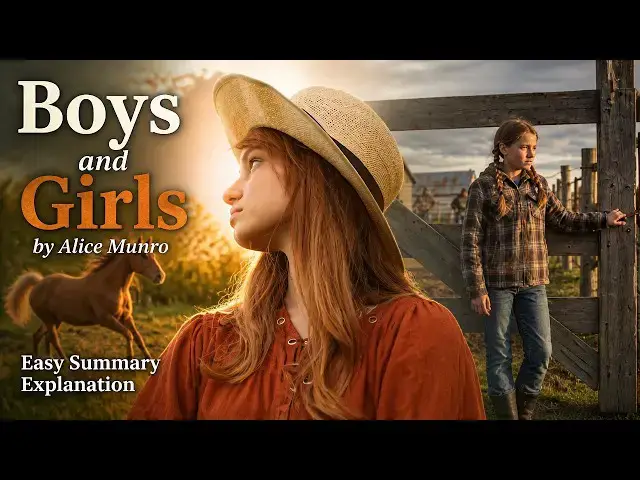

Boys and Girls by Alice Munro | Easy Summary Explanation
Oct 6, 2026

Boys and Girls by Alice Munro | Summary & Analysis | Themes, Characters & Ending Explained
In this video, we explore Alice Munro’s “Boys and Girls” through a complete summary and detailed literary analysis. The story follows an unnamed young girl growing up on a fox farm in rural Canada as she gradually discovers how family and society define the different roles expected of boys and girls.
At the beginning of the story, the narrator is proud to work alongside her father on the fox farm. She sees herself as capable, useful, brave, and independent. She enjoys outdoor work and feels that she belongs in her father’s world. As she grows older, however, she begins to realize that being a girl carries expectations that limit the freedom and opportunities she once believed were available to her.
The video explains the narrator’s relationship with her father, mother, and younger brother Laird, as well as the importance of Henry Bailey, Mack, and Flora. We also examine how the fox farm provides the setting for the narrator’s changing understanding of childhood, adulthood, work, gender, violence, and responsibility.
What this video covers:
Complete summary of “Boys and Girls”
Alice Munro and the story’s literary context
The unnamed narrator and her childhood perspective
Character analysis of the narrator, Laird, father, mother, and Henry Bailey
The conflict between the narrator and her mother
The narrator’s relationship with her father
Gender roles and social expectations
Coming of age and loss of innocence
Freedom, identity, and conformity
The significance of the fox farm
The symbolism of Mack and Flora
The importance of the gate and Flora’s escape
The meaning of the narrator’s changing imagination
The significance of the phrase “She’s only a girl”
The meaning of the ending
Why the narrator says “Maybe it was true”
Major themes and literary significance
The central conflict of the story emerges when the narrator is expected to accept the increasingly narrow role assigned to her because she is a girl. The episode involving Flora becomes the decisive moment in this conflict. When the narrator is expected to close the gate and prevent Flora from escaping, she instead opens it.
Although Flora is eventually caught and killed, the narrator’s action remains significant. It reveals her instinctive resistance to authority and to the role that is being imposed upon her. The ending, in which her father dismisses her as “only a girl,” brings together many of the story’s central ideas about gender, identity, family, and growing up.
“Boys and Girls” is therefore much more than a story about a child on a fox farm. It is a powerful coming-of-age story about the gradual discovery of gender roles and the ways in which social expectations shape a person’s understanding of herself.
This video is especially useful for English Literature students, teachers, exam preparation, assignments, classroom discussion, and anyone studying Alice Munro’s short fiction.
If you find this analysis helpful, like the video, subscribe to Ask Literature, and share it with other literature students.
#AliceMunro #BoysAndGirls #EnglishLiterature #ShortStoryAnalysis #Literature
Show More Show Less