Up next in 10


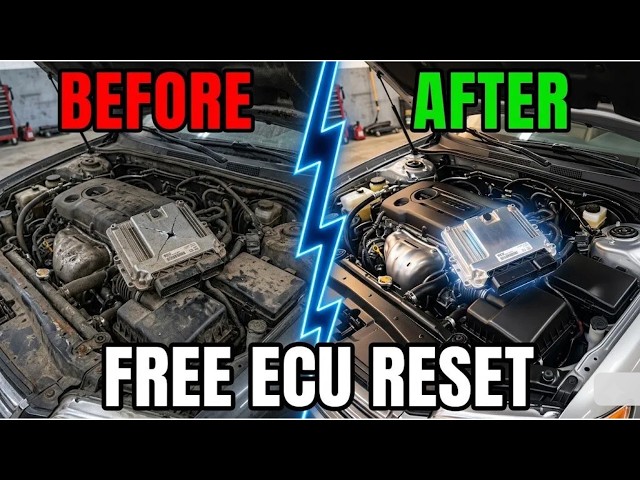
ECU reset procedure that fixes rough idle, bad fuel economy, and sluggish
acceleration — completely free, no parts needed.
Most mechanics will never tell you this. Your engine's computer builds up
years of incorrect corrections — and it causes REAL symptoms that get
misdiagnosed as part failures every single day.
This full ECU reset procedure costs $0 and takes under 30 minutes.
⚠️ WATCH UNTIL THE RELEARN SECTION — that's where 90% of people fail.
─────────────────────────────
📌 TIMESTAMPS
─────────────────────────────
0:00 - Why your car isn't actually broken
1:45 - How ECU drift causes fake symptoms
4:20 - The full reset procedure (step by step)
8:30 - The relearn phase (most people skip this)
10:00 - Throttle body resync for Toyota/Honda
─────────────────────────────
Show More Show Less View Video Transcript
0:00
Your car might not be broken. And if you
0:02
have spent money trying to fix a rough
0:04
idle, bad fuel economy, or sluggish
0:06
acceleration, there is a high chance you
0:09
fixed the wrong thing. Because your
0:11
engine can literally train itself to run
0:13
worse over time. And the worst part, it
0:15
can look exactly like a mechanical
0:17
failure. Even when nothing is actually
0:19
broken, almost no mechanic resets it
0:22
properly. Here's what's actually
0:23
happening inside your engine's computer.
0:25
How to fix it correctly at home for $0
0:28
in parts. and the two critical steps
0:30
that almost every version of this
0:32
procedure skips entirely. Without those
0:34
two steps, the reset does almost
0:36
nothing. Stay with this video until the
0:38
relearn section. That is where the real
0:40
results come from, and it's the part
0:42
nobody talks about. Why your ECU builds
0:45
up problems over time. Every Japanese
0:47
vehicle built after roughly 1996 has an
0:50
engine control unit, the ECU, that does
0:53
not run on fixed programming. It learns.
0:55
It adapts continuously to your fuel
0:57
quality, your altitude, your driving
0:59
habits, and the gradual changes
1:01
happening inside your engine as the
1:03
miles add up. Here's the part nobody
1:05
tells you. The ECU does not know what's
1:07
right or wrong. It just keeps adjusting,
1:09
even when the data feeding it has gone
1:11
bad. Think of it like this. Your ECU is
1:14
stacking tiny corrections for years
1:16
until it's completely out of sync with
1:18
reality. A mass air flow sensor reads
1:20
slightly lean. Adjust it. Carbon buildup
1:22
changes air flow. Adjust it. Different
1:24
fuel brand adjusted. Sticky EGR valve
1:27
adjusted. Every correction stacks on top
1:29
of the last. Now imagine that happening
1:31
for 100,000 mi. What you end up with is
1:34
an engine running against itself. Old
1:37
corrections fighting new corrections.
1:39
The system is not broken, it's confused.
1:41
And a confused engine produces every
1:43
symptom that mechanics routinely blame
1:45
on worn out parts. A 2018 study
1:48
published in the SAE International
1:50
Journal of Engines documented measurable
1:53
fuel trim deviation in high mileage
1:55
vehicles with completely intact
1:57
nonfaulty sensors. The sensors were
1:59
fine. The accumulated adaptive
2:01
corrections were the problem. And that
2:03
misunderstanding is what costs people
2:05
hundreds of dollars over and over. What
2:07
the symptoms look like? Here's where it
2:09
gets interesting. Because these symptoms
2:11
are gradual enough that most people
2:13
never connect them to a single cause. An
2:15
idle that floats between roughly 600 and
2:18
1,000 RPM at a stoplight instead of
2:20
sitting rock solid. A flat, vague
2:22
feeling in the first inch of throttle
2:24
travel. Like the engine takes half a
2:26
second to decide to respond. Fuel
2:28
economy that has quietly dropped 8 to
2:30
15% over 2 or 3 years with no obvious
2:34
mechanical reason. A rough stumble at
2:36
cold start that smooths out after a few
2:38
minutes. and that brief hesitation when
2:40
you pull out from a stoplight into
2:42
moving traffic. None of these symptoms
2:44
force an emergency shop visit. All of
2:46
them will produce real diagnostic codes
2:48
that a scan tool will attribute to real
2:50
components. And all of them can be
2:52
caused entirely by accumulated ECU
2:54
drift, not a single failing part. That's
2:57
the trap. What this procedure actually
2:59
is. Before going into the steps, here's
3:01
where almost every version of this
3:03
procedure fails. They skip two steps and
3:05
without them, the reset does almost
3:07
nothing. So, let's be precise about what
3:10
this is first. This is not a battery
3:12
disconnect. Disconnecting your battery
3:14
does clear some ECU volatile memory, but
3:17
the adaptive fuel trim tables and
3:19
long-term correction data are stored in
3:21
nonvolatile memory that survives a
3:23
battery disconnect in most modern
3:25
Japanese vehicles. It's an incomplete,
3:27
imprecise interruption. This is also not
3:29
the same as clearing codes with a scan
3:31
tool. Clearing codes removes stored
3:33
fault history. It does not touch
3:35
adaptive learning tables. The full
3:37
procedure covered here is a controlled
3:39
graduated shutdown sequence that allows
3:42
the ECU circuits to discharge in the
3:44
correct order, which is what enables the
3:46
deeper memory tables to fully clear.
3:48
Japanese dealerships have treated this
3:50
as routine maintenance. In the United
3:52
States, it's almost never mentioned.
3:54
This is where most people mess it up.
3:56
They use a shortcut version and wonder
3:58
why nothing changed. The full reset
4:00
procedure, step one, and if you skip
4:02
this, the entire reset fails. Your
4:05
engine must be fully at operating
4:07
temperature, not started and idling in
4:09
the driveway, actually driven. A minimum
4:11
of 15 minutes of highway driving. A cold
4:14
or partially warm engine will not
4:16
complete the idle stabilization phase
4:17
the way it needs to. Step two, once you
4:20
park, turn everything off. Air
4:21
conditioning, rear defroster, heated
4:23
seats, every accessory drawing current.
4:26
You want the absolute minimum electrical
4:28
load on the system before the next phase
4:30
begins. Step three, this one is easy to
4:32
rush, and rushing it costs you the whole
4:34
result. Let the engine idle completely
4:36
undisturbed for 10 full minutes. Don't
4:39
touch the accelerator. Don't rev it.
4:40
What's happening during those 10 minutes
4:42
is the ECU settling its current
4:44
operating state into a clean, stable
4:47
baseline before the reset wipes it. Step
4:49
four, shut the engine off. Now, wait 30
4:51
seconds exactly. Step five, this is the
4:54
core of the procedure and the reason it
4:56
works differently from a battery
4:57
disconnect. Turn the ignition to the on
4:59
position. Dash lights up. Engine stays
5:02
off and hold it there for 60 seconds.
5:04
Then fully off. Wait 30 seconds. Repeat
5:07
that complete cycle three times total.
5:09
Those key cycles allow the ECU capacitor
5:12
circuits to discharge in a controlled
5:14
graduated sequence. This is the
5:16
technical difference between this
5:17
procedure and a battery disconnect. An
5:19
abrupt battery disconnect interrupts the
5:21
system mid-process. These cycles allow
5:24
the adaptive memory tables to close
5:26
cleanly before the volatile memory
5:28
clears, which is what produces a
5:30
complete factory reset rather than a
5:32
partial one. And now here's the first of
5:33
the two steps most versions skip
5:36
entirely. Leave the car completely alone
5:38
for a minimum of 2 hours. 4 hours is
5:41
meaningfully better. Overnight is best.
5:43
The capacitors in the ECU continue
5:45
discharging for an extended period after
5:48
the key cycles finish. The full reset of
5:50
the adaptive tables doesn't complete
5:52
until that discharge is done. People who
5:54
try this and report zero results almost
5:57
always cut this weight to 20 or 30
5:59
minutes. That's exactly why most people
6:02
see no results. The weight is not
6:04
optional. This is where the reset
6:06
actually happens. The second step most
6:08
people skip is coming next, and it's the
6:10
one that determines whether you get 80%
6:12
of the benefit or the full result. The
6:14
relearn phase. After the long wait,
6:16
restart the engine. The idle will sound
6:19
rough and unsteady for the first 60 to
6:21
90 seconds. That is a good sign. What
6:23
you are hearing is the ECU rebuilding
6:26
its idle control parameters from factory
6:28
defaults in real time. Do not touch the
6:30
accelerator. Let it idle for five full
6:33
minutes and watch it settle. Now the
6:35
relearn phase begins. This is where most
6:38
people think the job is done. It is not.
6:40
The reset clears the memory, but the ECU
6:42
immediately starts relearning. And how
6:45
you drive the next 20 to 30 mi
6:47
determines the quality of everything it
6:49
builds. For the first stretch after
6:51
restart, drive gently. Nothing above
6:53
moderate speed. Smooth, gradual throttle
6:56
inputs, no hard acceleration. You are
6:58
letting the ECU establish clean idle and
7:01
low-speed fuel values without throwing
7:03
complicated high load data at it before
7:05
the baseline is stable. After those
7:07
initial miles, work up to highway speeds
7:09
with natural varying throttle. Do not
7:12
use cruise control during this phase.
7:14
The ECU needs real throttle variation to
7:17
build accurate fuel maps across the full
7:19
operating range. Those moments where you
7:21
lift off the throttle and let the car
7:23
slow on its own. Do not fight them with
7:25
the brakes. Those deceleration events
7:27
are how the ECU learns its lean fuel
7:29
trim correction values. They matter.
7:32
Avoid short trips for the first 2 days
7:34
if you can. Every cold start that gets
7:36
shut off before the engine reaches
7:38
operating temperature interrupts a
7:39
learning cycle. Longer drives during
7:41
this period produce significantly
7:43
cleaner results. Here is the second
7:45
critical step that almost nobody
7:46
includes. For Toyota, Lexus, and Honda
7:49
vehicles with electronic throttle
7:51
control, which covers essentially
7:52
everything built after 2003, there is a
7:55
separate throttle body relearn that must
7:57
be performed before the procedure is
7:58
complete. The throttle body has its own
8:01
adaptive position memory. without
8:02
reyncing it to the freshly reset ECU.
8:05
Some vehicles will continue showing a
8:07
hanging or slightly elevated idle
8:09
because the throttle body minimum
8:11
position no longer matches the new ECU
8:13
baseline. With the engine at full
8:15
operating temperature and running,
8:17
slowly depress the accelerator pedal to
8:19
the floor over 3 to 5 seconds. Hold
8:21
briefly, release slowly back to idle.
8:24
Repeat three times. that allows the
8:26
throttle body to register its full range
8:28
of travel and sync its minimum position
8:30
to the new ECU parameters. Skip this on
8:33
a Toyota or Honda and you will likely
8:35
end up blaming the reset for an idle
8:37
problem that is actually just an
8:38
incomplete sync. When this does not
8:40
apply, this procedure will not fix a
8:42
genuinely failing sensor. If your oxygen
8:45
sensor is physically degraded, clearing
8:47
the adaptive tables built around that
8:49
bad data will not make the sensor
8:51
accurate. The symptoms will return
8:52
within two to three tanks of fuel. In
8:54
that case, the reset has done something
8:56
useful. It has confirmed the problem is
8:58
real and not just accumulated drift. The
9:01
procedure also does not address
9:02
mechanical wear. Worn piston rings, a
9:05
leaking intake manifold gasket,
9:07
significant valve carbon buildup. These
9:09
are real problems the ECU has been
9:11
masking. Clearing the compensation may
9:13
temporarily make symptoms more
9:15
noticeable. If that happens, the
9:16
mechanical issue needs direct attention.
9:19
Active check engine lights with hard
9:20
fault codes should be investigated
9:22
before performing this reset. Pending or
9:24
historic codes are fine. An active fault
9:27
means something is broken right now.
9:29
Address it first. And if you have
9:30
recently replaced a component and the
9:32
car still doesn't feel right, the reset
9:34
is often exactly what closes the loop.
9:36
But if symptoms persist more than 500 m
9:38
after the full relearn, the replacement
9:40
part itself deserves a second look. What
9:43
actually changes when the procedure is
9:45
done correctly and the relearn phase is
9:47
followed. Idle stability improves within
9:49
the first day and idle hunting between
9:51
600 and,000 RPM at stoplights settles
9:54
into a consistent locked number. Fuel
9:56
economy improvement shows up within the
9:58
first full tank, typically in the range
10:00
of 8 to 15% with the higher end
10:02
appearing in vehicles that had the most
10:04
significant adaptive drift before the
10:06
reset. Throttle response sharpens. That
10:09
flat, vague quality in the first range
10:11
of pedal travel becomes more direct.
10:13
Cold start behavior normalizes. The
10:15
stumble in the first 60 seconds of a
10:17
cold morning startup becomes cleaner.
10:19
These results hold across Toyota, Honda,
10:21
Lexus, Subaru, and Mazda because the
10:24
procedure addresses the actual root
10:26
cause, not a component, but a system
10:28
level condition that builds across all
10:30
modern ECU equipped vehicles over time.
10:32
Here's what to take away. One, your ECU
10:35
learns continuously and over high
10:37
mileage builds layers of adaptive
10:39
corrections that begin to conflict. This
10:41
creates real symptoms that get
10:43
misdiagnosed as fail parts every day.
10:45
Two, the full reset requires a warmed
10:48
engine, minimum electrical load, a
10:50
10-minute stabilized idle, three
10:52
controlled key cycles, and a minimum
10:54
2-hour wait. The wait is where the reset
10:56
actually happens. Three, the relearn
10:58
phase. 20 to 30 mi of smooth, varying
11:01
driving after restart determines the
11:03
quality of everything the ECU rebuilds.
11:06
It is not a bonus step. Four, Toyota,
11:08
Lexus, and Honda users with electronic
11:11
throttle control need the separate
11:12
throttle body relearn or risk a hanging
11:15
idle that the ECU alone will not
11:17
resolve. Five, if symptoms return within
11:19
two to three tanks after a clean
11:21
relearn, you have a genuine sensor or
11:23
mechanical issue. The reset confirmed it
11:25
rather than caused it. Performing this
11:27
procedure before replacing sensors,
11:29
throttle bodies, or injectors can
11:31
eliminate parts and labor costs that
11:33
routinely run between $300 and $900. I
11:37
want to test something. Comment below
11:38
with this. What symptom is your car
11:40
showing right now? Rough idle, bad fuel
11:43
economy, slow acceleration, something
11:45
entirely different. Try the procedure,
11:47
then come back and update your comment
11:48
with what actually changed. Let's see
11:50
how many cars this fixes. If this video
11:52
gave you a real answer to something
11:54
you've been chasing, hit the thumbs up
11:56
and subscribe to Your Motorc Care. New
11:58
videos every week. Always accurate,
12:00
never padded. Your comment is waiting.
12:02
Drop it below.
#Autos & Vehicles