Up next in 10


How often should you change your oil with synthetic? The answer from
your owner's manual will shock you — and it's nothing like what your
quick lube sticker says.
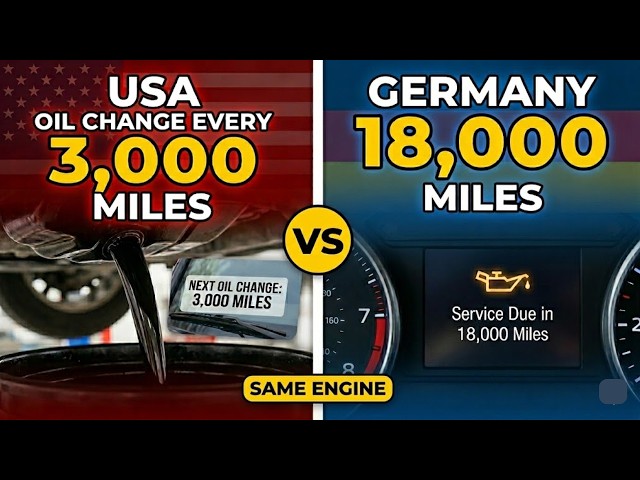
I compared two drivers. Same car. Same engine. Same mileage. One
American, one German. The American changed his oil 16 times and spent
$1,400. The German changed his 3 times and spent $280. Then I sent
both oil samples to a certified lab (Blackstone Laboratories — the
same lab used for aircraft engines and industrial equipment).
The driver who changed his oil 16 times had MORE engine wear.
Here's what I cover in this video:
— Why the 3,000 mile interval was invented in 1979 by a marketing
department, not an engineer
— What Germany's 18,000 mile standard proves about modern synthetic oil
— How BMW's Condition Based Service sensor actually works
(it measures oil degradation in real time — not mileage)
— The Total Base Number explained: why modern Mobil 1 at 15,000 miles
beats conventional oil at 3,000 miles
Show More Show Less View Video Transcript
0:00
My neighbor just showed me his oil
0:01
change receipt. 47,000 mi, 3 years of
0:04
ownership, 16 oil changes. My German
0:07
colleague, same car, [music] same
0:09
engine, $52,000 mi, three oil changes.
0:12
One guy spent $1,400, the [music] other
0:14
spent 300. But here's what made me
0:16
actually angry. I had them both send oil
0:19
samples to a certified lab. The guy
0:21
[music] who changed his oil 16 times,
0:24
his engine shows more wear. If you're
0:26
still doing the 3,000mi oil change,
0:29
you're about to find out [music] why
0:30
that advice is costing you over $2,000
0:33
per vehicle, and [music] it might be
0:35
doing more harm than good. The 3,000mi
0:38
problem. This recommendation came from
0:40
the 1970s when oil genuinely broke down
0:43
in 3,000 mi. Engines were different.
0:45
Carburetors dumped excess fuel.
0:47
Tolerances were loose. That was 50 years
0:49
ago. Walk into most quick lube shops
0:51
today and you'll still get a sticker
0:53
[music] saying next oil change in 3,000
0:56
miles. Here's where that sticker
0:57
actually came from. Jify Lube introduced
0:59
the window sticker reminder in 1979,
1:02
[music]
1:03
the same year they opened their first
1:04
drive-thru service bay. That sticker was
1:06
never an engineering recommendation. It
1:09
was a marketing tool. They invented it
1:11
and the [music] entire quick lube
1:12
industry adopted it because the math is
1:14
simple. Four visits per year [music]
1:16
instead of one means four times the
1:18
revenue from your vehicle. Jify Lube now
1:20
serves over 20 million customers per
1:22
year across [music] 2,000 locations. The
1:25
entire Quick Lube industry generates an
1:27
estimated $2.3 billion [music] dollar
1:29
annually from premature oil changes,
1:32
services the engineers who built your
1:33
engine never asked for. In 2011, Jify
1:36
Lube [music] actually launched a new
1:38
program called the oil change schedule
1:40
that moved away from the 3000mi model
1:43
and [music] towards manufacturer
1:44
recommendations. They quietly
1:46
acknowledged the sticker was outdated.
1:48
>> [music]
1:48
>> Most of their locations still put it on
1:50
your windshield anyway. Here's what most
1:52
people never [music] look at. Go find
1:54
your owner's manual right now. Look at
1:56
the maintenance schedule. Almost every
1:57
car built after 2010 says 7500 to 10,000
2:01
[music] mi. My Toyota manual says
2:03
10,000. My friend's Honda says 10,000.
2:05
[music] His Ford F-150 says 10,000 with
2:08
synthetic. The disconnect between what
2:10
quick lube places recommend and what
2:12
your [music] engine's engineers
2:13
recommend is massive. Now, here's where
2:15
it gets interesting. In Germany,
2:17
standard oil change intervals are 30,000
2:19
km. That's about [music] 18,600
2:22
mi for us. Many German vehicles with
2:25
long life [music] service go even
2:26
further. BMW uses something called
2:29
conditionbased servicing. The car
2:31
monitors oil degradation in real [music]
2:33
time. Here's specifically how it works.
2:35
Around 2003, BMW introduced an oil
2:38
[music] condition sensor located in the
2:40
bottom of the oil pan. And that sensor
2:42
measures the electrical [music]
2:43
conductivity of the fluid. As the
2:45
additive package degrades, the
2:46
resistance of the fluid changes. The
2:48
sensor detects this. Combined [music]
2:50
with data on fuel consumption, engine
2:52
load, oil temperature, cold start
2:54
frequency, and RPM patterns. [music] The
2:56
car's computer calculates the optimal
2:58
moment for an oil change. Not based on
3:00
an arbitrary mileage, but based on the
3:03
actual state of your oil. The maximum
3:05
service interval on late model BMWs
3:07
running this system using BMW approved
3:10
high-performance 5W30 synthetic [music]
3:12
is 15,500 mi. Some drivers with
3:16
predominantly highway [music] miles have
3:17
reported the CBS system extending past
3:20
that. When the car calculates your oil
3:22
is actually wearing out based on real
3:24
conditions, [music] it tells you not at
3:26
an arbitrary mileage when it's actually
3:28
necessary. And before someone says
3:30
German engines must be falling apart,
3:32
it's not uncommon for well-maintained
3:34
German engines [music] to exceed 300,000
3:37
mi with proper care. I got hold of a
3:39
certified oil analysis from a BMW 330i
3:42
in Munich. 25,000 m on the same [music]
3:46
oil. Blackstone Laboratories tested it.
3:48
These are the people who analyze oil for
3:50
aircraft [music] engines and industrial
3:51
equipment. They've been doing this since
3:53
1985 using [music] inductive coupled
3:56
plasma spectrometry. The same analytical
3:58
technology used for [music] industrial
4:00
machinery worth millions of dollars.
4:02
Total base number 6.8 out of 10. That
4:05
measures acid neutralizing ability.
4:07
Viscosity still in spec. Metal [music]
4:09
wares normal range. The lab wrote, "Oil
4:11
and filter suitable for continued use at
4:14
25,000 mi. That's not typical for most
4:17
drivers, but it's proof that oil [music]
4:19
chemistry isn't the limiting factor
4:21
people assume it is. This is the part
4:23
most people get wrong. Modern full
4:25
synthetic oil is fundamentally [music]
4:27
different from 1980s conventional oil.
4:29
We're not talking about minor
4:31
improvements. The chemistry [music] is
4:32
completely redesigned. Old conventional
4:35
oil was refined, crude, inconsistent
4:37
molecules loaded with impurities and
4:39
paraffin waxes that solidified in cold
4:42
temperatures [music] and broke down
4:43
under heat within a few thousand miles.
4:45
Modern Mobile One extended [music]
4:47
performance is engineered at the
4:48
molecular level. Every molecule uniform
4:51
chemical structure designed for thermal
4:53
[music] stability. The paraffin waxes
4:55
are gone entirely. Real numbers.
4:57
Conventional oil from the 80s started
4:59
with a TBN [music] around 6. After 3,000
5:01
mi, it dropped to 2 or 3. Barely
5:04
functional. Modern [music] Mobile 1
5:06
extended performance starts with a TBN
5:08
around 9 to 10. After 10,000 mi, it's
5:11
still at 7 or 8. After 15,000 [music]
5:13
mi, it's at 5 or 6. Well above the point
5:16
where conventional oil was failing at
5:18
3,000. But here's the part of the
5:20
chemistry that really matters and
5:21
[music] almost nobody talks about. Your
5:23
engine's anti-wear additives, the ZDDP
5:26
compounds, [music] the phosphorus and
5:28
zinc chemistry that actually prevents
5:30
metaltometal contact are not [music]
5:32
fully activated until the oil reaches
5:34
operating temperature. A cold engine
5:36
gets less anti-wear [music] protection
5:38
per mile than a warm one. This is why
5:40
engineers have known for decades that
5:42
the most wear on any engine doesn't
5:44
happen during normal operation. It
5:46
happens during cold starts and warm up
5:48
before the oil [music] is circulated
5:49
fully and before those additive packages
5:52
activate. Studies referenced in SAE
5:54
research [music] papers going back to
5:55
the 1950s tied peak engine wear to
5:58
thermal expansion [music] phase of
5:59
warm-up, not to oil mileage. Cold piston
6:02
rings and cylinder walls don't seal
6:04
correctly. The air fuel mixture runs
6:06
rich and washes [music] lubricant off
6:08
cylinder walls. The oil filter can
6:09
bypass entirely in very cold oil because
6:12
the thick fluid can't pass through the
6:14
media fast enough. What does this mean
6:16
for oil change intervals? Every [music]
6:18
time you change your oil unnecessarily,
6:20
you're adding one more cold start, one
6:22
more warm-up cycle, one more period of
6:24
elevated [music] wear before everything
6:26
reaches temperature. The neighbor
6:28
changing his oil 16 times added 12 extra
6:31
cold start wear [music] events compared
6:33
to the guy changing three times. That's
6:35
why the oil analysis showed more [music]
6:37
wear, not less. European manufacturers
6:39
understood this 20 years ago. They
6:42
created long life specifications.
6:43
[music]
6:44
BMW longife04, Mercedes MB229.5,
6:48
Volkswagen 504.0. [music]
6:51
These aren't marketing labels. These are
6:53
laboratory certifications proving the
6:55
oil handles extended intervals without
6:58
breakdown. What your oil life monitor
7:00
actually works. [music] Most people
7:01
treat the oil life monitor like a
7:03
nuisance. They ignore it and change it
7:05
3,000 miles anyway. That's throwing away
7:07
technology that cost manufacturers
7:09
millions of dollars to develop. Honda's
7:12
maintenance [music] mander system used
7:13
on Accords, CRVS, and most of their
7:15
lineup doesn't track mileage. [music] It
7:18
tracks engine parameters, oil
7:19
temperature, engine revolutions, vehicle
7:21
speed, [music] cold starts. The
7:23
algorithm calculates actual oil
7:25
degradation based on [music] how you
7:27
specifically drive your specific car. If
7:30
you do mostly highway miles in a
7:31
moderate climate, Honda's system will
7:33
often let you go 10,000 miles or more.
7:35
If you do short [music] city trips in
7:37
extreme cold, it might tell you to
7:39
change at 5,000. It's custom to your
7:41
vehicle and your driving. Ford's
7:43
intelligent oil life monitor works
7:45
similarly. [music] GM's oil life system
7:47
has been in their vehicles since the
7:48
early 2000s and was one of the first
7:50
mass market implementations of [music]
7:52
this technology. When these systems
7:54
display 10% oil life remaining, they're
7:56
not being conservative and rounding
7:58
down. They've calculated [music] that
7:59
your actual oil has 10% of its
8:02
protective capacity left. Changing it
8:04
3,000 mi when the monitor says [music]
8:06
70% remaining isn't being careful. It's
8:08
ignoring the instrument. The sludge myth
8:10
and other objections. [music] Now,
8:12
before someone comments that extended
8:14
intervals cause sludge and destroy
8:16
engines, let me address that directly.
8:17
[music]
8:18
Sludge comes from three things. Using
8:20
cheap oil, severe short trip driving
8:23
where the engine never reaches full
8:24
temperature, and outright neglect. It
8:27
doesn't come from running quality
8:28
synthetic oil to 10,000 miles in normal
8:31
[music] driving conditions. The sludge
8:33
issues you've heard about, Toyota 2AZ FE
8:36
engines from the early 2000s, [music]
8:38
Volkswagen 1.8T turbos from the same
8:41
era, those were engineering problems.
8:43
Poor PCV system design, inadequate oil
8:46
return passages, nothing to do with oil
8:48
change [music] intervals. And here's the
8:50
real test. If extended intervals
8:53
systematically caused premature engine
8:55
failure, manufacturers would have been
8:57
forced to revise their maintenance
8:58
programs [music] years ago. They've been
9:00
recommending these intervals in Germany
9:02
for over two decades. The programs
9:04
haven't changed because when you use the
9:06
right oil for the right [music]
9:07
application, it works. Yes, European
9:10
fuel quality is slightly different. Yes,
9:13
German drivers do more highway miles on
9:15
average, but that accounts for [music]
9:16
maybe a,000 mi of difference, not 7,000.
9:20
What about your American car? Here's
9:21
what American and Japanese manufacturers
9:23
[music] actually recommend. 2020 Ford
9:26
F-150 with the 5 L V8, 10,000 mi with
9:30
synthetic. [music] 2021 Chevy Silverado,
9:33
7,500 mi. 2019 Honda Accord, 10,000 mi.
9:37
2020 [music] Toyota Camry, 10,000 mi.
9:40
Almost all of them are 7,500 mi or
9:43
higher. [music] None say 3,000. They're
9:45
not at 30,000 mi like some German
9:48
vehicles because American driving
9:49
includes more short [music] trips and
9:51
because legal liability makes
9:53
manufacturers conservative. But
9:55
conservative means 7500 to 10,000 mi,
9:59
not [music] 3,000. When you need shorter
10:01
intervals, your manual has two
10:03
schedules, normal and severe. [music]
10:05
Most people think they're normal. Most
10:07
are wrong. Your severe service if you
10:09
make mostly short trips under 10 m. If
10:12
you sit in stopand go traffic daily. If
10:14
you operate in extreme heat [music] or
10:16
extreme cold, if you tow regularly or
10:18
haul heavy loads, that applies [music]
10:20
to many drivers. Severe service interval
10:22
is usually half the normal interval.
10:24
[music] If normal is 10,000, severe is
10:27
5,000. Still not 3,000. Here's the
10:30
science behind [music] why short trips
10:31
are so damaging. When an engine runs
10:33
cold, the air fuel mixture [music] is
10:35
richer than normal. The engine injects
10:37
extra fuel to maintain idle. Some of
10:40
that unburned fuel blows past the piston
10:42
rings [music] and directly into the oil.
10:44
This is called fuel dilution and it
10:46
thins the oil and degrades its
10:47
protective properties. On a longer trip,
10:50
the engine [music] heats to full
10:51
operating temperature and those volatile
10:53
fuel contaminants evaporate out of the
10:55
oil. But 5-minute trips twice a day
10:57
never reach [music] that temperature,
10:59
never boil off the contaminants, and the
11:01
oil accumulates fuel [music] dilution
11:03
and moisture with every cold start. This
11:05
is the actual chemistry of why [music]
11:07
short trips are hard on oil. Not because
11:09
the oil ages, but because it never gets
11:11
hot enough to clean itself. That's when
11:14
5,000 mi makes sense. [music] If you're
11:16
doing mostly highway driving in a
11:18
moderate climate, your manual's normal
11:20
schedule is fine. The oil analysis
11:22
advantage. [music] Here's a tool that
11:24
almost nobody in America uses, but that
11:26
industrial operations and European
11:28
enthusiasts have relied on for decades.
11:30
[music]
11:31
Blackstone Laboratories in Fort Wayne,
11:33
Indiana, has been analyzing oil since
11:34
[music] 1985. They use inductive coupled
11:38
plasma spectrometry, the same technology
11:40
used in mining, manufacturing, and
11:42
aerospace. For $35, you mail them a
11:45
small oil sample and within days [music]
11:47
they email you a complete breakdown,
11:49
wear metals like iron and aluminum and
11:52
parts per million, TBN remaining,
11:54
viscosity grade confirmation, and a
11:56
plain English comment from their
11:58
engineers telling you whether your oil
11:59
is still good, [music] whether to watch
12:01
any elevated metals, and what interval
12:03
they recommend for your specific engine.
12:05
They maintain an enormous database of
12:07
averages by engine type. So when they
12:10
say your iron reading is 16 parts per
12:12
million, they can compare it to the
12:14
average for your exact engine at that
12:16
interval and tell you whether that's
12:17
normal or elevated. People use
12:19
Blackstone to find head gasket failures
12:21
before they cause [music] catastrophic
12:23
damage, to track bearing wear trends, to
12:25
confirm that a used car they bought has
12:27
no hidden problems, and most
12:29
importantly, to dial in their exact oil
12:31
[music] change interval for their exact
12:33
driving habits. Do it once and you'll
12:36
know whether you're changing too [music]
12:37
early, right on time, or even whether
12:39
you could push further. It's $35 of
12:42
actual engineering data versus a sticker
12:44
on your windshield invented by a
12:46
marketing department in 1979. [music]
12:48
Your actual action plan. Here's exactly
12:51
what to do. Read your owner's manual
12:53
maintenance [music] schedule. Know what
12:54
the engineers who built your engine
12:56
recommend. Be honest about your driving.
12:58
Short [music] city trips mean severe
13:00
service. Highway miles mean normal
13:02
service. Use [music] quality full
13:04
synthetic that meets your specs. Mobile
13:06
One, Penso, Platinum, Castro Edge,
13:09
Valvaline Advanced. [music] If you want
13:11
European specs, Liquoli or Ravvenol.
13:14
Yes, they cost more upfront, [music] but
13:16
you're changing half as often, so annual
13:18
cost is the same or less. Consider
13:20
getting one oil analysis from Blackstone
13:22
[music] Labs. $35 tells you if you're
13:24
changing too early or too late. Do
13:26
[music] this once and you'll know your
13:28
exact interval. If your car has an oil
13:30
life monitor, and most cars after 2010
13:32
do, [music] use it. When it says 10%
13:35
remaining, change it. Don't ignore the
13:37
system and change at [music] 3,000
13:38
anyway. The real cost, $15,000 m per
13:41
year. Average American driving. At 3,000
13:44
mi intervals, that's five [music]
13:46
changes annually. $75 each, $375 per
13:50
year. [music] Over 10 years, $3,750.
13:53
At 10,000 mi intervals, that's one or
13:56
two changes [music] annually. $75 to
13:58
$150 annually. Over 10 years, $750 to
14:02
$1,500. You save $2,000 per vehicle. But
14:06
there's a cost beyond money that most
14:08
people never think about. Every time you
14:10
change oil, there's risk. Stripped drain
14:12
plug, overtightened filter, wrong
14:14
[music] oil, forgotten gasket. More
14:16
changes means more chances for mistakes.
14:19
And every additional oil change means
14:21
one more cold start, one more warm-up
14:23
cycle of elevated wear before your
14:25
engine reaches operating temperature
14:27
[music] and your anti-wear additives
14:28
activate. Plus the environmental impact.
14:31
The 3,000mi myth generates hundreds of
14:34
millions of quarts of perfectly good
14:35
waste oil every year in the United
14:37
States alone. [music] Oil that still had
14:40
protective capacity drained
14:41
unnecessarily because of a sticker a
14:43
quick lube franchise invented to drive
14:45
foot traffic. [music] Multiply the
14:47
environmental processing cost of that
14:49
across 200 million vehicles and the
14:51
numbers become staggering. [music] What
14:53
to do now? Tonight, read your owner's
14:55
manual maintenance schedule. Know what
14:57
the engineers who built your engine
14:58
recommend. Assess your actual [music]
15:00
driving, city or highway, short trips or
15:03
long. Next oil change, switch to quality
15:05
synthetic that meets your specs. [music]
15:07
Follow your manufacturer interval, not
15:09
what a sticker says. If you want
15:10
detailed oil specification charts,
15:13
interval recommendations for different
15:14
manufacturers, [music] and how to read
15:16
oil analysis reports, I've put together
15:18
a complete guide at your motorcare.com.
15:20
[music]
15:21
Links to certified labs, recommended
15:23
synthetics, and manufacturer specs are
15:25
in the description. The bottom line is
15:27
simple. The 30,000mi [music] myth is
15:29
outdated and costing you money. Germans
15:32
run 18,000 to [music] 30,000 mi without
15:34
issues. American manufacturers recommend
15:37
7500 to 10,000 for almost every modern
15:40
car. Stop following marketing. Start
15:42
following [music] engineering. If this
15:44
just saved you $2,000, subscribe for
15:47
more content that actually helps [music]
15:48
instead of selling you things you don't
15:50
need. Thanks for watching. Now go check
15:52
that manual.
#Autos & Vehicles
#Autos & Vehicles
#Vehicle Parts & Services
#Vehicle Repair & Maintenance