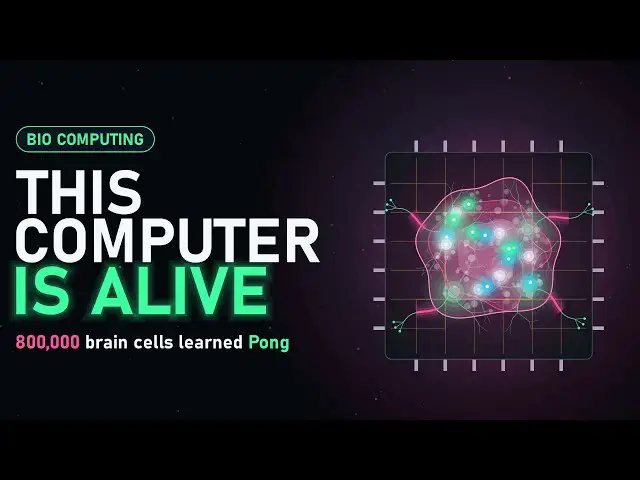

This Computer Is Alive: What Is Bio Computing?
Sep 12, 2026

800,000 living brain cells, grown in a dish, learned to play Pong in about 5 minutes — and nobody programmed them. Welcome to bio computing: computers built from the materials of life.
In this video:
• Why your 20-watt brain outclasses a 20-megawatt supercomputer on efficiency
• How Leonard Adleman solved a maths puzzle in a test tube in 1994
• How scientists program bacteria to behave like logic gates
• Brain organoids on electrode chips, and the first biological computer you can buy
• The hard problems: lifespan, speed, consistency and ethics
⏱ CHAPTERS
00:00 Brain cells that learned to play Pong
00:19 What is a computer, really?
00:55 The 20-watt brain vs a 20-megawatt supercomputer
01:25 The three branches of bio computing
01:40 DNA computing: a puzzle solved in a test tube
02:43 Living circuits: programming bacteria
03:30 Living neurons: brain organoids on a chip
04:36 Why it's not in your phone (yet)
05:17 The future: silicon + biology
05:42 Recap: what is bio computing?
📚 SOURCES & FURTHER READING
• Kagan et al. (2022). "In vitro neurons learn and exhibit sentience when embodied in a simulated game-world." Neuron. (DishBrain / Pong)
• Cortical Labs: CL1 biological computer announcement (March 2025).
• Jordan et al. (2024). "Open and remotely accessible Neuroplatform for research in wetware computing." Frontiers in Artificial Intelligence. (FinalSpark)
• Adleman, L. M. (1994). "Molecular computation of solutions to combinatorial problems." Science.
• Erlich & Zielinski (2017). "DNA Fountain enables a robust and efficient storage architecture." Science.
• Gardner, Cantor & Collins (2000). "Construction of a genetic toggle switch in Escherichia coli." Nature.
• Elowitz & Leibler (2000). "A synthetic oscillatory network of transcriptional regulators." Nature. (the repressilator)
• Smirnova et al. (2023). "Organoid intelligence (OI): the new frontier in biocomputing and intelligence-in-a-dish." Frontiers in Science.
• TOP500 list: power draw of the Frontier supercomputer (~21 MW).
Note: "200 million gigabytes per gram" is a theoretical maximum for DNA storage. The brain-vs-supercomputer comparison is about power draw, not a like-for-like measure of computing ability.
#BioComputing #Science #FutureTech
Show More Show Less #Science