
How Quantum Computers Actually Work (and Why They're Faster)
Sep 24, 2026

Quantum computers are not faster laptops. They are faster at a few specific jobs, and this video builds one of those jobs from scratch, with numbers you can check by hand.
We start with a puzzle: four boxes, one hidden prize, lids shut. An ordinary computer has one move -- open a box and look -- so it averages two and a half opens for four boxes, and half a million for a million boxes. Then we build the machine that can do better. A bit is a switch. A qubit keeps a number for each answer, called an amplitude, and squaring it gives the chance (0.71 squared is a half). The pair of numbers is an arrow whose length is always one, so the chances always add to 100%. An amplitude can also be NEGATIVE, and a measurement cannot tell plus from minus -- a fact that decides everything later. Two qubits keep four amplitudes: one per box. But measuring collapses all of it to one random box, so the numbers have to be rearranged first, using interference. The Hadamard gate is shown twice over: from zero it gives +0.71 and +0.71; from one it gives +0.71 and MINUS 0.71. Run it twice and four paths appear; the two paths to zero give 0.5 + 0.5 = 1, while the two paths to one give 0.5 - 0.5 = 0. The wrong answer erases itself. Then Grover's search on the four boxes: start at a half each, let one check flip the prize's sign, flip every amplitude around the average of 0.25, and box three goes to 1 while the empties fall to 0 -- the right answer, after a single check. Finally: inside a real machine (the dilution refrigerator, its temperature stages, the wiring and the chip), a million boxes in about 785 rounds, Shor's algorithm and encryption, and the honest limits.
CHAPTERS
00:00 Five minutes vs ten septillion years
00:30 The puzzle: four boxes, one prize
01:22 What a qubit really is
02:45 Two qubits, four numbers, four boxes
03:18 The catch: measuring throws it away
03:54 Interference and the Hadamard gate
05:16 Solving the puzzle in one check
06:29 Inside a real quantum computer
07:42 A million boxes, and breaking encryption
08:21 Why it is not in your phone
08:55 Where things stand
SOURCES & NOTES
• Google Quantum AI, "Meet Willow, our state-of-the-art quantum chip", 9 December 2024: 105 qubits; random circuit sampling in under five minutes against an estimated 10^25 years for a leading supercomputer; the first below-threshold error correction, where a larger grid of physical qubits lowers the logical error rate.
• Craig Gidney (Google), "How to factor 2048 bit RSA integers with less than a million noisy qubits", arXiv:2505.15917, 21 May 2025: under a week, down from a 20 million qubit estimate in 2019.
• L. K. Grover, 1996: search in about (pi/4) times the square root of N steps; for a million items that is roughly 785 rounds against 500,000 on average for checking one at a time.
• P. W. Shor, 1994: factoring in polynomial time, the reason a large enough quantum computer would break RSA-style encryption.
• The four-box worked example is exactly one Grover iteration: start at 0.5 each, flip the sign of the marked item, then reflect every amplitude about the average of 0.25. For N = 4 that lands on the answer with certainty after a single check. Every number on screen was checked by hand.
• Dilution refrigerators hold superconducting chips at roughly 10-15 millikelvin, colder than the 2.7 K background of deep space. The machine in this video is drawn to the real layout: a 300 K flange, 50 K and 4 K stages from the pulse tube, the still near 0.9 K, a cold plate near 0.1 K, and the mixing chamber near 0.01 K with the processor hanging below it; attenuators on the way down, a near-quantum-limited amplifier beside the chip and a HEMT amplifier at 4 K on the way back up.
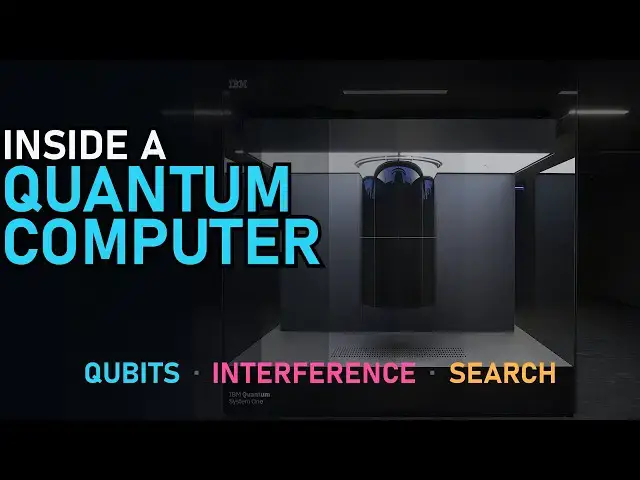
• IMAGE CREDITS: photograph of IBM Quantum System One by IBM Research, CC BY 2.0. Micrograph of a four-qubit device by Jay M. Gambetta, Jerry M. Chow and Matthias Steffen (IBM), CC BY 4.0. Both are used unmodified under those licences. Paper page: arXiv:2505.15917.
Logos are trademarks of their respective owners. Facts are as of September 2026.
Animated with Manim; maths typeset with LaTeX.
#physics #computerscience
Show More Show Less #Jobs & Education