Up next in 10

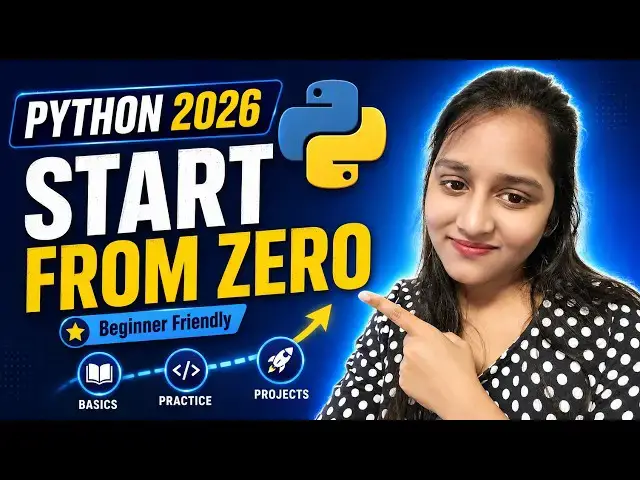
If I had to learn Python all over again, starting from nothing... this is exactly what I'd do. No confusion, no random tutorials, just a simple step-by-step plan.
In this video, I share 5 easy steps: learning the basics properly, building small simple projects, picking what to focus on, sharing your work online, and staying consistent... which matters more than being "smart."
If you're just starting out or feel stuck jumping between random videos with no clear direction, this will help.
📌 Watch next:
👉 Python programming for Beginners: https://youtu.be/4Dw7ZrTMOAo?si=m9_A8ObH904Yqd5-
👉 How long does it take to Learn Python: https://youtu.be/FYC5icAkLhM?si=iKIRE-S3h2JoEytP
⏱️ TIMESTAMPS
0:00 – Intro
0:26 – Step 1: Learn the Basics
1:56 – Step 2: Build Small Projects
4:10 – Step 3: Pick What You Like
6:13 – Step 4: Share Your Work
7:00 – Step 5: Stay Consistent
8:00 – Quick Recap
🔔 Subscribe to Simplified by Singham for more easy Python videos every week.
Show More Show Less View Video Transcript
0:00
If I had to delete everything I know,
0:02
and start Python from zero, then this is
0:05
what I would do exactly in 2026. No
0:09
fluff, no buy my course, just the real
0:12
roadmap. So, let's simplify Python right
0:14
now, but before that, one favor first.
0:17
Just hit subscribe. It's free for you,
0:20
really massive for me. Deal? Deal. Let's
0:22
begin then. So, stage one, the first two
0:25
weeks, what I would do is I would
0:27
definitely focus on the foundations, the
0:30
Python basic concepts. I will take as
0:32
much time I need to complete them and to
0:35
finish it. I would definitely not jump
0:38
directly into building an application on
0:41
the day one. So, I would definitely
0:42
learn all the basics, whatever needed to
0:45
learn Python to get the programming
0:47
language. Variables, loops, lists,
0:51
functions, everything. And yeah, if that
0:54
list sounds familiar, the keywords, I
0:56
have already made a video on them. The
0:59
link in the description, you can just go
1:00
there and check the videos and check the
1:04
content on the basics of Python. And
1:06
here [snorts] is one rule I will
1:08
definitely follow. I will not just watch
1:10
videos, instead, I will also code. I
1:14
will also code it myself. I will see how
1:17
it goes through, how it runs, and I will
1:20
also face all the errors that I'm
1:22
getting, and I will try to do it my
1:25
best.
1:26
So, not just seeing coding is not about
1:29
just seeing the code. It's all about the
1:31
practice, it's all about you have to do
1:34
instead of just seeing. So, don't just
1:37
watch, type the code first. Watching
1:40
someone code feel like learning? No,
1:42
it's not. Typing it, breaking it, fixing
1:46
it is the learning, is the actual
1:48
learning. So, two weeks, only basics.
1:52
So, week three and four, I will start
1:54
with numb and basic projects. Like what
1:59
I mean is I I might build a number
2:01
guessing game or just to do to do
2:04
application or maybe a calculator,
2:07
right? Sounds boring, but here is why it
2:11
really matters. It's not a resume worthy
2:13
app, it's not a startup app, but I will
2:16
definitely do it though it feels dumb,
2:18
it looks dumb because you'll be getting
2:21
output just in the form of text.
2:23
And that's really boring and that's
2:25
totally fine. Tutorials teach you syntax
2:29
and projects teach you thinking, how to
2:32
think like a programmer. Tutorials will
2:34
just teach you until that particular
2:36
concept. It will just give you some
2:38
examples, it will give you exercises and
2:40
you're good at doing it, but the project
2:43
you have to think like a real
2:45
programmer. So that is where you will
2:47
learn a lot rather than going through
2:50
it. So while doing projects, you'll get
2:52
stuck a lot. Trust me, a lot. So this is
2:56
the hardest part ever, but that's not
2:59
failure. That is learning.
3:02
That is not at all a failure, that is
3:04
learning. Every hour you spent where you
3:07
stuck looking at code and not getting
3:10
what to do and what's going on because
3:13
that's where you are actually learning
3:16
about programming. That is where you are
3:18
going through the things which are
3:20
really hard to understand, which are
3:22
really hard to process in your brain,
3:24
but yet you're just sitting there and
3:26
trying to figure it out yourself.
3:29
So that is where you're learning. That
3:30
is where you're becoming a programmer.
3:32
Trust me, that is not the place where
3:35
you stuck, that is the place where you
3:38
develop. You are not someone who copies
3:40
code. You are someone who understands
3:43
it, who gets what's going on there, who
3:46
gets how to fix it. So on to stage
3:49
three, like after building some dumb
3:51
projects and you know, after going
3:53
through all those trauma up there, I'm
3:56
I'm joking. It's not a trauma. It's a
3:59
place where you develop yourself, where
4:00
you develop your brain, where you
4:02
extend, okay? So, after going through
4:05
the most hardest part, in the second
4:08
month, I will definitely pick a lane.
4:10
Like, you know, like for example, if
4:13
you're learning Python, in the first 2
4:15
weeks you completed the basics and in 3
4:18
to 4 weeks you have completed building
4:20
some projects. And now, you have to
4:22
understand that like after learning
4:25
Python basics, after building some
4:27
projects, you should know what you want
4:30
to pick up. You want to be a developer
4:32
or you want to be a data scientist or
4:34
you want to be something else.
4:36
So, I can say that this is where most
4:39
beginners stuck. Like, they'll be like,
4:42
"Should I learn Python for data science?
4:44
Should I learn Python for AI? Should I
4:45
learn Python for web development? What I
4:47
have to do? What is it?"
4:50
They're like they have no idea about it,
4:52
right? Even I met that stage before. So,
4:56
here is my honest answer. It doesn't
4:58
matter what lane you pick. Seriously,
5:01
because the core Python skills will go,
5:04
will match, will transfer to whatever
5:08
the lane you pick, whatever the lane you
5:10
choose first. No matter which path you
5:13
choose later. So, if you're interested
5:16
in data, learn Pandas. If you're
5:18
interested in websites, learn Django and
5:21
Flask frameworks. Interested in
5:23
automation, learn to script your boring
5:26
tasks. So, you can learn file renaming,
5:29
file awakening, and many more. But, but
5:32
pick the lane whichever excites you.
5:36
Pick the lane whichever excites you.
5:38
Like if you're excited to learn web
5:40
development, pick web development. If
5:43
you're excited to learn a data
5:44
scientist, then pick that data
5:46
scientist. The reason I'm telling you to
5:49
pick whatever excites you because that
5:52
excitement is the actual fuel to learn
5:55
more about it. To to dig in, to get more
5:59
knowledge about it. Because that is what
6:01
keeps you consistent. So, this is what I
6:05
would do in the stage three. And coming
6:06
to the stage four,
6:09
I will start keeping my code in public.
6:11
I will start building in public. So,
6:13
every beginner must start build their
6:16
code in public. What does it mean? And
6:20
this is the stage where more beginners
6:22
skip. Even I skipped before. So, month
6:25
three onwards, build in public. And it's
6:29
the one that actually gets you hired,
6:32
noticed, and that gets you better. Put
6:35
your code in GitHub. Don't worry, even
6:37
if it's messy, even if it's small, mine
6:40
sure didn't. Post what you build. Talk
6:44
about what you learned. Try to ask
6:47
questions in communities. You can go to
6:49
Discord servers, Reddit, whatever.
6:53
Here's the secret. The people who
6:54
improve fastest are not the smartest.
6:57
They are the ones who show their work.
7:00
Consistently, publicly, without hiding.
7:04
And one more stage, which can be the
7:06
bonus one and the most important one,
7:09
and honestly, the one thing that matters
7:11
more than everything else combined, is
7:14
not code for eight hours on Sunday. I
7:18
mean, you have to code for 30 minutes
7:20
every single day. In 2026, there are
7:23
more AI tools, there are more tutorials,
7:26
and there are more resources than ever
7:29
in the history. So, I can say that I can
7:32
definitely say that access is not the
7:35
problem anymore. Consistency is.
7:38
Consistency is the problem. Everyone
7:41
wants to learn Python, but very few
7:43
literally show up learning it every
7:45
single day even when it is boring even
7:48
when it is hard. I want you to be one of
7:51
the few who are consistent, who show up
7:54
every single day, who just code for at
7:57
least 30 minutes in a day. So, here is
7:59
the recap guys. So, weeks one to two go
8:02
through the basics. Learn the basics and
8:04
type everything yourself.
8:07
Type everything yourself. That is where
8:10
you learn. And week three to four start
8:13
with small projects. Don't worry whether
8:15
they're dumb or smart.
8:17
Just start with dumb smaller projects.
8:20
And in the second month, I want you to
8:23
pick a lane. Whatever it is, whatever
8:26
that excites you. Web development, data
8:29
science, AI, automation.
8:31
Just pick a lane. And after 3 months, I
8:34
want you to build in public. Show up in
8:36
public. Get into the discussions. Try to
8:39
ask questions. Try to learn more. And
8:42
always show up daily, practice for 30
8:45
minutes.
8:47
Try to solve a coding problem maybe in
8:49
30 minutes.
8:50
That's how you get more practice and
8:52
more knowledge and more skills. So,
8:55
yeah. That's the road map and that's
8:57
what genuinely what I would exactly do.
9:01
And always always we have AI, we have
9:04
many resources, we have multiple things
9:06
in our hands and we can just get those
9:08
resources in seconds by just typing, by
9:11
just going to the YouTube, by just going
9:14
to the ChatGPT. You can use AI as well
9:16
according to your knowledge.
9:19
According to your questions. You'll get
9:21
customized answers. So, if this gave you
9:24
some clarity, then smash the like button
9:27
and hit that subscribe button. And I
9:29
want you to comment which stage are you
9:32
in right now. I read every single
9:34
comment. So, yeah. Keep coding. Keep
9:37
showing up. I'll see you in the next
9:39
video.
#Science