Up next in 10


Spark Transformation Functions
Show More Show Less View Video Transcript
0:00
in this video we are discussing spark
0:02
transformation functions so there are so
0:05
many functions are there and you'll be
0:07
concentrating only those functions which
0:09
are very much regularly used and in our
0:12
spark related applications so here we
0:16
are having one table the first column is
0:18
containing the function name and the
0:20
sinem column is containing the purpose
0:22
and description of the function so first
0:24
function is map so returns new or DT
0:27
formed by passing elements from the
0:30
source through the map so in the sub map
0:33
the user can put their respective
0:35
business logic and here it will take the
0:38
same partitions same number of
0:40
partitions as as input and same number
0:42
of partitions will be produced as output
0:44
so that is a main concept are in this
0:47
map and like all transformation
0:50
functions it will take our duty as input
0:53
and produces our DD as output next one
0:56
is the filter returns new or DD by
0:59
selecting those element who where filter
1:02
returns true so filtered will have some
1:04
criteria so depending upon the criteria
1:07
those records will be selected from the
1:10
input to the output which are matching
1:12
with the criteria next one is a flat map
1:16
so here each input item can be mapped to
1:19
0 or more output items so here in case
1:23
of flat map it will have say in number
1:26
of partitions as input and it can
1:28
produce 0 1 or more than 1 partitions as
1:32
output so that is a basic concept of
1:34
this flat map method and here each input
1:38
item can be mapped to 0 or more than
1:41
output items and more output items and
1:44
that is known as the flat map method we
1:47
are having a separate video on this map
1:49
and flatmap method you can also watch
1:51
that one next one is the map partitions
1:54
this particular method so same as map
1:57
but runs map tasks for each partitions
2:00
of an RDD next one is Union so returns
2:05
the new oddity of the Performing Union
2:08
operation on the data so it will return
2:10
that separate another ID or Duty there
2:13
is a
2:13
or did he and which is performing the
2:16
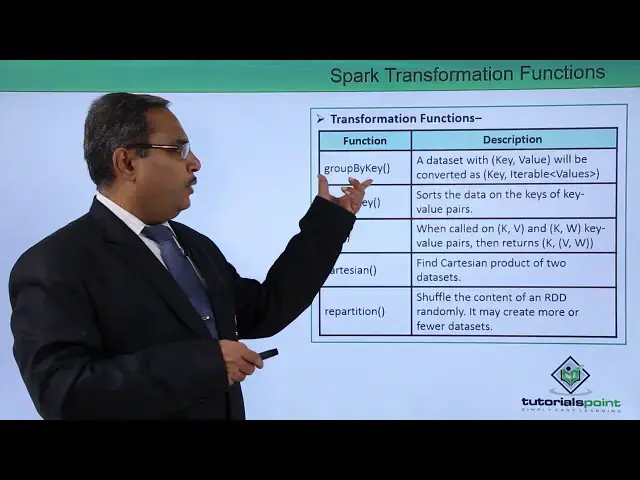
union of our data next we are going for
2:20
group by key method so this particular
2:23
function is that a data set with key
2:26
value pair will be converted to key and
2:28
then iterable values because it is a
2:31
group by key so he will be there for the
2:34
same key that it a table on the values
2:37
will be obtained in case of group by key
2:40
method next one is the shot by key
2:43
function and shorts the data on the key
2:45
of key value pairs so it will shot it
2:49
depending upon the key value pairs so
2:51
depending upon the key in the key value
2:53
pairs next one is the joint function and
2:56
when called on kV and kW the key value
3:01
pairs
3:01
it returns K V Kamata blue and that is
3:05
known as the joint operation next one is
3:08
the Kardashian so fine Cartesian product
3:11
of two data sets that means all possible
3:14
combinations of two data sets next one
3:16
is the repartition and suffle the
3:19
content of an RDD randomly and it may
3:22
create more fewer more or fewer data
3:26
sets and that is known as the real
3:28
partition so these are the different
3:30
functions which are available in our
3:32
transformation on our didi thanks for
3:35
watching this video
#Programming