Up next in 10


Spark Ecosystem
Show More Show Less View Video Transcript
0:00
In this video, we are discussing Spark ecosystem. Spark ecosystem is having mainly six components
0:07
We'll be discussing all of them one by one with one proper diagram
0:11
So, let us go for this Spark ecosystem. Now, this is our Apache Spark ecosystem
0:17
It is having mainly six components. So, that is the SparkSQL, Spark Streaming, then the MLL, that is our machine learning libraries
0:27
And then Graph X, that is for the Spark. a graph related computations and Spark R. And there is another one, there is an Apache Spark
0:36
Core API. This Apache SparkCode API is consisting of R, SQL, Python, Scala, and Java. So while
0:45
developing Spark applications, we can select any one of the languages as required as according
0:51
to our choice. So there are six components are there in Spark ecosystem. So we shall be discussing
0:57
each one of them one by one. So, what is the Spark ecosystem? In this diagram, we can see that
1:04
six components of Spark ecosystem, and these components are Spark Core, and then Spark SQL
1:11
we're having the Spark Stream, we're having the respective ML lib, that is the machine learning
1:17
library, we're having the Graph X for the graph-related computations, and also the Spark
1:22
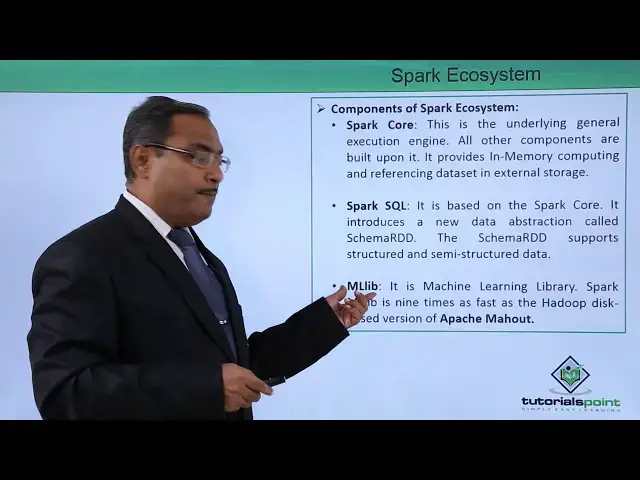
R So let us go one by one at a time So components of Spark ecosystem the first component is the Spark core So this is the underlying general execution engine and all other components are built upon it
1:38
So, this is the general execution engine and other five components, they are depending on this Spark core
1:45
And it provides in-memory computing and referencing data set in external storage
1:51
So, it can do the referencing from the external storage, but always it does the in-memory
1:57
computation and that's why it is faster and lightning first. Next, we're going for the SparkSQL
2:05
So it is based on SparkCore and it introduces a new data obstruction, a new data
2:12
abstraction called schema RDD. We know that RDD is having the full form that is a resilient distributed data set
2:20
It is nothing but one data structure with the help of which one data set or all the data sets
2:26
residing in the RDD can be distributed onto multiple nodes and server
2:31
And that is the main feature of RDD. So here it is having this one that it is based on SparkCode and it introduces a new data
2:40
obstruction that is known as schema RDD. The schema RDD supports the structured and semi-structured data
2:47
So structured data can be considered as the database. tables that is a relational management database tables can be considered as a structure type of data and semi data might be in the form of say CSB might be in the form of say XML and JSON
3:03
So next one we are going for this ML Lib, that is a machine learning library
3:07
So it is machine learning library and Spark ML LEB is nine times as fast as a Hadoop disk-based
3:16
version of Apache Mahat. So compared to the Hadoop disk-based version, for the machine learning operations or to develop the machine learning related applications from this Apache Mahat this particular ML lib is nine times faster
3:33
Next we are going for this spark streaming and spark streaming is leveraging the spark course for scheduling capability to perform streaming ytics
3:44
So for the streaming ytics, this particular spark streaming will be used here and it ingests data in
3:51
mini batches and perform odd d transformations on those mini batches of data so it will take the data
3:59
in the mini batches and then it will perform the rddd transformations on those mini batches of data
4:08
next we are going for this graph x which is capable to do the graph related computations so this is
4:14
a distributed graph processing framework and it provides an API for expressing graph computations that can model the user defined graphs by using the pre abstraction API So there is a very important one So pre abstraction API
4:32
So it provides an API for expressing graph computations. Whenever we are having graph-related competitions are required, always you'll be referring
4:40
with this particular component in the Spark ecosystem that is a graph X and that can model
4:45
user-defined graphs by using pre-gill abstraction API. it also provides an optimized runtime for this abstraction
4:54
Next one, we are having this one as spark R. So it is introduced in Apache Spark 1.4
5:02
So from the Apache Spark 1.4 version onwards, we are getting this Spark R
5:07
And this SparkR data frame is the key components and it is a fundamental data structure
5:12
for R programming language. In the Spark code, we have the option to write our Spark related applications or develop
5:19
about spark related applications using the R language and this spark art is a data frame is a key
5:25
component and it is a fundamental data structure which is required for the R programming language
5:31
R also provides different facilities for data manipulation, calculation and also the graphical
5:38
display. So these are the six different components we have explained them with the proper diagram
5:43
and explanation and we will be working on them, we will be discussing all these concepts later on
5:48
also in our other videos please watch all of them and thanks for watching this one
#Programming