Up next in 10



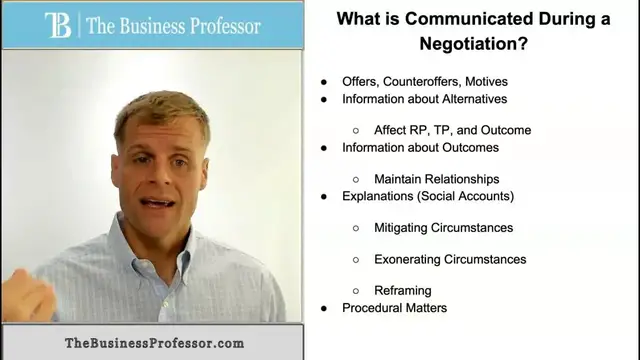
This video explains what is communicated during a negotiation.
https://thebusinessprofessor.com/en_US/communications-negotiations/what-is-communicated-during-a-negotiation
Show More Show Less View Video Transcript
0:00
In this video I'd like to address what is communicated during the negotiation process
0:07
Okay, so to start with the information that's being exchanged can be broken down into groups
0:16
or categories so that you simply understand how it pertains to the framing of the planning of the
0:24
negotiation process and once again how that is communicated and used strategically in exchanging information with the other party. So once again
0:35
negotiation is by and large a communication exercise. Okay, so to start
0:43
with offers, counter offers by the other side, displays of motives or perceived
0:50
motives of the parties. Okay. All of this is generally communicated back and forth between
1:00
the parties upfront. Okay. Tactically, parties will put information out there about their
1:10
alternatives The objective there is to affect the other party perception of the negotiation but once again information about your alternatives Now you may not expressly state what your alternatives are You may make
1:24
vague reference to them, for example, but nonetheless, information about your alternatives
1:31
This will affect both yours and the other party's reservation point, the point at which you're
1:36
willing to walk away, the target point, what you aspire to in the negotiation, and what you're
1:42
willing to accept again as an outcome, okay? What you perceive at least as being an acceptable outcome
1:50
So once again, you're communicating back and forth or exchanging information about your potential
1:56
alternatives. And once again, this will affect the reservation point, target point, and potential
2:02
outcomes in the negotiation, okay? Now, you express information about what you are willing to accept
2:09
in terms of an outcome or your perceptions as to what is a viable outcome. You will also do things
2:17
in a way that seeks to establish and both maintain the relationship at stake in the negotiation
2:25
This can be an interest that is identified up front Otherwise it can simply be used tactically to once again affect the context of the negotiation or the perception of the other side in that way
2:41
Okay, now explanations. Oftentimes this is used in terms of maintaining the relationship again, but we call it taking
2:50
social accounts of the other side and it's explaining your position. Okay, which again can be done tactically for purposes of logic, having an effect emotionally
3:03
on the other side. Some examples of how we use explanations in terms of taking social accounts is one, mitigating circumstances
3:13
We explain away why we took a position. We explain that we needed to take a position because we didn't have another option, right
3:24
We're mitigating, right, our fault, I guess, in the situation, right, or our selection of our position, that we had to take this position that was necessary
3:37
Exonerating is when we basically say we took a position but we not to blame because once again we were our purpose was good and ultimately we going for fairness or equity or the greater good in the scenario right So we are exonerating ourselves by saying you know we took a position that appears negative
4:04
but in reality it is positive, okay? That's again an explanation for how you would
4:11
take an exonerating circumstance. So sometimes we explain a way to reframe the negotiation in terms
4:18
of what procedures we followed or the outcome there that ultimately with the
4:23
objective of having the other person see an otherwise apparently inequitable outcome as being more fair because we're trying to once again change the frame
4:32
through which they are seeing it in a separate sections we deal with or
4:37
address what are cognitive frames in a negotiation okay and then lastly simply
4:43
procedural matters we'll explain how things are going to work what we're
4:47
going to address next, what are the things that we have yet to talk about, how
4:52
we should manage our time, those types of things. All of those are procedural
4:57
aspects. All of these are communicated during the negotiation and require specific skills of the negotiator in terms of communication in order to do so effectively
#Management
#Social Sciences
#Communications & Media Studies