Up next in 10



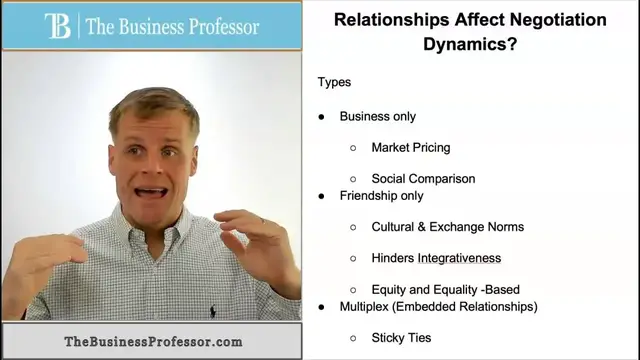
This video explains the primary types of relationship in a negotiation.
https://thebusinessprofessor.com/en_US/communications-negotiations/how-do-relationships-affect-negotiation-dynamics
Show More Show Less View Video Transcript
0:00
In this video I'd like to talk to you about once again the effects of relationships on
0:06
negotiations but primarily I want to identify the types of relationships that exist in a negotiation
0:15
Generally there are three types of relationship that can appear in any negotiation
0:22
These are business only, friendship or social only relationships and then a mix or multiplex
0:29
of these two types, business and friendship in the negotiation. In the business only negotiation where you have a business relationship only, generally
0:44
this is the most straightforward in that it allows for a tendency called market pricing
0:50
That is, we identify a value for the various interests associated with the negotiation
0:57
either the direct interest or the direct interest and the indirect interest in the negotiation
1:03
And we put a price a value on it right And that allows us to effectively frame up the negotiation set a target point set a reservation point that type of thing Okay now that is extremely difficult to do in other forms of negotiation such as friendship
1:23
only or multiplex mixed negotiations. Okay, one difficulty in a business only negotiation is that you have a great deal of social comparison
1:34
that tends to go on. So status or socio-economic status or structural status in the organization often has a big
1:43
impact which once again causes that tendency towards social comparison. And if you're wondering what is social comparison, you can get more information on our other
1:52
video addressing that tendency. Okay, now moving on to friend or friendship-only relationships where you are negotiating with
2:01
someone that you have those close familial or social ties to, right? But it's not a business
2:08
relationship. Now, these tend to be very difficult, okay? There's a lot of constraints there based
2:16
upon your past interactions One notable constraint is the impact of cultural and exchange norms Now cultural norms are our tendencies based upon our culture that tells us to take care of to
2:32
guard the interest of, to meet the needs of the other person, right? A communal
2:37
type approach to how we live or interact with others. Exchange norms is how when
2:42
you have a finite amount of resources how you allocate those resources. Okay
2:47
Now, one interesting thing is these two tendencies cause parties to lean more towards an equality
2:55
or equity-based approach rather than a form of approach that is based upon, well, excuse
3:03
me, an equality-based approach rather than an equity-based approach or a competitive
3:08
approach wherein you attempt to grab more value or allocate value more efficiently based
3:13
upon inputs. So, that being said, it tends to hinder the ability to arrive at an integrative negotiation
3:22
because ultimately because of these exchange norms, you're mismanaging the interest in
3:27
the negotiation or the allocation of interest So the actual objectives of the negotiation are thwarted in that way Okay Now to the mixed relationship the multiplex relationship what we often call embedded
3:43
relationships where you have a business relationship with a person, but you, or the other party
3:50
to the negotiation, but you also have some sort of friendship, social, familial relationship
3:56
with them. Okay. difficult once again because you have those different norms coming in and
4:03
affecting the negotiation process but much of your negotiating is affected by
4:11
the prior experience you have with that individual on the social level. These are
4:17
known as sticky ties. So once again it makes it very difficult to adequately
4:23
seek to grab value or to maximize the allocation of value amongst the parties
4:29
in the negotiation. Okay, now the thing to remember once again the types of
4:34
relationship that you have in the negotiation are business only, friendship only, and then a combination of the two known as multiplex or embedded relationships
#Business Services
#People & Society
#Troubled Relationships
#Romance