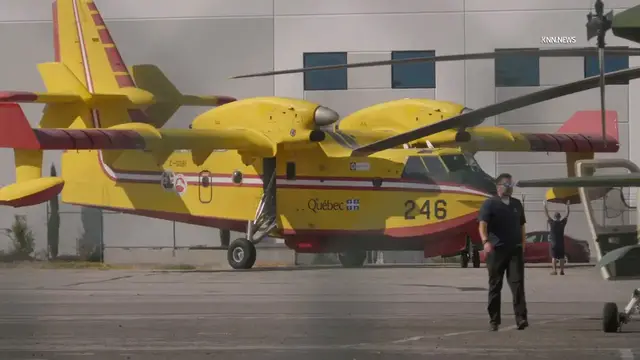

US, Los Angeles: Van Nuys Canadian Super Scoopers Arrive To Aid Amid Trade Tensions with USA.
Aug 30, 2026
Los Angeles, United States - August 29, 2026 08/29/2026 04:14 pm GMT-0700 VAN NUYS, LOS ANGELES, Calif. – Canadian aircraft and pilots have arrived to help protect Los Angeles County from wildfires, even as a deepening tariff battle strains relations between the United States and its northern neighbor. Two Quebec-based CL-415 “Super Scoopers” landed at the Van Nuys Airport Tanker Base at 4:14 p.m. after a two-day journey from Canada. The aircraft will augment Los Angeles County’s firefighting fleet during an initial 90-day deployment as summer heat dries vegetation and El Niño strengthens in the Pacific. Their arrival provides a striking counterpoint to the deteriorating political relationship between Washington and Ottawa. The United States imposed 50% tariffs on $27.6 billion in selected Canadian goods on Aug. 22 after trade negotiations collapsed. Canada has announced matching duties on the same value of American products beginning Sept. 8. The new U.S. tariffs cover products including wine, cement and dairy goods, while Canada’s response targets American steel, appliances, agricultural equipment and food products. Although the aircraft lease is separate from the dispute, Canadian government planes and crews crossing the border to defend American communities illustrate how decades of practical cooperation continue despite the widening economic rift. Los Angeles County began using Super Scoopers in 1994 after the destructive Southern California fires of 1993. What began as a three-month trial developed into an annual arrangement with the government of Quebec. The planes typically arrive before the peak Santa Ana wind season and can remain longer if dangerous conditions persist. Built specifically for aerial firefighting, the amphibious, twin-engine CL-415 can operate from runways or water. By skimming across a lake, reservoir or calm section of ocean, each plane can scoop roughly 1,600 gallons in about 12 seconds without stopping. When a suitable water source is nearby, crews can make repeated drops in quick succession. Pilots may release the load in one concentrated salvo or divide it across several drops. Foam can also be mixed with the water to improve coverage and help it adhere to vegetation. The aircraft are particularly useful around Southern California’s canyons and foothill communities, where they can slow a fire, cool hot spots and give firefighters time to establish containment lines. Heavy smoke, darkness, high winds and rough water can limit their use, and the planes do not replace crews on the ground. The Super Scoopers join Los Angeles County’s Firehawk and Bell helicopters and contracted Chinook helitankers. California’s state firefighting agency, California Department of Forestry and Fire Protection, separately operates what it calls the world’s largest civilian aerial firefighting fleet, with nearly 70 aircraft. El Niño provides part of the season’s broader climate backdrop but should not be described as the direct cause of a particular Los Angeles heat wave. Local high pressure, offshore winds, humidity and fuel moisture are more immediate drivers of regional fire danger.
Show More Show Less #news