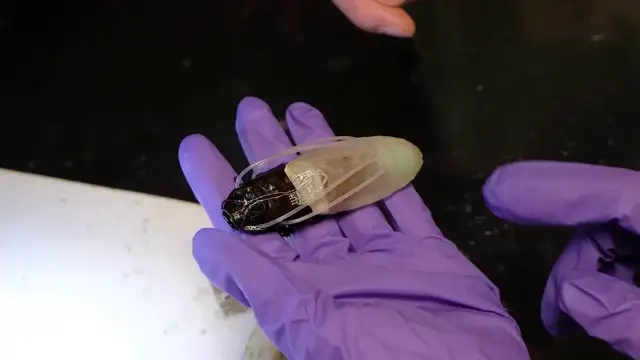

RAW Video: Cyborg cockroaches given tiny diving suits to hunt for disaster survivors.
Jul 6, 2026
Credit: NTU Singapore/Cover Images Scientists have developed a tiny 3D-printed "diving suit" for cyborg cockroaches that could one day help search for survivors trapped in flooded disaster zones. The miniature suit acts like a scuba tank, supplying the insects with oxygen so they can crawl underwater and through low-oxygen spaces that are inaccessible to rescuers and conventional robots. Researchers from NTU Singapore and Waseda University say the technology could allow the remote-controlled insects to reach people trapped beneath rubble after floods, earthquakes and other disasters. The cyborg cockroaches carry electronic backpacks fitted with sensors capable of detecting signs of life, including movement, heat signatures and carbon dioxide produced by human breathing. Their new soft, flexible diving suit includes a built-in oxygen generator that enables the insects to survive underwater or in oxygen-poor environments for up to three hours. The findings were published on Monday (June 29) in the journal Nature Communications. Researchers say flooded rubble, standing water and partially submerged voids can prevent existing rescue robots from reaching survivors. Unlike conventional robots, cyborg insects use the cockroach's own muscles for movement, meaning they require only a fraction of the power needed by motor-driven machines. To test the technology, scientists sent the insects through plastic tubes designed to mimic disaster environments, including flooded tunnels filled with carbon dioxide to recreate low-oxygen conditions. The suited cockroaches remained active and mobile underwater for as long as three hours. Professor Hirotaka Sato, of NTU Singapore's School of Mechanical and Aerospace Engineering, who led the study, said: "Our new insect diving suit works like the oxygen tank used by human divers. It generates oxygen and delivers it directly to the insect's breathing holes, allowing the cyborg cockroach to survive and move in underwater or low-oxygen environments. "This is important because real disaster sites can be challenging after heavy rain or flooding, blocking access routes in the rubble, drains and narrow gaps. By expanding the operating parameters of our cyborg insects to include underwater travel, we believe that they can enhance search and rescue efforts." The project builds on more than a decade of cyborg insect research at NTU, where Prof Sato's team has developed insect-based robots capable of operating on land, in the air and now underwater. The technology has already been tested in real-life rescue scenarios, including Singapore's Operation Lionheart disaster response exercises.
Show More Show Less #news