
China: Shenzhen strives to shorten supply circle to fuel robotics boom.
Sep 28, 2026
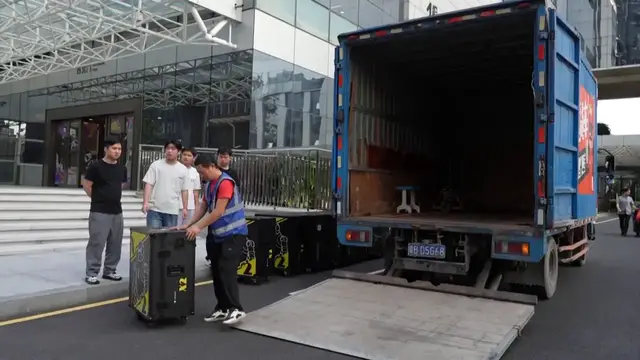
Shotlist Shenzhen City, Guangdong Province, south China - Recent (CCTV - No access Chinese mainland) 1. Various of engineers training robot 2. Various of robots at work 3. SOUNDBITE (Chinese) Mo Lei, vice president, AI² Robotics (partially overlaid with shots 4-5): "From the uppermost reaches of the supply chain to the numerous modules, covering the entire mechanical core power modules and upstream joint components like motors and reducers, we can actually source them [locally]. What needs to be shortened the most is the research and development cycle. Hardware often needs to iterate alongside models. It is crucial for a fast-developing industry like ours." ++SHOTS OVERLAYING SOUNDBITE++ 4. Various of robot; robot part 5. Various of Mo at work ++SHOTS OVERLAYING SOUNDBITE++ 6. Various of robots, employees introducing robots to visitors 7. Sensors on robot's head 8. SOUNDBITE (Chinese) Zhong Lianghong, head of product and technical support, Orbbec Inc. (starting with shot 7/ending with shot 9): "We provide clients with comprehensive vision solutions, covering vision sensors on the head, chest, waist, hands, and even the chassis. Basically, clients can achieve one-stop procurement of vision kits from us. To date, our clients have exceeded 1,600." 9. Animation showing sensor on chassis working 10. SOUNDBITE (Chinese) Xie Tiandi, marketing director, RoboSense (partially overlaid with shot 11): "We provide sensing parts to clients. We can colloquially refer to these components as the 'eyes of the robot.' We provide components for robots of all types and for all scenarios. Our shipments of robotic LiDAR alone exceeded 280,000 units in the first half of this year, which is more than sixfold compared to the same period of last year." ++SHOT OVERLAYING SOUNDBITE++ 11. Animations showing sensor on chassis working ++SHOT OVERLAYING SOUNDBITE++ 12. Various of truck traveling; workers loading cargo to truck; truck driver at work 13. SOUNDBITE (Chinese) truck driver (name not given) (starting with shot 12): "Orders have increased noticeably this year compared to the previous year. We generally can get more than 10 orders a day, and basically run back and forth within office buildings at the Robot Valley in Nanshan." 14. SOUNDBITE (Chinese) Zhang Qiaofang, head of corporate business south China, Shenzhen Yishi Huolala Technology Co., Ltd. (ending with shot 15): "The number of robot transportation orders in Shenzhen's Nanshan District increased by 94.4 percent year on year in the Jan-Aug period, with second-quarter orders growing by 51.2 percent quarter on quarter. Robots from Nanshan, Shenzhen primarily flow to nearby cities including Dongguan, Foshan and Huizhou." 15. Various of workers loading cargo to truck; truck traveling 16. Aerial shots of cityscape 17. Animation showing clusters of robotics companies 18. Various of parts, robots; employees at work 19. SOUNDBITE (Chinese) Zhou Jun, office director, Shenzhen Robotics Association (ending with shot 20): "From companies engaged in core components manufacturing and precision machining to those in assembly, the driving time between supply chain enterprises generally does not exceed half an hour. This enables the realization of 'drawings sent in the morning, prototyping in the afternoon, and iteration the next day,' shortening the research and development cycle from months to days, significantly enhancing collaborative efficiency and reducing innovation costs." 20. Various of engineer coding; robotic hand; robot in training Storyline South China's tech and innovation hub Shenzhen is rapidly building a "half-hour supply circle" for its booming robotics sector, aiming to source all core components locally by 2028 as high-density industrial clusters are able to shorten development cycles from months to just days. Sensors, actuators, reducers and controllers are the vital building blocks of modern robotics. In Nanshan District's 28-square-kilometer "Robot Valley," more than 200 robotic enterprises, including 15 listed companies and 32 specialized "little giant" firms, are clustered within a 30-minute drive of one another. These mesh together precisely like gears, forming one of the regions with the highest density of China's robotics industry. The geographic proximity has proven crucial for firms developing advanced embodied AI and humanoid robots, allowing hardware to iterate seamlessly alongside software models. "From the uppermost reaches of the supply chain to the numerous modules, covering the entire mechanical core power modules and upstream joint components like motors and reducers, we can actually source them [locally]. What needs to be shortened the most is the research and development cycle. Hardware often needs to iterate alongside models. It is crucial for a fast-developing industry like ours," Mo Lei, vice president of AI² Robotics, a playe
Show More Show Less #news