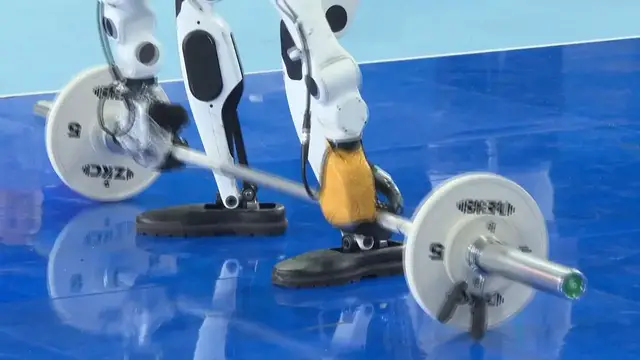

China: Weightlifting debuts as humanoids show strength at Robot Games in Beijing.
Aug 25, 2026
Shotlist Beijing, China - Aug 24, 2026 (CCTV - No access Chinese mainland) 1. Various of humanoid robots in weightlifting competition 2. SOUNDBITE (Chinese) Wen Han, member, Beijing Innovation Center of Humanoid Robotics and Huazhong University of Science and Technology Joint Team (starting with shot 1/ending with shot 3): "The reason why we focus on humanoid structures is that many robots with [thicker] bases [instead of legs] can't lift such heavy weights, while humanoid robots can utilize the full-body torque to lift, giving them a higher potential limit." 3. Various of humanoid robots in weightlifting competition 4. SOUNDBITE (Chinese) Wen Han, member, Beijing Innovation Center of Humanoid Robotics and Huazhong University of Science and Technology Joint Team (starting with shot 3): "We specifically selected such agile hands and reinforced them so they can carry heavier loads." 5. Various of team members, robots preparing for competition 6. Referees 7. Various of humanoid robots in weightlifting competition Storyline Humanoid robots flexed their muscles on Monday as weightlifting made its debut at the second World Humanoid Robot Games in Beijing, with the event testing bots' balance, stability and coordination and showing how these machines could soon work in factories and homes. The five-day Games got underway at the National Speed Skating Oval in the Chinese capital on Saturday, with over 2,000 robots developed by more than 600 teams from 16 countries and regions battling it out in 51 competitive events. Under the rules for the weightlifting contest, robots must grasp the barbell with both hands and lift it along a strictly vertical path, holding it steadily above their heads for at least two seconds for the attempt to count. To create an even playing field, every competing robot must have a complete humanoid structure, and only its feet may touch the platform during the lift, while any contact from their torso, arms or knees results in a failed attempt. Rankings are based on the heaviest weight successfully lifted in a single try. The distinctive structural requirement which sees the bots mimic the movements of their human weightlifting counterparts is central to the event's appeal, according to one competitor. "The reason why we focus on humanoid structures is that many robots with [thicker] bases [instead of legs] can't lift such heavy weights, while humanoid robots can utilize the full-body torque to lift, giving them a higher potential limit," said Wen Han, a member of the joint team from the Beijing Innovation Center of Humanoid Robotics and Huazhong University of Science and Technology. The participating teams are aware that grip strength matters just as much as raw power and have developed their robots to have dexterous hands with at least three fingers, while some even wrapped their humanoid's hands in tape to give them a tighter grasp of the barbell. "We specifically selected such agile hands and reinforced them so they can carry heavier loads," said Wen. The hard-work and meticulous preparation paid off for Wen and his team, who were crowned champions after their robot successfully lifted 16 kilograms to clinch the inaugural title. Though it may appear like a simple test of strength, the weightlifting challenge actually provides a much sterner assessment of the overall prowess of the current generation of humanoid machines, measuring their load-bearing capacity, balance under pressure, and joint coordination. Insiders say these are the core abilities needed for the robots to succeed in real-world roles like industrial logistics, sorting and the domestic service sector.
Show More Show Less