Up next in 10



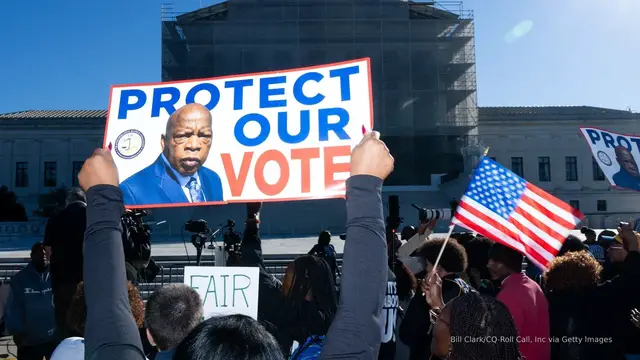
The Supreme Court is deliberating a challenge to the Voting Rights Act, which could impact minority representation in Congress.
Show More Show Less View Video Transcript
0:00
The Supreme Court heard a challenge to the Voting Rights Act Wednesday
0:03
Its decision could change the way states draw congressional maps and in turn impact
0:08
minority representation in Congress. The Constitution prohibits intentional discrimination. The pending decision is cause for concern among black members of Congress
0:17
whose seats were created by the landmark civil rights law. If states can pick and choose which voters to silence, none of us are safe
0:25
That's right. So here's how this case got here. Louisiana's legislature drew a new congressional map in 2022 that only had one black majority district out of six total seats in the House of Representatives
0:40
Black residents sued, arguing the state should have two black majority districts since 30 percent of the state's population is black
0:47
They won. The state redrew the map to include two black majority districts
0:51
Then another group of state residents sued, arguing the second black majority district violates the Constitution's 14th Amendment equal protection clause and the 15th Amendment, which prohibits race based voter discrimination
1:05
Here's what lawyers arguing against the new map told the justices. The Constitution prohibits intentional discrimination
1:11
It's saying that you have to create a district for black Democrats that you would never create for white Democrats in a Republican state
1:17
It's essentially being used as a reverse partisan gerrymander on purely racial grounds
1:23
And that is a constitutional problem. The case revolves around Section 2 of the Voting Rights Act
1:28
which essentially says minority groups have a right to elect a representative of their choosing
1:33
This is what lawyers arguing in favor of the two black majority districts said would happen
1:38
if the court further alters the Voting Rights Act. I think the results would be pretty catastrophic if we take Louisiana as one example every congressional member who is black was elected from a VRA opportunity district
1:53
We only have the diversity that we see across the South, for example
1:57
because of litigation that forced the creation of opportunity districts under the Voting Rights Act
2:04
This decision is being made by the Supreme Court, but it will directly impact the folks who work across the street
2:09
And for black members of Congress, the Voting Rights Act is personal. For so many of us here today, Section 2 is why we stand before you as members of the Congressional Black Caucus
2:22
Congresswoman Terry Sewell is sponsoring the John Lewis Voting Rights Advancement Act
2:26
a bill that would expand upon the Voting Rights Act preclearance provision, which requires states with a history of racial discrimination to get approval from the federal government
2:34
before new voting laws or electoral districts can take effect. She's criticizing the challenge to Louisiana's second majority black district
2:42
And now they are back in the Supreme Court trying to legalize discrimination against black and minority voters
2:50
The stakes couldn't be higher. For decades, Section 2 of the Voting Rights Act has served as a critical tool to fight back against discrimination
2:59
and to ensure that minority communities are fairly represented. The Congressional Black Caucus members hope the Supreme Court will uphold Section 2
3:07
but if they lose, they're preparing to take action. That while the Supreme Court may render a decision that's antithetical to our best interests
3:14
they don't have the last word. They do not. We are the we and we the people
3:19
That's right. We have the last word. And we are not going to take this lightly
3:24
I'm Ray Bogan for Straight Hour News. For more unbiased reporting straight from our nation's capital, download the SAN app
Government
news
Politics
Constitutional Law & Civil Rights