Up next in 10


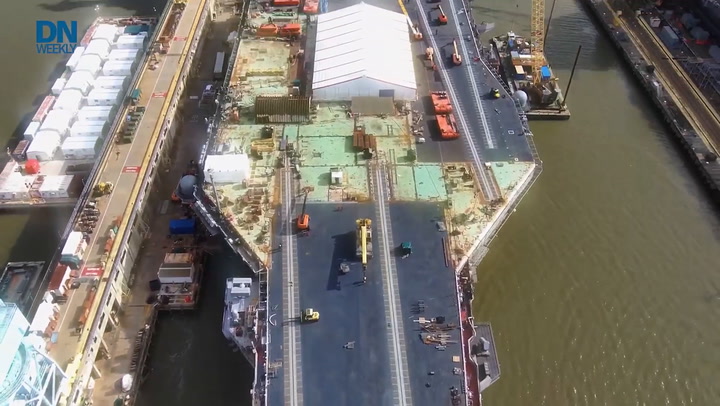
Shipbuilders Hanwha and HII lay out their offerings and strategies for providing more ships to the Navy at a recent conference.
Show More Show Less View Video Transcript
0:00
I'm Dwayne Fotherham. I'm the president of the Unmanned Systems Business Unit within HII
0:07
HII is probably best known as being a ship builder of nuclear ships and conventional warships
0:13
but we're part of the mission technologies, and we bring a whole portfolio of technologies
0:17
to the warfighter. My business unit, the Unmanned Systems, we bring a whole portfolio of
0:22
unmanned vessels, unmanned underwater vehicles, and unmanned surface vessels. That's the Remus
0:28
line of unmanned underwater vehicles and the Romulus unmanned surface vessels. In underwater
0:34
vehicles, we build everything from small class to large class. We build over 750 vehicles
0:40
delivered those to 30 countries around the world. On the Romulus USVs, we build everything from small
0:45
seven-foot vessels up to what you see here is our 151-foot Romulus vessel. This is the vessel
0:52
that is part of our medium USB portfolio. So our Remus UUVs, yesterday we celebrated the 25th anniversary of Remus
1:01
So we've been building vehicles for a long time. We've built over 750 vehicles, delivered them to 30 countries around the world
1:07
They're used for everything from ocean bottom mapping to intelligence gathering. The most common use of the vehicles is for mine countermeasures
1:16
So we are the U.S. Navy's vehicle of choice for exhibitionary mine countermeasures
1:21
Our largest program right now is a lionfish program. We deliver that to the U.S. Navy for expeditionary mine countermeasures
1:30
That was a DIU program. In fact, that was the first DIU program ever to transition from an OTA to a full-rate program of record
1:40
And we're delivering that vehicle at scale right now. We're delivering, and in total backlog right now, we have over 100 small vehicles that we're building for Lionfish and for our international customers
1:52
For the medium UUVs, you'll see a model of it over here next to us
1:58
That vehicle has been recently used to do torpedo tube launch recovery
2:03
Our first generation Remus 600 with yellow Moray technology developed by the Woods Hole Oceanographic Institution successfully performed real-world operational missions with U.S. submarines swimming in and out of torpedo tubes
2:16
Our Remus 620 the latest generation of that vehicle last summer went through tests to prove that it could do the same on a test platform at Seneca Lake Romulus vessels are in production today We are delivering them to a variety of customers from the small size to the large size Right now we are building five medium
2:35
unmanned service vessels, a Romulus 151 at our partnership yard in Louisiana
2:41
Royal Brothers Enterprises. So the common piece that links both of our underwater vehicles and
2:45
our unmanned surface vessels together is autonomy. And our autonomy is Odyssey. It's an AI enabled
2:52
of full platform, open architecture, modular, designed to be scaled from small vessels to large vessels
2:59
from underwater vessels to surface vessels. And one of the things that make us unique
3:04
is that open architecture aspect of our autonomy. We can bring third-party autonomy behaviors
3:10
onto our platform to get best of breed in everything that we do
3:14
Hello, I'm Rick Williams, and I do business development for Mission Technologies
3:18
and unmanned surface vessels. And I'm here to talk today about our C4I systems, command control, communications, computing, cyber
3:28
and how we integrate that with lots of different types of payloads and networks
3:33
The innovations are adding artificial intelligence and machine learning to the autonomy systems
3:39
and using AI at the tactical edge and at the operational level
3:44
and using sensors like our perception suite that we have on our future MUSV, unmanned surface vessel
3:52
as well as with our long-range unmanned surface vessels, and integrating those unmanned platforms with manned platforms
3:59
and the network command and control with our system called Minotaur, which is a long-range anti-surface warfare capability that's used at the operational level
4:10
taking Odyssey, autonomy, and AI at the edge for the boat, and then integrating with Minotaur is where we're going
4:19
So for manned-unmanned teaming, what we want to have is interoperable C4I solutions
4:25
So what you have on the unmanned platform interoperates or is connected with the manned platforms
4:32
So you have one tight model series of networks, communications, command control, and reliable data
4:40
And so these boats will be an extension of those manned platforms
4:44
They operate in the highly contested and contested areas allowing the manned platforms to have extended reach for classification ID situational awareness and targeting as well as letting the manned platforms remain clear of a hostile weapon engagement zone
5:10
My name's Mike Coulter. I'm the CEO of Hanwha Defense USA. Hanwha Defense USA is a U.S. defense company
5:16
that is focused on bringing forward technology, process, capability from our parent company
5:22
Hanwha in Korea. Hanwha in Korea is the leading aerospace and defense company in Korea and one of
5:27
the global leading shipbuilders. So here at Sea Airspace in 2026, we are bringing forward the
5:35
capacity that we have in Korea and intend to bring to the United States. From a capability perspective
5:41
we have a portfolio of companies. So Hanwha Ocean is our shipyard in Korea. Hanwha Ocean
5:47
last year we acquired Hanwha Philly Shipyard. We are in the early stage process of bringing forward
5:52
our capabilities from our shipyard in Korea to our shipyard in Philadelphia to expand shipbuilding
5:59
capacity in the United States. Hanwha Defense USA is also bringing forward at sea airspace
6:03
our capability from Hanwha Aerospace, which as a leading aerospace and defense company in Korea
6:08
brings of interest to the Navy munitions and missile capabilities. So we're showcasing
6:14
our missile and munitions capability. Similar to what we're doing in Philly for Shipyard
6:19
we have announced a munitions campus in Arkansas where we're bringing munitions capability from Korea
6:25
to build here in the United States to meet the needs of both the U.S. Navy
6:30
but also other customers, including the U.S. Army. Hanwha, a leading aerospace and defense company in Korea
6:36
Korea, a nation that has been on war footing for 70 years, has been investing in ways that companies in the United States
6:43
and elsewhere globally have not been investing in. So in addition to the technology of the platforms
6:49
munitions that we're bringing, it's really the industrial capacity that we're focused on bringing to the United States
6:54
So we want to be the most efficient shipbuilder in the United States
6:58
the most efficient munitions builder in the United States, the most efficient artillery builder in the United States
7:04
to bring industrial strength with American workforce, pulling technology process automation from Korea into the United States
7:12
to support the U.S. Navy and the U.S. warfighter. We're a start-up in the United States
7:17
but we have the strength of an industrial leading global company behind us in Korea
7:21
As such we have the financial backing industrial strength in Korea but here in the United States we interested in becoming a constructive disruptor that the U customer is looking for We are acting in ways that they have asked U industry to get back onto a war footing leveraging our war footing industrial strength in Korea but acting like a disruptor
7:43
So as you look around our booth this week, you will see investments that we are making in industrial capacity in the United States
7:49
technology partnerships we have with other disruptors. Like this morning, we announced a partnership with Magnet Defense
7:56
to bring USB capability with munitions capability on that USB to the United States
8:02
So we are intent on being a constructive disruptor, supporting the U.S. industrial baits and the U.S. warfighter
8:08
Yeah, here in our booth this week, we have above us an orange Goliath crane
8:12
These Goliath cranes are a hallmark of our shipyard in Korea and now a hallmark of our shipyard in Philadelphia
8:18
As we work to expand the footprint in Philadelphia, you already find one orange crane
8:24
You will in coming years, you will find more orange cranes. As we take Philadelphia from a shipyard that was producing one ship a year
8:31
Today, just with Hanwha Process, we're at three ships a year. We have a path to get us to 10, 20 ships a year, more cranes, more people, but then technology automation to increase the capacity of U.S. shipbuilding in the United States
8:47
So our shipyard in Philadelphia right now largely does commercial work, government work
8:53
We just received our first Navy contract, which is initial design contract for the Navy
8:58
But we're in deep discussions with the Navy, who's looking to increase throughput of U.S. ships
9:03
everything from auxiliaries to support ships to combatants. As we grow at that capacity in Philadelphia, what are the right classes of ships for us to be building
9:14
and we will be building U.S. Navy ships in Philadelphia. At Hanwha in Korea, our shipyard in Korea produces one ship a week, 50-some ships a year
9:23
We will be bringing that capacity to Philadelphia to expand to 10, 20 ships a year in Philadelphia
9:29
Our munitions factory in Korea similarly produces thousands of missiles, munitions every year
9:35
We are intent on bringing that capability to the U.S. Navy warfighter in Arkansas and beyond
9:40
And as we look forward to Hanwha's presence in the United States, we look forward to expanding beyond Philadelphia, beyond Arkansas to rebuild industrial strength and support the U.S. warfighter
#news