Up next in 10



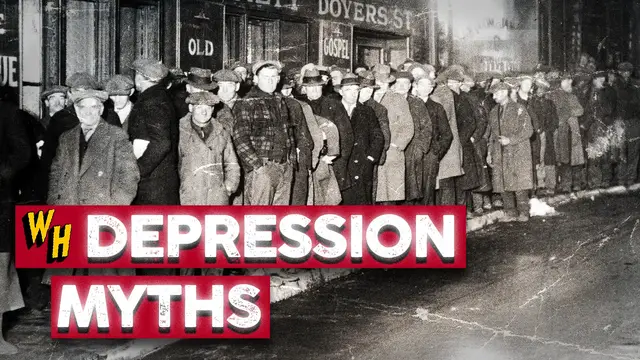
The Great Depression was the worst economic downturn in the history of the United States, but its true causes and conditions aren’t widely known. No, really - everything you think you know about the Great Depression was, in reality, crafted over decades to fit a variety of political agendas, leaving pop culture full of common misconceptions about one of the nation’s darkest periods.
Show More Show Less View Video Transcript
0:00
The Great Depression was the worst economic downturn in the history of the United States
0:06
But its true causes and conditions aren't widely known. No, really. Everything you think you know about the Great Depression was, in reality, crafted over decades
0:17
to fit a variety of political agendas, leaving pop culture full of common misconceptions about one of the nation's darkest periods
0:25
So, today we're crashing some popular myths about the Great Depression you probably believe
0:35
If there's one uncontroversial fact we all know about the Great Depression
0:40
it's that it was kicked off by the stock market crash of 1929. But uncontroversial doesn't mean the same thing as true
0:48
In reality, the recession that hit in 1929 was actually less severe than the one from 1920
0:53
money. Yet 1921 saw things recover into an economic boom, while 1930 was followed by 10 years of
1:02
economic hardship. It raises the question, if the stock market crash didn't start the Great
1:07
Depression, then what did? In a word, tariffs. What really made the depression the catastrophe
1:14
we all still talk about to this day was the incredibly high rate of unemployment
1:18
But while unemployment did spike after the 1929 crash, it didn't actually reach double digits, peaking at just 9%
1:27
In fact, it was actually down to just over 6% by June of 1930, which is right about when the Smoot-Hawley Tariff Act was passed
1:37
The act created tariffs, which were pitched as a way to tax imports and incentivize the domestic production of goods
1:44
The problem with this economic theory is that it assumes your trade partners will absorb the cost of the tariffs and won't impose their own or stop importing your goods altogether
1:54
1,000 economists from leading universities signed a public appeal warning against the act, but they were ignored
2:01
The tariffs were passed, quickly spawning retaliatory tariffs in other countries, which just made it harder for Americans to sell their goods abroad
2:10
Within five months of the passage of the bill, unemployment reached double digits for the first time
2:16
And that's where it stayed for the rest of the 1930s. Good thing we never made that mistake again
2:26
We've all heard the story. By 1929, the U.S. stock market was inflated to unsustainable levels
2:33
fueled by stock speculators, who purchased their stock on the margin. Purchasing a stock on the margin basically means that the buyer pays a percentage of the stock's cost in cash
2:42
and the rest is fronted by a broker or agent. So if the stock then falls, the buyer still owes the part of the sale that was fronted by the broker
2:51
It is true that buying on margin was popular in the years before the crash
2:56
but it also true that marginal trading was no worse in the 20s than it had been in the previous decades In fact margin requirements were actually starting to rise by the fall of 1928 So while the practice may have complicated things in the wake of the crash
3:12
it's hard to blame the historic financial disaster on margin trading. So what did cause the crash
3:18
Well, market crashes don't always have clear-cut causes. But some argue that the actions of the Federal Reserve during the 1920s
3:27
may have helped fuel a stock bubble. Between 1921 and mid-1929, for example, the Fed increased the money supply around 60%
3:36
Others suggest that the increased support for the Smoot-Hawley Tariff Act, which passed the House of Representatives in May 1929, played a role by spooking investors
3:50
You'll often hear old-timers ranting about how the Depression was caused by the world's
3:54
adherence to the gold standard. But that's probably not accurate. In fact, technically speaking, the world hadn't been on the classic gold standard since World War I
4:05
By the time of the Depression, the world was actually using a gold exchange standard
4:09
That means currencies were pegged primarily to the British pound and the American dollar, which, in turn, were redeemable for gold
4:17
So as the 1920s went on, gold itself played less and less of a direct role in international finance
4:23
Then in 1933, having determined that the hoarding of gold was slowing economic recovery
4:29
President Franklin D. Roosevelt began forcibly purchasing the gold assets of private American
4:35
citizens, as well as forbidding banks from paying out or exporting gold. This completely liquidated
4:41
the natural gold exchange system that existed. FDR also had the Federal Reserve raise the price
4:47
of the dollar relative to gold. In other words, far from creating a stable currency
4:52
which was the whole point of the gold standard, FDR actually intervened to subvert the gold
4:58
standard and inflate the dollar. Some argue that the sudden change in the value of money
5:03
exacerbated the climate of uncertainty, plaguing the economy. The Great Depression definitely started in the U.S., but it didn't stay there. In fact
5:17
It quickly spread outward and became a global event. The protectionist policies that began in the U.S. also quickly spread around the world
5:26
causing international trade to grind to a virtual standstill. That, in turn, created conditions conducive to the rise to fascism and national socialism in Europe
5:36
and in many ways, set the stage for World War II. Given how it's usually portrayed in the media, you can be forgiven for thinking that 99% of Americans were living in cardboard boxes during the Depression
5:52
But it wasn't actually quite that bad. That doesn't mean living through the Great Depression didn't suck
5:59
But the truth is while the Depression had a wide impact up to 40 of Americans faced no real economic hardship at all Heck some people even manage to get rich during the time period For example the Great Depression is also the same era that sometimes called the Golden
6:17
Age of Hollywood, when the studio system was at its zenith. Such classics as Bela Lugosi's Dracula, Boris Karloff's Frankenstein, and even King Kong
6:26
were all filmed during the 1930s. It's widely believed that a large number of banks closed during the Great Depression
6:36
because they didn't have access to the credit needed to stay afloat. But that starts to seem fishy once you remember that the Federal Reserve was created in 1913
6:45
for the explicit purpose of being the lender of last resort when transactions between banks dried up
6:52
So why did so many banks close between 1929 and 1932? Well, at the time, many states in the U.S. had so-called unit banking laws
7:03
which made it illegal for large banks to open branches in certain locations
7:07
That left those areas in the hands of unit banks, which are small banks that operate independently to serve a single specific location
7:15
Long story short, branch banks are backed by large financial institutions, while unit banks are not
7:21
Without a widely diversified financial backer, unit banks are much more sensitive to financial downturns
7:29
In other words, widespread reliance on unit banking was the major reason so many banks closed
7:35
In fact, the records show that states which allowed branch banking saw fewer bank failures during the Depression
7:41
And Canada, which had no laws against branch banking, didn't see a single bank closure
7:46
In retrospectives on the Depression, Herbert Hoover is typically portrayed as pro-free market
7:55
believing the economy would fix itself eventually. That depiction actually has no basis in reality
8:01
For one, Hoover was fiercely opposed to the Smoot-Hawley terror fact of 1930
8:06
and initially refused to sign it. However, he caved after intense pressure from both the Republican Party and American business owners
8:14
and after his cabinet threatened to resign. So while we can't admire him for sticking to his guns and possibly preventing the Great Depression
8:22
at least he knew tariffs were a bad idea. He also engaged in a multitude of other economic interventionist policies
8:31
The Hoover Dam, for example, is a monument to Hoover's public works projects
8:35
and so is the Golden Gate Bridge. But that's not all he did. Higher taxes were necessary to get the country out of the Depression
8:42
But in 1932, Hoover raised them equitably by increasing the top income tax level from 25 to 63%
8:50
He also pressured business leaders to maintain wages despite falling consumer prices
8:55
In fact, to combat the Depression, Hoover doubled government spending in only four years
9:01
It was so much, so fast, that even FDR, the architect of the New Deal
9:06
criticized Hoover as the greatest spending administration in peacetime of all of history Speaking of which In 1932 Franklin Delano Roosevelt clobbered Herbert Hoover in the Electoral College with
9:24
472 electoral votes compared to Hoover's 59. But it wasn't because FDR was promising to deliver
9:30
New Deal programs. On the contrary, the Democratic platform during the election actually called for a
9:37
25% reduction in federal spending, a balanced federal budget, and a smaller federal government
9:43
If you know anything about the era, however, you know that's not how things went down
9:49
Once elected, FDR abandoned his platform and worked to erect a massive federal bureaucracy
9:55
that in many cases simply expanded programs created by Hoover. As a result, director of
10:01
the Bureau of the Budget, Lewis W. Douglas, resigned after just one year on the job
10:07
Ultimately, government expenditures rose by more than 83% between 1933 and 1936
10:13
while federal debt rose by 73%. Generally speaking, most Americans did back FDR. Nonetheless, their enthusiasm for his New Deal
10:28
policies has been frequently overstated. Many, for example, were particularly unhappy with FDR's
10:34
repeated scoldings of the business community. And it wasn't a minority. A 1939 poll by the
10:40
American Institute of Public Opinion shows that two-thirds of Americans thought Roosevelt's
10:45
attitude towards big business was actually delaying a recovery. To be clear, that doesn't
10:50
mean it really was, but people at the time sure thought as much. Famed journalist H.L. Mencken of
10:55
the Baltimore Sun, for one, was openly critical of FDR. In 1933, he wrote
11:00
Roosevelt now proposes to relieve us by spending 5 or 6 billions more
11:05
I am advocating making him king in order that we may behead him
11:09
Yikes! They say hindsight is always 20-20. But, even today, the effects of FDR's New Deal aren't entirely clear
11:22
Obviously, there are those who think it was instrumental in getting the US back on its feet
11:25
But there are also folks who think it was ineffective, or may have even lengthened the depression
11:31
Whatever the case, most agree that the manpower requirements of World War II is what really got most people back to work
11:38
Millions of Americans found gainful employment as enlisted men, and others found work due to the increased production demands of the war
11:45
All that effectively brought unemployment below double digits for the first time since 1930
11:50
Some argue that the rationing and economic hardship imposed during the war years technically
11:55
means that the Great Depression really didn't end until the war ended in 1947
12:01
Under this view, the Depression finally ended because the manufacturing capabilities of
12:05
most of the rest of the world had been devastated, giving the U.S. a grim but competitive advantage
12:12
Either way, the Great Depression came to an end just in time for the space race
12:16
and no one can be depressed about space