Up next in 10



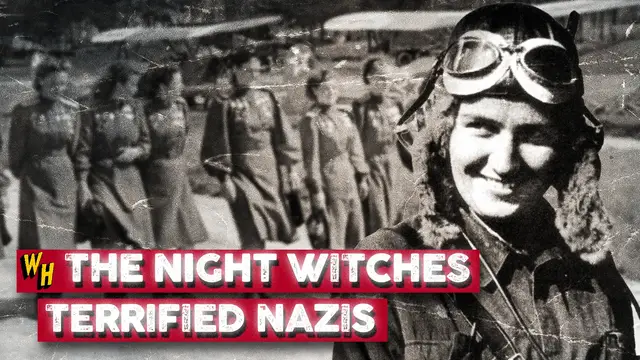
On the dark battlefields of World War II, German soldiers feared an enemy they could barely see and rarely heard... until it was too late. Out of the blackness came a faint whooshing sound. Seconds later, bombs rained from the sky, buildings crumbled, and chaos erupted across the Eastern Front. On this episode of Weird History we take a look at the mysterious Night Witches: an elite squadron of all-female Soviet pilots who became one of the most feared forces of World War II. Flying outdated wooden biplanes on daring nighttime bombing missions, they terrorized German troops, earned countless military honors, and cemented their place among history's most legendary warriors. Have you ever heard of the Night Witches? Let us know in the comments.
Show More Show Less View Video Transcript
0:00
All is quiet on the eastern front, when from somewhere in the vast blackness of night
0:05
there comes a soft whooshing sound that grows steadily louder until it's practically overhead
0:10
Its source remains mysterious, until the deafening concussive crash of explosions and a hail of gunfire. The ground trembles, buildings topple, men scream, and for a brief
0:23
moment, a pair of airplanes are visible above, before disappearing into the night just as quickly
0:29
as they arrived. These assailants were the Night Witches, a band of all-female pilots
0:36
who terrorized the Nazis throughout World War II. And today, we're taking a look at
0:42
why Nazis feared the Night Witches. Sunday, June 22nd, 1941. Germany and the Axis powers have executed Operation Barbarossa
0:57
and their invasion of the Soviet Union has begun. Taking place deep behind Russian borders
1:03
this massive land war would come to be called the Eastern Front and it's still regarded
1:08
as the largest and most deadly military conflict in human history. The Soviets and their allies would, of course, win the day
1:15
and the war on the Eastern Front finally came to an end on May 8th, 1945
1:21
But this victory would not have been possible without the valiant effort of thousands of soldiers
1:26
and the lesser-known aid of a select group of female pilots and navigators
1:31
The first of these women was Marina Raskova, widely regarded then and now as the Russian Amelia Earhart
1:38
Raskova was already an accomplished pilot by the time her home came under fire in 1941
1:44
During the 1930s, aviation clubs were growing increasingly popular in the Soviet Union
1:49
and while women faced significant social backlash, they were not technically barred from joining
1:54
nor were they barred from enlisting in the Russian military in support roles
1:58
Raskova did both. She was a part of Russia's first all-female piloting crew
2:04
broke several long-distance flight records, and was one of the first three women to receive the Hero of the Soviet Union Award
2:11
the country's highest possible honor, in 1938. She was well-respected and highly esteemed, especially among her peers
2:18
So when the fighting broke out and Germany threatened to overtake Moscow
2:22
Raskova found herself inundated with letters from other Russian women asking how they might be able to help in the war effort
2:29
And they weren't looking to fill support roles. Rage, grief, and fierce patriotism had bolstered their resolve
2:37
They wanted to fight. Leveraging her reputation and well-established connections within the military
2:43
Raskova was able to bend the ear of Joseph Stalin himself. She petitioned the Soviet leader to create a series of combat aviation regiments
2:52
made up entirely of women. And he agreed. Now, let's not get things twisted here. Stalin and his
2:58
Soviet Union were not staunch feminists looking to empower Russian women during wartimes. This
3:04
arrangement was instead born from political convenience. The early months of the war were
3:10
not kind to the Soviets. They'd been caught almost entirely unaware, and they needed all the help
3:15
they could get. And as for Stalin, well, he was really only interested in the tremendous
3:20
international propaganda value of these potential female pilots Raskova had already proven to inspire people with her pre achievements and there was no telling what she was capable of on a larger stage in the theater of war So on October 8th of
3:35
1941, Raskova was given permission to create the 122nd Composite Air Group. The group consisted of
3:43
three entirely female Air Force units, the 586th Fighter Aviation Regiment, the 587th Bomber
3:50
Aviation Regiment and the 588th Night Bomber Regiment. Raskova hand-selected around 400 women
3:57
for each unit from more than 2,000 applications and invited them to join her at the Engels
4:03
Military Aviation School, where they would begin their training. These volunteers were mainly
4:07
students ranging between 17 and 26 years old, though a few more were already accomplished pilots
4:13
like Major Yevdokia Bershinskaya, who had 10 years of flight experience under her belt when
4:19
Raskova assigned her to lead the 588th. But Bershinskaya was the exception, not the rule
4:25
Those with the least experience were actually assigned to the night bomber regiment, presumably
4:29
because night bombing required less precision and was considered less dangerous due to lower
4:35
enemy visibility. But ironically, it would be these inexperienced women who would gain the most
4:40
fearsome reputation. In May of 1942, around eight months after they'd started training
4:50
members of the 588th Regiment were deployed to the Southern Front. They were given meager rations
4:56
and hand-me-down uniforms, which weren't made with women in mind. Some of them even resorted
5:00
to stuffing their boots with torn-up bedding to better fit their feet, but they didn't downplay
5:05
their feminine flair. Some of the 588th got creative, using colored pencils to line their
5:11
eyes and color their lips, and a few even painted flowers and other designs on their planes
5:17
which was really all they could do in terms of an upgrade on their aircraft. The planes allotted to the 588th weren't exactly up to the current military standards. They were
5:26
open-air plywood and canvas Polikarpov PO2 biplanes, originally designed in 1928 for training
5:33
purposes. Later described as a coffin with wings, the PO2s were also incredibly small
5:40
with just enough room for a pilot and navigator who had to rely on old-school maps and compasses
5:45
for directions. The tech in the planes was obsolete, and their usefulness was limited
5:49
They weren't equipped with radar, radio, or even parachutes. If one of the PO2s went down
5:56
there was no hope of escape, and because of the building materials, the planes were highly
6:00
flammable, a single well-placed shot from an anti-aircraft weapon meant a PO2 caught fire and
6:07
burned up completely in the air before reaching the ground, like a match, according to an article
6:12
on the National World War II Museum website. To make matters worse, the 588th were highly
6:18
susceptible to that aforementioned anti-aircraft weaponry, since the weight of the bombs attached
6:23
to their planes forced them to fly at a maximum altitude of just 3,937 feet, or a minimum altitude
6:29
of just 1,968 feet. And it wasn't just altitude. The PO2s were also limited in their distance
6:37
which meant that the pilots were required to be on the front lines of the fight. So the women flying in the 588th knew
6:43
that they were putting their lives in serious jeopardy. But many of them preferred the idea of death
6:48
in the line of duty anyway. Being taken prisoner by the Nazis was tantamount to treason in the Soviet Union If a soldier survived and was rescued they could be subject to a trial by the military tribunal and banished to a remote penal colony or even executed But staying in the air also came
7:04
with its own set of dangers. If a PO2 pilot managed to escape a fiery demise or a crash and capture
7:11
they still had to contend with the natural elements. As the seasons changed, the open-air
7:15
nature of the PO2s became difficult to deal with. Flying on cold winter nights in Russia meant the
7:21
pilots dealt with severe frostbite while simply trying to do their jobs. Still, despite their
7:26
limited rations, decades-old technology, and the risk to their lives and limbs, the 588th Night
7:32
Bomber Regiment persisted. And on June 12, 1942, they successfully completed their first mission
7:38
by bombing several road and river crossings used by German soldiers overnight. As it turned out
7:44
while the PO2s had significant drawbacks, their maneuverability, light weight, and slow gliding
7:49
speed made them well-suited for the task at hand. Their small size prevented them from being detected
7:55
on radar or infrared, and their lack of technology meant they couldn't be tracked via radio locators
8:00
either. In the words of author Steve Prowse, they were basically ghosts. But ghosts were not the
8:06
supernatural creature that history would come to associate with the 588th. As they continued their
8:12
onslaught through the 1940s, the Nazis came to know and fear the night bomber regiment, calling
8:17
them Nachthexen, which of course translates to Night Witches. You don't acquire a nickname like
8:29
Night Witches without good cause, and the 588th certainly earned their reputation through their
8:35
terrifying tactics. Along with dropping supplies and food to Soviet troops, the Night Witches
8:40
targeted German ground troops, supply lines, and vehicles. But while the aid of their fellow
8:45
soldiers and the destruction of their enemies was an important part of the night witches
8:49
evening tactics, their main goal was actually psychological warfare. They would fly in pairs
8:54
under cover of night, with one plane drawing attention by circling the enemy searchlights
8:59
and lighting up the target area with a flare, while the other cut their engine and quietly
9:04
drifted overhead to deliver their payload in stealthy silence. The Germans compared the
9:09
whooshing sound the plane made to that of a witch's broom, and they quickly learned that once
9:14
they heard it, it was already too late. Upon a successful drop, the planes would return to their
9:19
base and reload for another flight, completing between 8 and 18 sorties a night, with each
9:25
lasting between 30 and 50 minutes. With those kinds of numbers, the attacks were practically
9:29
endless. German soldiers weren't allowed a moment's rest or relaxation and were kept awake
9:35
all through the night by not-so-distant explosions. The Nazis could never predict where the Night
9:40
witches would strike next, but they knew wherever it was, the attack would be preceded by the grimly
9:45
foreboding sound of witches' broomsticks, and the effect was highly potent. The night witches were
9:51
so harrowing and did so much damage that the German army began rewarding any airmen who managed
9:57
to down one of their planes. For their efforts, they were bestowed a coveted iron cross medal
10:03
but no iron cross could protect them from the attacks once night fell. As the war progressed
10:08
the Night Witches focused their efforts largely on the Eastern Front. They were present at several
10:13
key defensive positions, including the battles for Stavropoul and Transcaucasus, as well as the
10:19
liberation of Novorossiysk and Gdansk They also assisted in the Crimean and Belarus offensive campaigns and played an instrumental role at Stalingrad which was perhaps the most pivotal battle in the war that ultimately handed the Soviets the victory
10:33
All this talk of witches may sound fantastical, but the cold, hard reality
10:38
is that the 588th Night Bomber Regiment helped the Allies win the war
10:42
against Germany and the Axis powers. At the height of its operations
10:50
The 588th Night Bomber Regiment was composed of 42-woman crews, which flew over 23,000 sorties
10:58
Together, the Night Witches dropped an impressive 3,000 tons of bombs and 26,000 incendiary shells on the Nazis
11:06
They damaged or destroyed tens of river crossings, railway stations, warehouses, and armored vehicles
11:12
and they completed 155 drops of food and ammunition to the Soviets
11:16
They were also the only regiment in the 122nd Composite Air Group that remained 100% female for the entire duration of the war
11:25
a fact its members were especially proud of considering one of the 12 commandments they lived by was
11:30
Be proud, you are a woman. In February of 1943, two years before they were disbanded, the regiment was honored with a redesignation
11:38
Due to their achievements during the Novorossisk Taman operations on the Taman Peninsula
11:42
They earned the title of the 46th Hamon Guard's Night Bomber Aviation Regiment
11:47
which gave them a new level of elite status. The Night Witches became the most highly decorated female-only unit in the history of the Soviet Air Force
11:56
with 23 of its members officially being dubbed Heroes of the Soviet Union
12:00
But while their successes were innumerable, they did not come out of the war unscathed
12:05
By the time the Night Witches were disbanded in 1945, 32 women had perished
12:10
Among that number was the group's founder, Marina Raskova. After the war, these loyal fighters and patriots were turned away from the military
12:19
being disallowed to continue serving, and having many of their most impressive achievements minimized
12:24
or entirely left out of most Soviet history books. The Night Witches instead sought work as commercial pilots
12:30
factory workers, teachers, and other civilian jobs. For years, their contributions to the war were forgotten by many
12:36
but not by other women. You see, the Soviets weren't the only ones deploying female fighting squads during World War II
12:44
The Americans had the WASPs, the Women's Air Force Service Pilots. And while the WASPs and the Night Witches' flight paths never crossed during the war, they did later on
12:54
In 1990, on the 45th anniversary of the end of the war
12:58
some of America's original WASPs made the trip to the Soviet Union to meet with a few of the surviving Night Witches
13:04
The arrival was recognized with a formal parade, and together, the two groups of women penned letters to then-U.S. President Bush and Soviet President Mikhail Gorbachev
13:14
In the letters, the Wasps and Night Witches referred to themselves as sisters in the sky and hoped to work together for a common good
13:21
They made a plea for a lasting, peaceful future for their grandchildren, and they caught the world's attention once more
13:26
Today, key figures like Raskova and Major Yevdokia Bershinskaya have found a permanent legacy through the actions of those who came after
13:35
You can find streets and town squares named after Raskova in Moscow and Kazan
13:40
And two monuments have been built in Bershinskaya's name. It's safe to say that while history may have tried to bury the Night Witch's impact on the war, they will never be truly forgotten
13:50
not by the generations of lives that have come after, and definitely not by those who experienced them up close