Up next in 10



We often don't give a second thought to the color of everyday items. Of course a pencil is yellow! Well, yes, a candy cane should be red and white. But these things didn't always have these telltale colors. Some were changed - to be easier marketed, or for safety reasons. Sometimes the iconic color was an accident during the creation process, or simply the easiest thing people had on hand.
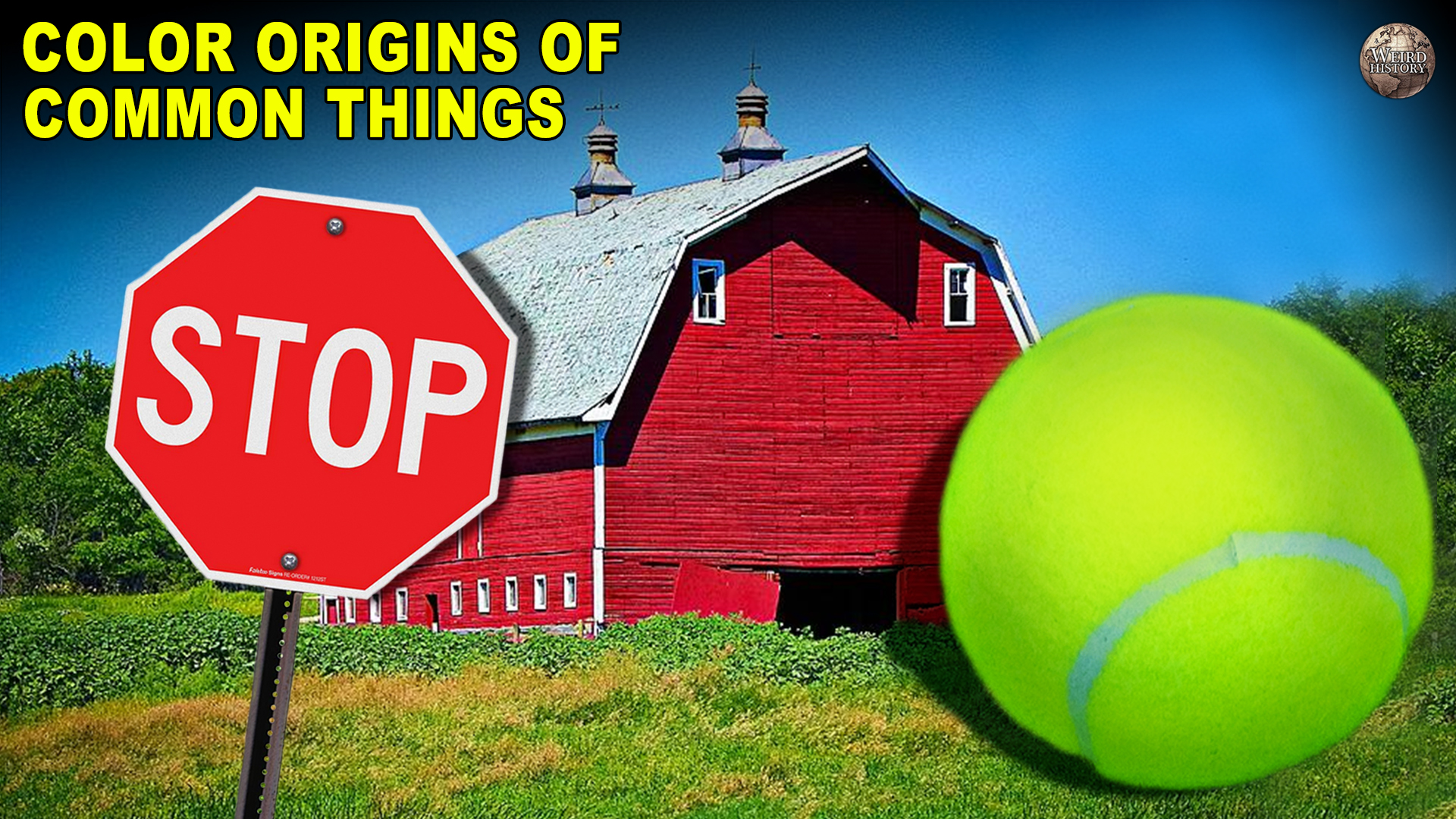
So if you've ever wondered why barns are red or tennis balls are yellow (or green?), this video is for you!
Show More Show Less View Video Transcript
0:00
Take a hard look around this kaleidoscope world of ours
0:03
and you'll begin to notice that certain concepts and things seem to have common, immediately understood colors
0:10
We expect stop to be red, go to be green, and tennis balls to be whatever color tennis balls are
0:17
Who gets to decide what color gets assigned to everyday objects? And why did they choose to confuse us specifically with ambiguous tennis balls
0:25
Today, we're giving you the colorful history of why common, everyday items are the specific colors they are. But before we take you on a trip through
0:33
history's hues, why don't you subscribe to the Weird History YouTube channel? Then let us know
0:39
what other surprising pieces of everyday history you want to hear about next. Okay, now it's time
0:44
to roll out the red carpet. Back in the old days, it took a lot of time and money to dye any fabric
0:55
So if you wanted fancy colored fabric, you had to get in a pretty long line
1:00
This wasn't like today, where one can hop onto any t-shirt website and order up a brightly colored design of Garfield riding a lasagna skateboard
1:07
Because of time and money concerns, much of the cloth you would see back then was left uncolored
1:13
And if you happened to be fighting a war and losing, the odds were pretty slim that you would be carrying a Jack Skellington featuring
1:19
I Surrender Please Don't Shoot Me graphic tee from Hot Topic. So when soldiers needed to surrender, they had to work with whatever cloth they had handy, namely plain old white cloth
1:29
When attached to a pole or a stick, it was also easier to spot the white against the sandy beaches or green forested areas
1:36
And with no other distinguishing marks, it was impossible to mistake the flag of surrender for any other established flag, especially red flags like Doesn't Like Garfield
1:45
Whether you get it from a pack, a gumball machine, or the bottom of your high school desk
1:56
chewing gum has long been associated with the color pink. There wasn't really a conscious decision to give the original bubble gum this rosy-colored hue
2:03
Like sticking gum under your high school desk, it was a total accident
2:07
Accountant Walter E. Dimer worked at a Philadelphia chewing gum company during the 1920s
2:12
His job was to crunch the numbers, but that didn't stop him from crunching the new chewing gum recipes in his free time
2:20
One particularly productive day, Dimer invented a substance that was thin enough to blow bubbles, but not sticky enough to cling to your teeth
2:27
He dubbed it Double Bubble and sent some out to his local candy store
2:32
Like a rock band offered the chance to put their song in a Target commercial, it sold out within one day
2:38
And while the double bubble had a distinctive, unmistakable pink color, that was no premeditated coloring decision
2:45
Pink was, in fact, the only color food dye Dimer had in the factory
2:49
But after the pink double bubble flew off the shelves candy history was made Drive out of the city into the country and you almost always see a red barn up on a hill
3:03
That is after you tell the rest of the passengers, cow, whenever you see a cow. Huh, I wonder if cows moo human when they see us
3:10
Red barns seem to be the standard, both in real life and pop culture. Even Green Acres had a red barn
3:16
But it may surprise you to know that originally, most barns in the U.S. were unpainted. Barns are big and paint is expensive, so farmers were not
3:25
exactly rushing to make a pretty-looking building out of a place where your animals do their business
3:30
And we don't mean taxes. But untreated wood came with its own problems, namely damage from the
3:37
elements. With paint being a luxury, farmers were forced to coat their barns cheaply with whatever
3:42
they happened to have laying around. The most effective coatings were a mixture of linseed oil
3:46
from flax plants, milk, lime, and iron oxide. And that iron oxide has a particularly rusty color
3:54
which ended up giving barns their reddish hue. This red paint-like substance
3:58
ended up being beneficial in other ways. The iron oxide keeps moss and fungi
4:02
from growing on the barn, and the rich color is able to absorb the sun's rays
4:06
way faster than untreated wood. This made the barns warm and toasty
4:10
during the colder months. Once red barns were discovered to be cheap as well as efficient
4:14
other farmers began to follow suit. and the red barn stereotype was born
4:25
Traffic lights. The game-changing invention that saves as many people as it drives crazy during morning commutes
4:31
Before the red, yellow, and green of our modern traffic lights, there were railway lights
4:36
These precursors to today's traffic lights blinked red for stop, white for go, and green to indicate slow
4:43
Wait, why was red the only one who got to keep its job when the others had to change
4:47
Must be somebody's kid. It turns out red lights caused the least amount of problems
4:53
Red happens to be the easiest color to see from far away, due to having the longest wavelength of any other color
4:58
But white as go became an issue if the green cap indicating slow fell off
5:04
making both go and slow appear white to conductors. Additionally, on a clear night, the white light could be confused with the stars in the sky
5:12
And then you'd have flying trains. And we simply don't have the infrastructure for that
5:17
So eventually, green became go, and white was replaced by yellow, which was chosen due to its stark difference from red and green
5:25
And since it's pretty important for train conductors to have plenty of time to stop their 4,000-ton machines
5:31
red remained in the stop slot. the tennis ball an invention enjoyed by humans and dogs alike the tennis ball is bouncy fuzzy
5:45
and easily identified by its not quite green not quite yellow color rather than give it a specific name most just call the hue tennis ball neon It hard to imagine the classic tennis ball
5:56
being colored any differently than its current grello, yin. But it may surprise you to know that the tennis ball's neon glow
6:02
is a fairly recent development. From the 1870s to the 1970s, a tennis ball was black or white
6:09
And that was just fine and dandy for players until networks began airing tennis matches in color
6:14
The at-home audience had trouble following the ball when it was near the white lines outlining the court
6:20
This is something the NBA previously dealt with regarding brown basketballs, thus deciding on the easier-to-see orange
6:26
After some research, the International Tennis Federation decided that a yellowish color ball would be the easiest to see
6:33
The color was then adopted for tennis balls in 1972. During school days, if you weren't using a yellow number two pencil, were you even really writing
6:47
But when pencils first hit the scene in the late 1800s, anyone could get in on this simple combination of graphite encased in wood
6:55
So if you wanted to succeed in the gritty cutthroat pencil game, you had to stand out and look sharp
7:01
Austrian pencil maker Franz von Hartmut knew this back in the late 19th century
7:07
Hartmut, whose last name sounds like a rare dental disorder, wanted to give his bland wooden pencils a unique look, something regal and eye-catching
7:16
He took inspiration from the Austro-Hungarian flag, particularly the black and yellow side representing his homeland
7:23
And because the graphite already took care of the black half of the flag, Hartmut decided to paint the outside of the pencil yellow
7:29
It also didn't hurt that the best graphite happened to come from China, and yellow was the color of Chinese royalty
7:36
Thus, the superiority of the yellow pencil was penciled in. No eraser needed
7:46
America has been using green printed cash for some time now. Is it any wonder green is also the color of envy
7:53
But in our pre-Civil War era, money was not as well regulated. Cash was printed by private banks or state-backed institutions
8:00
and they all had their own ideas about what money should look like. This chaos resulted in cash taking many different forms, sizes, and colors
8:08
Imagine how many pockets your wallet would need just to contain them all. With no standardization came counterfeiters
8:15
who could easily scratch off the amount listed on a note, adding their own numbers
8:19
But the days of easy counterfeiting ended during the Civil War, when the federal government started printing money to support war efforts
8:25
they combated counterfeiting by printing one side of their notes with green and black ink
8:30
the green wouldn't fade and couldn't be photographed due to the black and white cameras of the time
8:35
after the war ended the green color of the dollar was kept partially because it represented the
8:40
stability of u currency and partially because it was super cheap huh it a wonder why they just don print more money
8:52
Whether you call them dungarees, Levi's, or one half of a Canadian tuxedo, there's no
8:57
question blue jeans are one of the most popular styles of pants in the world
9:01
And the color of the fabric is so renowned that it has become part of the name
9:06
The reason for the blue hue of these pantaloons is a simple one, comfort
9:10
During the 1870s gold rush, fortune seekers needed durable clothing to wear during the long hours spent panning for riches
9:18
And businessman Levi Strauss and Taylor Jacob Davis' indigo-washed dungaree was the answer to their prayers
9:25
Their denim quickly flew off the shelves due to their extremely comfortable fit
9:29
which came from the blue dye binding to the cloth's thread, softening the fabric when washed
9:34
The result was a fit as comfortable as it was rugged. Until the 1900s, there was no such thing as a color designated for a girl or a boy
9:48
Children at the time would wear plain white clothing, because white was easy to bleach if anything got spilled
9:53
and could become hand-me-downs for younger children, boy or girl, like a nicer version of that Chicago Bulls jersey you got from your older sibling
10:01
However, during the turn of the 20th century, department stores got the idea that parents would buy more clothing
10:06
if they separated them into gendered sections. But it didn't start with pink for girls and blue for boys
10:12
Not right away, anyway. In the beginning, little boys were the target market for pink-colored threads
10:17
while little girls were dressed in blue. At the time, pink was considered a stronger color
10:23
while blue was more delicate and dainty. The Toronto Blue Jays wept
10:27
What caused the gender-color reversal? It might involve a scene in the book Little Women
10:32
in which pink and blue ribbons are tied to a set of fraternal twin babies
10:36
one boy and one girl, to tell them apart. Before the late 1800s, the medical field was goth as hell
10:49
Doctors who were treating patients at the time would often be found wearing black, a color that signified the seriousness of the doctor's visit
10:55
and a respect for impending demise. Hey, medical knowledge wasn't great back then
11:00
so if you were at the point of actually needing a doctor, your card was pretty well punched
11:05
As time went on, doctors stopped poking around in their patients' guts and hoping for the best, and actually started applying educated, evidence-based treatment methods
11:14
Around the same time, the concept of bacteria and sterilization became widely recognized
11:19
and doctors became adamant about keeping things as clean as possible. So when the job called for a color to wear that indicated you were completely spotless
11:27
white was chosen for the rebrand. Whether their choice of clothing comforts you or intimidates you, today, the white coats
11:34
are synonymous with doctors and are part of almost all medical graduation ceremonies. Seems
11:39
harder to throw in the air than caps, though