Up next in 10



The Great Pyramid of Giza. The Great Wall of China. The Parthenon. The Eiffel Tower. Stonehenge. Great structures capture our imagination and give us a lasting collective heritage. (They also provide the backdrop to innumerable selfies). But while they may last for centuries, these familiar objects have widely divergent building times. Some take decades to erect, others just a few years. Still others have been slowly created over centuries. Here are some of the world's most famous landmarks, along with the time it took to make them a reality.
Show More Show Less View Video Transcript
0:00
Nothing captures our collective imagination quite like the world's most famous landmarks
0:04
It's why the Great Pyramid of Giza, the Great Wall of China, and Stonehenge are on so many
0:09
postcards. But while they may last for hundreds or even thousands of years
0:13
have you ever stopped to wonder how long they took to assemble? Well, today we're going to
0:19
take a look at how long some famous landmarks took to build. Remember to read all the instructions
0:25
before trying to build any of these. The one thing pretty much everyone in the world
0:31
knows about timetables for ancient construction is that Rome was not built in a day
0:36
So how long did it take? Well, when it came to the Colosseum, about seven or eight years
0:42
Hey, we said Rome wasn't built in a day. What's the Colosseum's excuse
0:46
The project was initiated around 72 CE by Emperor Vespasian. He was all about securing legitimacy for the Flavian dynasty
0:54
and one of the ways he went about that was by creating a massive public work for the people
0:59
of Rome. He died in 79 CE when the Colosseum was mostly finished, but his son Titus dedicated it
1:05
the following year with 100 days of games, which sounds like a lot, but it's still shorter than a
1:11
regular season of baseball. Come on, Titus, open up your wallet. The construction of the Colosseum
1:16
would have involved enormous amounts of labor. Perhaps as many as 20,000 to 30,000 enslaved
1:21
people were employed to quarry the stone and build the structure. For such a long-lived and
1:26
imposing landmark, it was completed in a surprisingly short time. It seems like it
1:30
takes three times as long just to get a pothole filled today. In the mid-5th century BCE, the
1:38
Greek city-state of Athens was on the rise. They had just defeated the invading Persians
1:43
and they still had a few good years before the Peloponnesian War, which, 2,500-year-old
1:48
spoiler alert, would not go great for them. But while all was still well, the famous leader, Pericles
1:54
ordered a fabulous construction project on the Acropolis, the elevated citadel that overlooks the city
1:59
Every Athenian citizen grumbling over visions of long construction-fueled traffic jams screwing up their commutes
2:05
for the next century or so were pleasantly surprised. Construction on the main building, the Parthenon
2:10
which was a temple to Athena, began in 447 BCE and continued to about 438 BCE
2:16
when the large golden ivory statue of the goddess was installed inside
2:20
Just a shade under 10 years. Plutarch even commented on how quickly the Parthenon got thrown up in his life of Pericles
2:30
Construction on the Great Pyramid of Giza, which is the tomb of Pharaoh Khufu
2:34
began somewhere in the neighborhood of 2550 BCE. Once completed, the pyramid would remain the tallest human-made structure in the world
2:43
for more than 3,700 years. It didn't lose that particular championship built until the completion of St. Paul's Cathedral in London
2:50
in 1221. Herodotus claimed that the Great Pyramid was built in 20 years
2:55
by work gangs of up to 100 people But while Herodotus was enthusiastic about recording history he was prone to making the more than occasional error Modern scholars think the size of the work gangs
3:07
were probably closer to 20,000 people, which is still a perfectly huge crowd
3:11
No need to embellish Herodotus. But they don't dispute the idea that it could have all
3:15
been completed in 20 years. And despite popular misconception, there's no evidence that enslaved people built the pyramids
3:22
The laborers may have been peasants working in the off season and may have owed labor to the pharaoh as part of an implied social contract, which is still
3:31
pretty close to being enslaved, if we're being honest. It's definitely in the same zip code
3:38
Outside of Euro Disney, the Eiffel Tower is France's most iconic landmark. The tower was
3:44
conceived and built by French civil engineer Gustave Eiffel and an engineering team for the
3:49
1889 Exposition Universelle in Paris, which was a centennial celebration of the French Revolution
3:57
And nothing says revolution like a big pointy tower. Using modern construction techniques
4:02
a felonist team were about to raise the tower to a height of 1,083 feet, making it the tallest
4:08
human-made structure in the world until the completion of the Chrysler Building in New York
4:12
in 1930. The tower was erected in a remarkably quick 22 months, which is less time than it took
4:19
to make the TV show Lost. Hmm, a timeless national landmark or six seasons of nonsense television
4:26
Weirdly, they're worth the same amount at the gift exchange. This miracle of construction was accomplished
4:31
only thanks to the fact that each of the 18,000 metal pieces that were used in the construction
4:35
were created with extreme precision, allowing rapid assembly. And it was quite a thing to see
4:41
According to journalist Emile Goudot, who visited the construction site, a thick cloud of tar and coal smoke
4:48
seized his throat, and he was deafened by the din of metal screaming beneath the hammer
4:55
Goudot also reported seeing workmen, with their iron bludgeons, perched on a ledge just a few
5:01
centimeters wide, taking turns at striking the bolts. The crew reminded him of blacksmiths
5:09
contentedly beating out a rhythm on an anvil in some village forge. Only he noted
5:15
the smiths were not striking up and down vertically, but horizontally, and with each blow came a shower of sparks
5:25
He thought that the workers appeared larger than life against the background of the open sky
5:32
as if they were reaping lightning bolts in the clouds. Apparently, the Eiffel Tower was built during a Dokken video
5:39
The awe-inspiring Taj Mahal in Agra, India, looks a lot like a palace
5:46
So it's easy to imagine more than a few people have gazed at pictures of it and dreamed of living
5:51
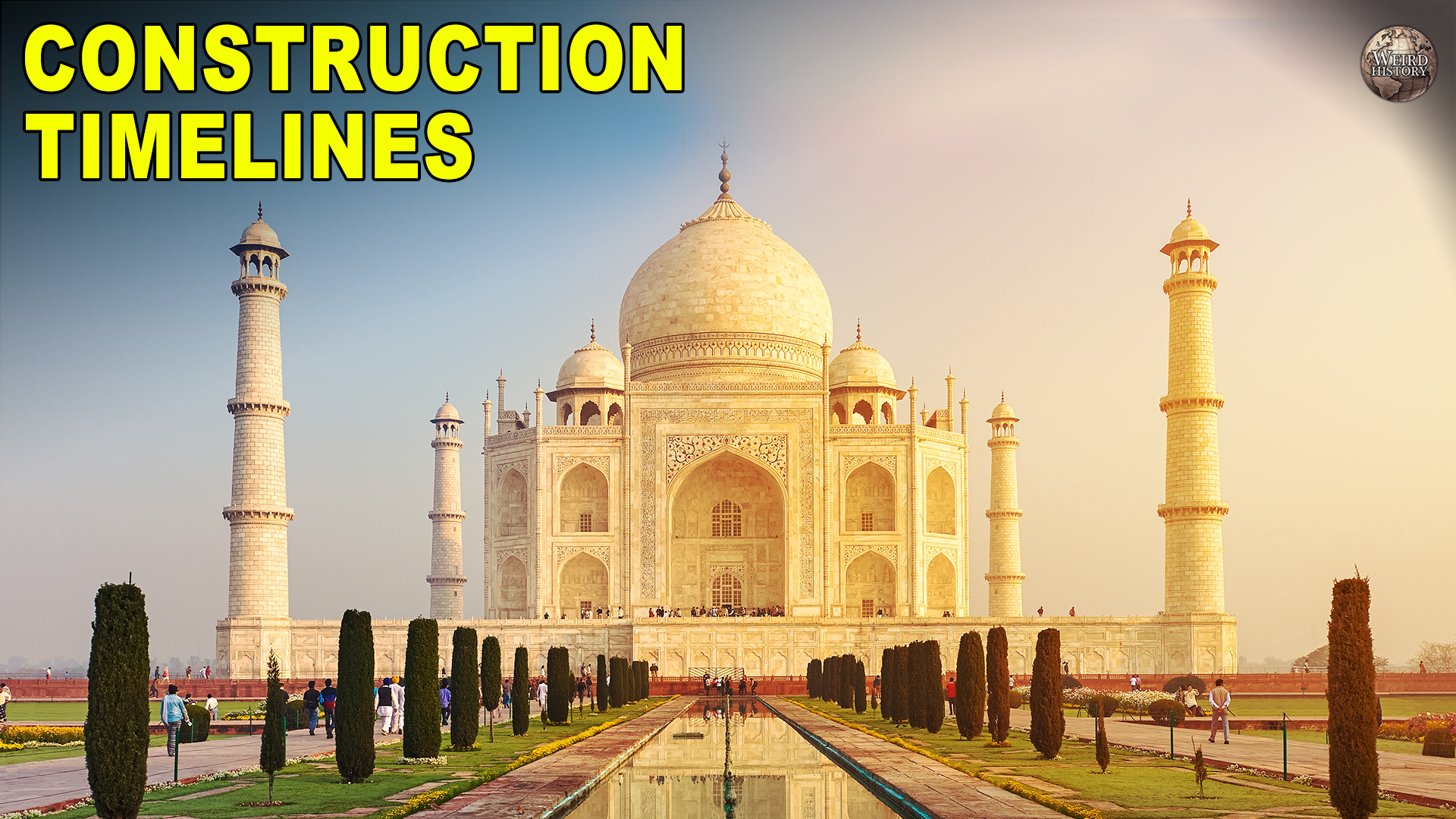
within its grand walls. But if you're one of those people, allow us to burst your bubble It is not a palace It a mausoleum commissioned in 1631 by Mughal emperor Shah Jahan to commemorate his wife Mumtaz Mahal who had perished in childbirth
6:09
It took some 20,000 laborers and 1,000 elephants to build the gargantuan marble edifice
6:14
Construction began in 1632 and continued for two decades, which is a long time to spend essentially digging your partner's grave
6:21
But in the field of grand romantic gestures, this one's pretty hard to top
6:26
Built in Beijing in the 15th century, the Forbidden City was an imperial residence for
6:34
the Chinese emperor and his court. And while it was once a place for the most elite
6:38
there's nothing particularly forbidden about it anymore. In fact, these days, nearly 14 million tourists make their way through it each year. The Forbidden City was part of a
6:48
complex that includes nearly 1,000 buildings with 10,000 rooms. The sprawling project was
6:54
commissioned in 1406 CE by the emperor Yongle and completed 14 years later in 1420. It wound up
7:01
becoming the political center of imperial China for almost half a millennium until the abdication
7:06
of the last emperor in 1912, which makes sense. If you sink two decades of the national budget
7:12
into a construction project, you'd better use it for something. Turns out it was a pretty good
7:16
investment. In 2018, the forbidden city was valued at over $70 billion US, making it the single most
7:24
valuable piece of real estate in the world. The Gothic cathedral Notre-Dame de Paris
7:31
which was created for the 1996 Disney animated film The Hunchback of Notre Dame
7:35
was built on the site of two earlier churches on the Île de la Cité, an island in the Seine River
7:41
The project was conceived around 1160 CE by Maurice de Sully, Bishop of Paris
7:47
and the foundation stone was laid in 1163. However, they were in no great rush to finish
7:52
the dang thing, because construction stretched on for about 90 years. By 1250, most of the structure
7:58
was complete, but additions were made for another century. The cathedral was almost destroyed during
8:03
the French Revolution, but it was saved by the intervention of Napoleon. It underwent an ambitious
8:08
restoration project in the mid-19th century. More recently, the building was badly damaged by a fire
8:14
in April of 2019, and repairs and restorations are ongoing. Ever been so happy about something that you have to build an enormous statue
8:25
Well, the people of Rhodes had, and there weren't too many other ways to express joy back then
8:30
as song dedications on the radio hadn't been invented yet. Commissioned to celebrate the lifting of the Siege of Rhodes in 305 BCE
8:38
the Colossus of Rhodes was a 105-foot-tall statue of the Greek sun god Helios
8:43
The impressive giant was considered to be one of the seven wonders of the ancient world
8:48
although they probably didn't call it the ancient world at the time. Designed by Jares Olindios, the statue only took 12 years to build
8:55
and contrary to popular misconception brought on by Jason and the Argonauts almost certainly did not straddle the harbor at Rhodes When will that movie learn The project relatively short completion time was ultimately a good thing because it didn last very long
9:10
Construction was completed around 282 BCE, and then an earthquake toppled the statue about 56 years later
9:16
The emperor offered to rebuild it, but the oracle at Delphi told the people of Rhodes
9:20
the statue had offended Helios. And since nobody wanted to be on the bad side of a god
9:25
they opted to leave it in broken pieces. The Statue of Liberty is arguably the most iconic landmark in one of the world's most iconic cities
9:35
and New Yorkers are the French to thank for it. In 1870, French sculptor Auguste Bartholdi began designing a statue of Liberty Leading the People
9:45
First conceived by the abolitionist Edouard de Labelais in the aftermath of the American Civil War
9:51
the statue was created to represent anti-slavery ideals while cementing the century-long friendship
9:56
between the US and France. In 1876, Bartholdi's design went into production in France
10:02
The statue was assembled in Paris between 1881 and 1884, then disassembled and shipped to the US in 1885
10:09
like a piece of IKEA furniture. The still-unfinished construction of the pedestal
10:13
delayed the project, which was finally completed on Bedlows Island, now Liberty Island, in 1886
10:23
Stonehenge, the mysterious prehistoric monument immortalized in various pieces of airbrushed art work
10:28
as well as a song by Spinal Tap, is old. Located in Wiltshire, England, the world-famous site
10:34
was constructed in multiple phases. In fact, it may have even taken as long as 1,500 years
10:39
of on-again, off-again building for the landmark to reach the form we're all familiar with
10:43
The first stage would have started some 5,000 years ago, when some Neolithic Britons got a huge circular ditch
10:49
and bank in Salisbury Plain. Maybe they were trying to build a French drain. Centuries later, they added smaller stones, called bluestones
10:57
The huge sandstone slabs, some formed into the famous triliths, were added around 2000 BCE, and adjustments continued for several centuries after
11:09
The construction history of the massive chain of fortifications that make up the Great Wall of China spans literally thousands of years
11:17
So if you were hoping to duplicate the project in time for your Labor Day luau
11:21
you should probably just think about putting in a fence. The project, which is intimately bound up with the history of China itself
11:27
began with a series of fortifications created in the 7th century BCE by the Xiu State
11:33
After the unification of China under the Qin Dynasty in the 3rd century BCE
11:38
a 10-year project significantly extended the wall, involving hundreds of thousands of soldiers and conscripted laborers
11:45
Over subsequent centuries, the structure went through cycles of repair, disrepair, and expansion
11:50
The last great wave of construction and maintenance occurred during the Ming Dynasty
11:54
between the 14th and 17th centuries. After that, the wall again fell into disrepair
12:00
With great walls come great maintenance bills