Up next in 10



While everyone suffers from clumsiness or preoccupation now and then, inventors, chemists, and engineers typically do everything they can to prevent accidents on the job. As they develop ideas they believe could possibly change the world - for better or worse - experts meticulously calculate their every move to ensure they can replicate the results, should they succeed.
Show More Show Less View Video Transcript
0:00
Inventors are people too, and just as prone to accidents as the rest of us
0:05
But when an inventor screws things up, it isn't always a bad thing
0:10
Because every once in a while, it results in a brand new invention
0:15
So, today we're taking a look at some popular everyday things that were invented by accident
0:21
Okay, you'll want to put on your hard hats for the remainder of the tour. You have to admire a man who doesn't let a failure to complete grade school
0:32
stop him from inventing something that would revolutionize the way Americans lived
0:36
That man was self-taught engineer Percy LeBaron Spencer, who accidentally discovered the technology to construct the first microwave oven in 1945
0:46
Spencer worked for the Raytheon Manufacturing Company in a department conducting radar systems experiments with magnetrons
0:52
which are vacuum tubes that produce microwave radiation, and not evil transformers
0:57
One day, while experimenting with the tubes, he realized the chocolate bar stashed in his pocket had melted
1:03
Most people probably would have excused themselves to look for some dark corner in which to shovel melted chocolate into their mouth
1:09
But Spencer wasn't most people. Instead, he became intrigued and placed other food items near the radioactive waves
1:16
As popcorn kernels popped and eggs vibrated before bursting, Spencer considered the notion that the vacuum tube's energy
1:23
might be able to quickly cook foods exposed to lower-density currents. Spencer constructed a metal box to hold the radioactive waves
1:30
knowing that the currents couldn't pass through metal. After realizing his discovery led to faster food cooking times versus a traditional oven
1:37
he filed for a patent in October 1945. In May of 1947, the Hotel Statler in Boston
1:44
became the first restaurant to commercially test the radar range microwave oven
1:48
But it took time before the trendy appliance landed in 90% of American households
1:52
The first ones were costly and almost the same size as a standard oven, making them inconvenient for most homes
1:59
Additionally, many potential customers worried that exposing food to microwave radiation might produce harmful side effects or weird superpowers, or vice versa
2:08
In 1967, Raytheon finally produced the first system small enough to fit on a typical American countertop
2:15
To add to the appeal, the appliance cost less than $500, or about $4,500 in 2023
2:22
Don't scoff. You pay $70 for a new Call of Duty every year
2:26
You can shell this out. However, Spencer received absolutely no royalties for his world-changing invention
2:33
Just a one-time payment of, brace yourself, $2. Can someone microwave his bank account
2:39
Charles Goodyear first entered the rubber industry in the 1830s long before his name would become synonymous with tires or blimps or wine vintages Rubber wasn considered particularly useful at this time as it was incredibly sticky it melted at high temperatures and it froze and cracked when introduced to cold weather
3:00
Kind of makes you wonder why he didn't choose to sell something people actually wanted. But as it turned out, Chucky Goodyear was on a mission to revolutionize the rubber industry
3:09
and he began experimenting with different compounds to help strengthen the product
3:12
and improve its flexibility. The self-taught chemist developed a nitric acid treatment in 1836 that demonstrated a
3:20
slight improvement in rubber's flexibility during extreme temperature changes. But otherwise, he failed to concoct the perfect recipe for a durable product
3:28
Undeterred, Goodyear continued to experiment with different compounds. And his efforts did eventually reap a reward, but not in the way he anticipated
3:37
In 1839, Goodyear accidentally dropped a mixture of rubber and sulfur on a hot stove
3:43
The heat bound the two elements to create an entirely new compound that held the consistency
3:48
of the rubber while allowing it to twist and return to its original shape
3:52
Additionally, the accidental invention strengthened the rubber to withstand drastic temperature changes
3:57
We imagine Goodyear immediately acted like it was what he was trying to do the whole time
4:02
And in 1844, he patented the process which is now known as vulcanization
4:07
Don't you hate it when you're trying to develop uses for coal tar derivatives
4:15
but you accidentally invent a zero-calorie sugar substitute? Well, that's exactly what happened to John Hopkins University researcher
4:22
Konstantin Falberg in 1897. After working all morning, he sat down to eat lunch without washing his hands
4:30
When he realized there was a sweet residue on his fingers, he returned to the lab to investigate its origins
4:35
at which point we assume he had to awkwardly tell his co-workers that he wasn't in the habit of washing his hands before a meal
4:41
By sampling small traces of every chemical he'd used that day, Falberg eventually realized the distinctively sweet substance was benzoic sulfamide
4:50
a chemical 300 times as sweet as regular sugar. Monsanto opened its corporate doors in 1901 by selling the chemical as a product named saccharin
4:58
which is the Latin word for sugar. An odd choice, since the whole point is that it's not sugar, but we admit it's catchy
5:04
Although it was widely used in prepackaged items like sodas and canned goods by 1907
5:10
the public had no idea they were ingesting the artificial sweetener. The U.S. Department of Agriculture later argued that the sugar substitute was toxic
5:17
and eventually attempted to ban saccharin. However, then-President Theodore Roosevelt nixed their efforts
5:23
At the time, he was on a diet, and his doctor had prescribed he ingest saccharin in lieu of sugar
5:28
And apparently, that's a good enough reason for a president to block legislation. But by 1912, the department had won the battle
5:34
and saccharin was briefly banned from the food industry. However once the US entered World War I sugar became a luxury making everyone a lot less worried about what was or wasn toxic And saccharin once again entered the American diet where it remains to this day
5:53
Quick, what's the most important invention in the history of the human species? Odds are, you just said bubble wrap
5:59
But at the time of its invention, Alfred Fielding wasn't thinking about how to revolutionize postal packaging
6:05
Instead, he and his business partner, Mark Chavons, were trying to create a textured wallpaper
6:10
that would appeal to the growing beat crowd in the late 1950s and early 60s
6:15
The original concept included two plastic shower curtains melted together to create a unique wall covering
6:21
But the end result was speckled with air pockets, not as visually appealing as Fielding and Chavons imagined
6:27
Giving up on the wallpaper idea but believing their invention could lead to something great
6:31
The duo registered for more than 400 patents involving laminating and embossing machines and techniques
6:37
Then, in 1960, IBM revealed its 1401 data processing system, now considered the Model T of the computer industry
6:44
The company needed a safe way to transport the delicate equipment, which made it a perfect customer for Fielding's and Chavon's product
6:51
After IBM proved that it trusted BubbleRat to deliver its computers without damage, other small companies quickly invested in the material
6:58
And people everywhere have since fought over who gets to pop the bubble wrap after opening a package
7:04
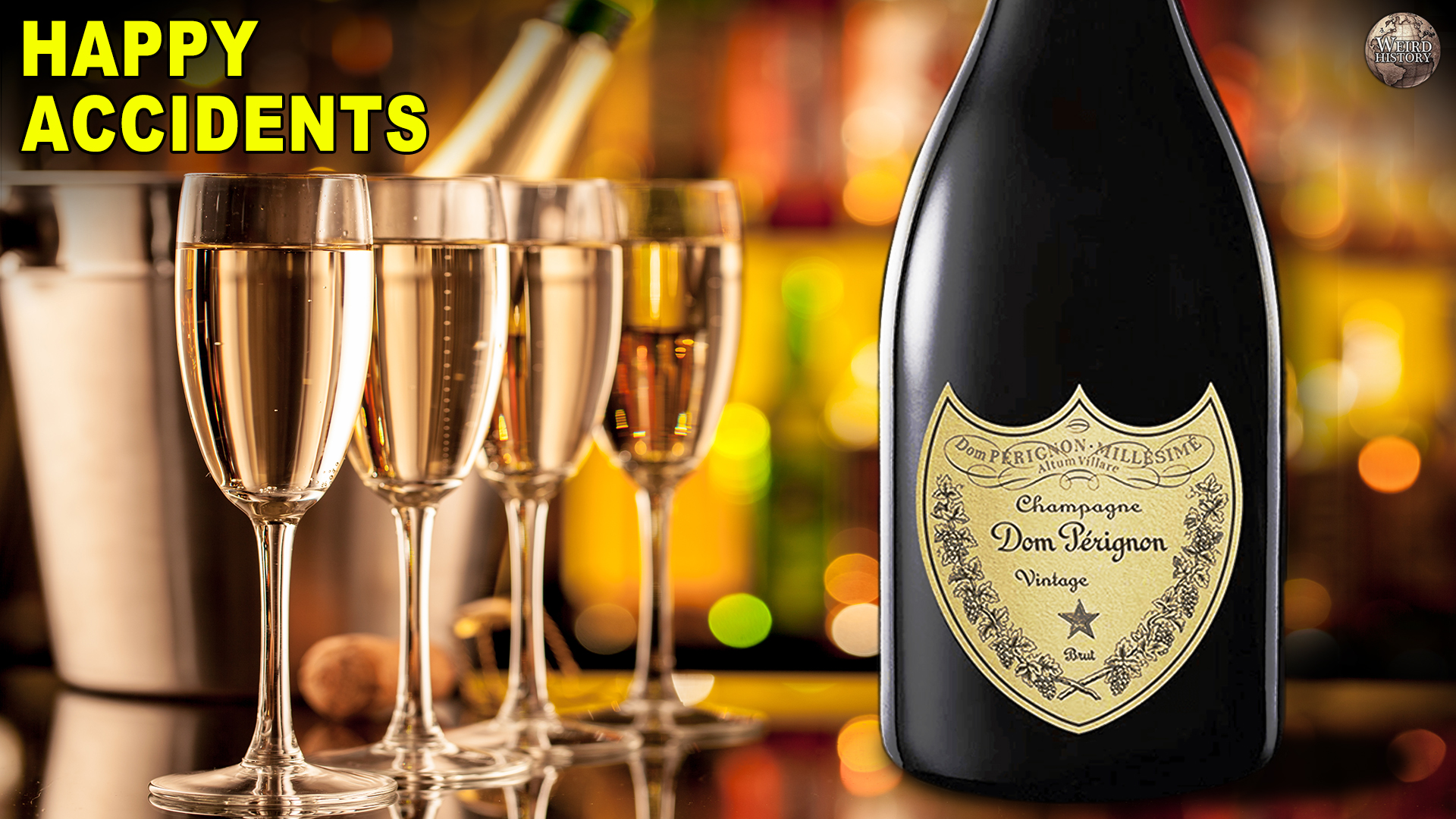
Once you pop, you cannot stop. Champagne is generally thought of as a fancy alcoholic beverage reserved for celebrations
7:16
which is ironic since it was originally considered a failed product and a distinct indication of substandard winemaking practices
7:24
So, uh, cheers. In the 1400s, the Benedictine monks of the Abbey of Auvière in Champagne, France
7:31
began bottling red and white wines each grape season. For grape juice to turn into wine, it must go through a fermentation process
7:38
When the bottles the monks produced started fermenting in the warmer months, the process would halt as temperatures grew colder in the high altitudes
7:45
Once the outdoor temperature became warmer again, the fermentation would restart. However, the pause in the process and the changes in temperature caused an excess of carbon dioxide to form in the wine
7:56
Bottles would sometimes even burst in the cellar before they were ever opened. And once opened, they were often considered too fizzy to drink
8:03
For centuries, the monk's wine was considered subpar. So, in 1668, the Catholic Church recruited a Benedictine monk named Don Pierre Perignon to control the fizzy problem
8:14
Although he temporarily halted the second fermentation cycle, French royalty and their guests eventually started loving the bubbles in the failed batches of wine
8:23
Let them eat cake and let them drink bubbles. As it grew in popularity
8:27
Dom Perignon new project required a blend that produced more bubbles but wouldn burst in the bottle Today the world most exclusive champagne bottles are bottled and fermented in the same fashion that the 15th century monks used to accidentally create them
8:44
In 1968, 3M initially hired Spencer Silver to invent a powerful adhesive
8:49
He came up with something he called a microsphere, which the company saw as an epic failure
8:55
Because, well, it didn't work. It was far too easy to unstick anything bound by Silver's glue
9:00
While the easily removable adhesive wasn't what the company had hoped for
9:04
Silver remained adamant that the invention had to be somehow helpful. A gutsy position to take, considering he wouldn't figure out precisely how the invention was helpful until 1975
9:15
And even then, it was only thanks to a co-worker with a niche problem that the patent for the sticky notes emerged
9:21
3M colleague Art Fry regularly participated in his church's choir and ran into a consistent
9:27
problem each Sunday. Although he marked the songs he planned to sing in his hymnal on Wednesday night, by Sunday
9:33
many of the bookmarks had fallen from their pages. Realizing Silver's easily removable adhesive would be the perfect way to keep a bookmark
9:40
in place, the two campaigned 3M for six years to market the sticky notepads
9:44
The company finally relented and launched the product in 1980. The post-it note became an instant hit and made about a bazillion sticky-icky dollars
9:56
The Industrial Revolution, from around 1760 through 1840, forever changed the way Americans did business
10:04
Large, mass-producing factories quickly replaced small companies, and the cheese industry was no exception
10:10
much to the dismay of local business favoring mice. Although cheesemakers had always experienced a small amount of inevitable waste during the production process
10:19
cheese manufacturing companies realized that the faster they churned out a product
10:23
the more excess, unusable pieces they had to throw away. To rectify the problem, New York cheesemonger Amel Fry began combining the misshapen and broken pieces to create one seamless block
10:35
By 1918, he realized that by adding whey to the leftovers, he could successfully melt and remold the once-wasted inferior product into a new block of cheese
10:46
Fry called his invention Velveeta, intended to convey a velvety-smooth product, and the Kraft company began marketing it in 1927
10:54
Because the added whey provided more carbohydrates and minerals, Kraft marketed the new product as a healthier alternative to other cheeses
11:02
But as the brand initially tried to compete with other sliced cheeses, no one seemed to care about its ability to hold together
11:08
They only cared about its ability to stay creamy and smooth as it melted apart
11:14
The advertisement strategy slowly evolved to trumpet that unique quality. And that liquid gold has been elevating our macaroni and cheese and game day dip ever since