Up next in 10



As the original Renaissance Man, Leonardo da Vinci did it all; the polymath was interested in everything from art to science to writing. The famous Renaissance artist's paintings, sculptures, and architectural achievements are as stunning as his intellectual contributions to history, anatomy, and mathematics. One of the areas where Leonardo truly excelled was inventing. While observing the world around him, Leonardo took copious notes and made sketches detailing his surroundings. In the process, he came up with practical and impractical mechanisms alike, many designed to be used as tools of destruction.
Show More Show Less View Video Transcript
0:00
Leonardo da Vinci is best remembered today
0:02
for his masterful artwork and the many obscure clues it contained that would one day lead Tom Hanks
0:07
on a treasure hunt. But of course, the ultimate Renaissance man was more than just an artist
0:13
As a scientist and engineer, Leonardo was extraordinarily ahead of his time
0:18
and contributed to an array of fields, including anatomy, astronomy, civil engineering, optics
0:25
and hydrodynamics. But he had a particular interest in warcraft and designing weaponry
0:31
Today in Weird History, we're looking back at the craziest weapons of war Leonardo da Vinci ever invented
0:37
OK, time for Leonardo to lead and do machines. Leonardo is arguably the most well-known artist
0:48
and inventor who has ever lived. And yes, you refer to him as Leonardo
0:53
because da Vinci isn't exactly the same as a modern last name
0:56
It means from Vinci. So he's Leonardo from Vinci, you know, Piero's kid
1:02
Despite his fame as an inventor, in most cases, he was merely drawing and conceptualizing these ideas
1:08
rather than actually building working models on his own. You may have heard things like, da Vinci invented the helicopter
1:14
but he wasn't out there in an AH-64 Apache doing strafing runs over olive groves
1:19
He drew a concept for a helicopter in his notebook. Modern engineers have noted that often
1:25
Leonardo's drawings would simplify the devices he was envisioning, leaving out necessary refinements
1:30
or small parts like a necessary gear or lever that would allow a machine to move freely
1:35
This has complicated modern efforts to actually fabricate Leonardo's inventions. Even those that have been reproduced are usually not functional, with a few exceptions
1:45
It's been suggested by some historians that Leonardo may have left these details out on
1:50
purpose so that the weapon couldn't be constructed by an unauthorized party should the drawing fall
1:56
into the wrong hands. Pretty sure Ikea is doing the same thing. Some of Leonardo's most famous
2:02
drawings depict everyday items, like household machines, concepts for new kinds of buildings
2:07
and bridges, and even musical instruments. But he had a soft spot for engines of war
2:13
Leonardo developed many of his designs on behalf of his frequent patron, Ludovico Sforza
2:18
the Duke of Milan, sometimes known as Ludovico il Moro, or the Moor, due to his black hair and
2:25
relatively dark complexion. Ludovico had one of the most celebrated courts, not just in Italy
2:31
but all of Europe. In addition to Leonardo, he was also a patron of the great architect
2:36
Donato Bramante, among other Milanese artists, poets, and musicians. He liked to keep a diverse portfolio
2:45
Ludovico would eventually commission Leonardo's famous depiction of The Last Supper. But a full decade before they reached this deal, the artist had reached out to the Duke
2:53
looking for work as a military engineer. Leonardo even sent the Duke a letter listing all of the various military ideas he'd been
3:01
tooling around with in his workshop. Nowadays cold calling a rich guy with a list of weapons you invented in your room is more likely to get your picture faxed to several law enforcement agencies than land you a job
3:13
But this was the Renaissance, and Leonardo was a go-getter. One of Leonardo's key beliefs about military design
3:23
was a general focus on mobility and transportation around the field of battle
3:27
In his notes, he theorized that one day soldiers could mount a full military strike via sea
3:33
and even presaged diving equipment by a few centuries, designing early rudimentary versions
3:38
of underwater masks and protective suits. Some say that he basically invented the first diving suit
3:44
and indirectly the poster for the 1989 film Deep Star 6. Leonardo suggested the diving suit could
3:50
be fashioned from an airtight coat, potentially made of leather, with a tube running inside from
3:56
above the waves to allow the soldier to breathe. A less complicated design in one of his notebooks
4:01
also postulates the idea that humans could walk on the surface of water using specialized footwear
4:07
Leonardo's plan seemingly involved some kind of inflated animal skin or bladder
4:11
attached at the feet to keep the body extra buoyant. The term stivali d'acqua, roughly translating as water boots
4:19
appears several times throughout his notebooks, as does imagery of people traversing waterways on foot
4:24
indicating that this was more than just a passing fancy, but something of a personal passion for the artist
4:31
A well-known designer of bridges and cs as part of his civilian work
4:36
Leonardo brought some of these innovations to his work on military devices as well
4:41
He developed several kinds of bridges between 1480 and 1485, with specifically military applications
4:47
such as a revolving structure that troops could bring with them throughout the campaign and use to traverse waterways
4:52
and other gaps in the terrain. These so-called revolving bridges featured interlocking beams fastened to a pylon that
5:00
would swing back to the shoreline and were designed to be strong enough to support a
5:03
soldier's weight while remaining light enough to be truly portable. Today, mobile bridges are a common and vital military tool
5:10
But 600 years ago, if your troops ran afoul of rocky terrain or a river that was just
5:16
a little too deep, they either had to find another way around or start chopping down
5:20
some trees. Leonardo also developed new concepts for siege towers. attempting to make them safer and easier for soldiers to use during offensive attacks
5:29
One design was specifically intended for the Milanese stronghold at Vaprio Dada
5:34
After troops from Venice managed to take the town of Trezzo, not far from Vaprio
5:39
Leonardo was brought in to fortify their defenses. He devised a single tower with multiple staircases
5:45
allowing soldiers to move around more freely during a potential siege. Presumably, at least one variation included a slide for break time
5:53
Later designs also included roofed towers and platforms, allowing soldiers to breach city and castle walls
5:59
and other fortifications under some kind of protective cover rather than remaining fully exposed
6:07
Many of Leonardo's inventions focused on making individual soldiers more efficient and effective freeing them up to quickly do major damage in the heat of battle For example his triple barrel cannon was designed to load and fire three cannon shots in sequence
6:22
and also to be an unlockable bonus in a Call of Duty game. In addition to being rad as hell, the triple barrel cannon
6:29
allowed soldiers the opportunity to make rapid fire shots without needing to move between weapons
6:35
because individual cannons needed to be cooled after they were fired. Leonardo also fashioned the weapon to be lighter weight
6:42
with larger wheels than a conventional cannon, to make it simpler to move around
6:46
Another of Leonardo's innovative cannon designs involved loading the balls from the back of the device
6:51
rather than the front. This not only allowed the cannon to be fired more quickly
6:55
but was also considerably less dangerous for the operator than standing in front of the weapon
7:00
which is the part where the cannonball comes out. Another device featured a 33-barreled organ
7:05
that aligned in rows all of its cannon shots and fired them simultaneously rather than one at a time
7:11
spreading the damage more widely across the field of battle. He also came up with ideas for cooling cannons
7:16
using water during battle, and even theorized that a copper cannon could use steam power
7:21
to fire cannonballs rather than gunpowder, though it's unclear if this hypothesis was ever fully tested
7:27
So Leonardo was into steampunk. That weirdly makes a lot of sense
7:32
It's worth noting that the use of gunpowder was still relatively new to Europe
7:36
when Leonardo began devising his own weapons in the 15th century. He was confident that over time
7:42
gunpowder would emerge as the weapon of choice in warfare and designed his machines accordingly
7:47
Some of his peers might have laughed at him at the time, but were pretty rarely using trebuchets nowadays
7:53
If only Leonardo had thought to invent the stock market, too. Give me 5,000 shares of gunpowder and let it ride
8:03
Still, some of Leonardo's fantastical armaments relied on conventional ammunition. For example, he developed a wooden wheel
8:10
known simply as ingranaggio, or gear, onto which crossbows could be attached
8:16
When the wheel was spun by a person or even propelled by a mechanical device
8:20
the crossbows would be fired off in succession. A human operator could then reload the crossbows
8:25
and refire the gear. Some historians theorize that a soldier would actually run on top of the gear
8:30
as a way to get the wheel moving, sort of like a big hamster wheel. Listen, nobody said war can't be fun
8:36
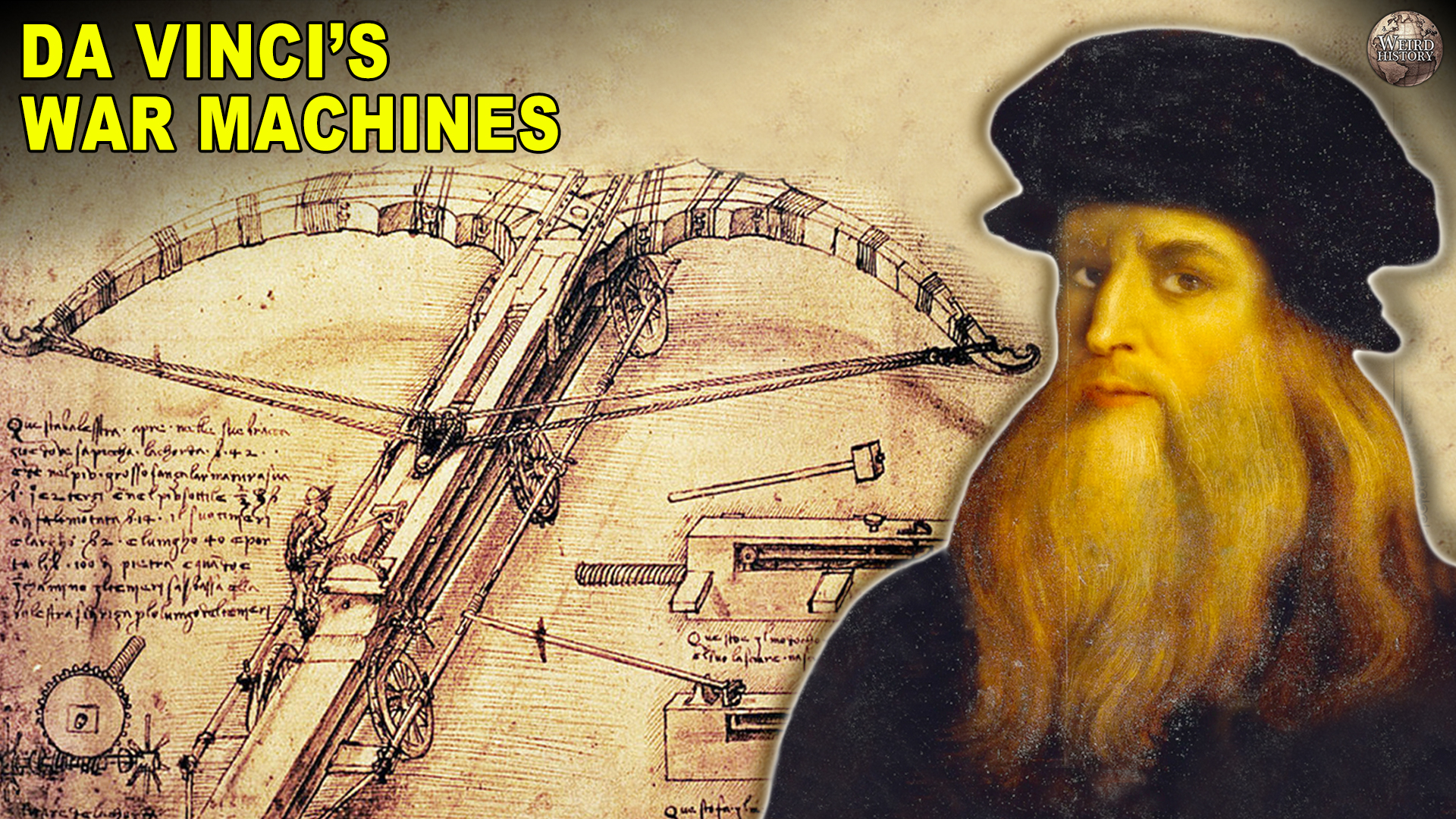
Leonardo also toyed with the idea of a giant crossbow that could serve as the ultimate siege
8:41
weapon. The concept was essentially a 25-meter-wide crossbow that would travel along the ground on
8:47
six maneuverable wheels. It would be loaded with incendiary ammunition or even large rocks
8:53
then operated with a crank, allowing a single soldier to pull back the projectile
8:58
pin it down until just the right moment, and then fire. Beyond just projectile weapons, Leonardo was also fascinated by vehicular designs and ways that new modes of battlefield transportation could aid soldiers in combat
9:16
This so aerial screw had rotating wings made of linen to create wind resistance Inspired by Archimedes water screw Leonardo idea was that if the driver managed to create enough resistance it would lift the machine off of the ground
9:30
And just in case your aerial screw gave out mid-flight, or if you lied about how many hours of aerial screw instruction
9:36
you really had, Leonardo also devised an early version of a parachute
9:41
His version featured wooden poles that came together to form a linen pyramid
9:45
Wind resistance would do the rest, pushing back against the pyramid to slow its fall back
9:50
to the earth. Leonardo's design featured no harness or any other specific way to attach a person to the chute
9:56
suggesting the user would simply hold on for dear life. The master was a big believer in grip strength
10:02
Leonardo's notebooks contained similar designs for hang gliders, using the same basic physical principles
10:07
of lift and wind resistance. In the late 1480s, he devised what
10:11
appears to be a proto-tank, a covered cart that would surround soldiers and offer protection
10:16
as they advanced on an enemy force. The cart itself featured armed cannons, which could be fired in any direction
10:24
The top was covered by a large cone made of metal plates and included a small protected
10:29
turret from which soldiers could peer out and maintain their bearings. The design was inspired in part by the Tortoise Formation, employed by Roman soldiers in ancient
10:37
times, in which soldiers would gather in a tight formation and align their shields as a barrier
10:43
Leonardo also worked on chariot designs and toyed around at least in one drawing with the idea of
10:48
using chariots as offensive weapons. This was, in some ways, a Renaissance-era update
10:53
to the scythed chariot, a real weapon from the ancient world that's depicted in a number of sword and sandal classics
10:59
like Ben-Hur and Gladiator. The real devices featured thin scythes extending at an angle
11:05
from the chariot's axles, which were designed to slash members of the enemy's infantry
11:09
and open gaps in the line that troops could then exploit. Leonardo's concept involved rotating scythes
11:15
which would be even more powerful, not only potentially harming individual soldiers, but also busting up other chariots and physical
11:22
defenses. We wouldn't be surprised if somewhere among his writings he'd drawn up tournament
11:26
brackets for a 15th century demolition derby. Leonardo tried to get one up on Tesla and Uber
11:35
by designing the first self-driving vehicles. One machine was a kind of wind-up tricycle
11:41
propelled by leaf-shaped springs, which then rotated a set of wheels. In 2004
11:46
engineers were able to build a working prototype of this vehicle and put it on display in Florence
11:51
The master went even further in 1495, devising an entire automated mechanical soldier and
11:57
presenting the plans as a gift to the Duke of Milan. The model appeared as a knight in armor
12:03
and would move realistically like a human via a series of interior pulleys, cables, bearings
12:08
and gears. It's unclear if a version of the mechanical knight was ever actually constructed
12:13
But even so, it would have likely been as an artistic or conversation piece rather than
12:18
an actual weapon of war. Still, just having the idea of robot soldiers in 1500 is pretty impressive, let alone the
12:25
mind to actually design one. And you gotta admit, here I built you a RoboCop is a hell of a gift