Up next in 10



If you're ever visited London and caught a glimpse of the guards outside of Buckingham Palace, you know the uniformed men are all business. Life inside the royal residence is fascinating, but have you ever wondered what the guards protecting the queen see on a daily basis? What kind of rules do they have to follow? What's the craziest thing to happen on their watch?
Show More Show Less View Video Transcript
0:00
When international tourists think about visiting London
0:03
a few key images come immediately to mind, like the Tower Bridge, Shakespeare's Globe Theater
0:09
and Big Ben. Then, of course, there are the familiar red-coated infantry
0:14
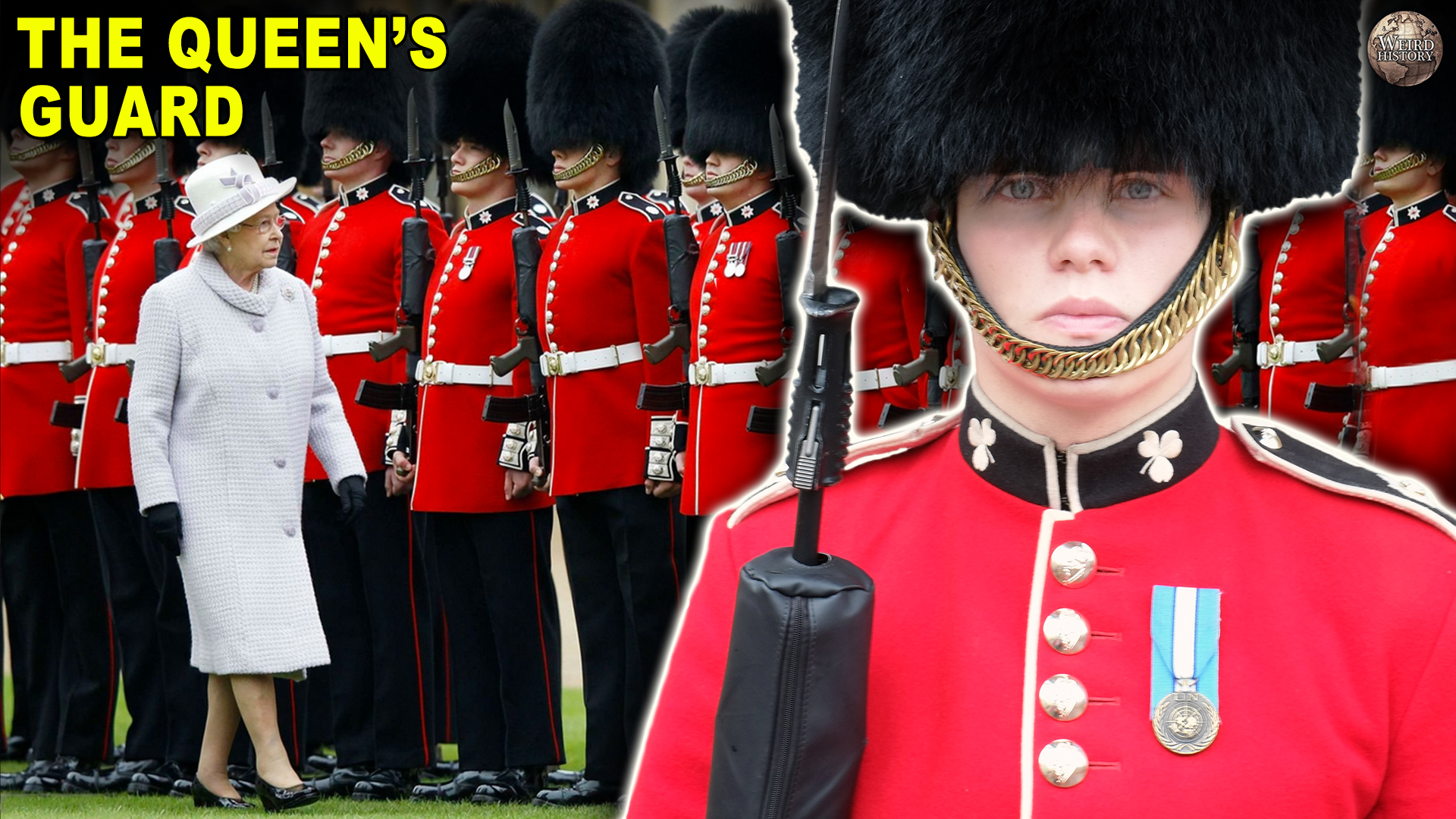
and cavalry soldiers posted outside the royal residence at Buckingham Palace, known as the Queen's Guard
0:20
We're all familiar with the tropes about the Queen's Guard, from their wildly oversized, heavy-looking hats
0:26
to their infamously stoic demeanor. But what is it really like to serve in this contingent
0:32
which has been part of the British Army since before the English restoration of 1660
0:36
Today on Weird History, we're taking a look at what it's like to serve in the Queen's Guard
0:41
protecting the royal family at their residence in Buckingham Palace and beyond. Okay, time to stand at attention and hold perfectly still for some weird history
0:50
No sneezing, please. Members of the Queen's Guard are immediately recognizable by their distinctive uniforms
1:04
particularly their bright red tunics and oversized black hats. Britain's use of red tunics dates back to well before the American Revolution
1:11
though there's some debate about the actual reasoning behind this tradition. Many soldiers have offered that the red uniforms would conceal bloodstains
1:18
making it less apparent to enemy troops if a soldier was injured. But many historians and experts believe that it's likely a factor of red dye being easier to produce
1:27
and thus cheaper than the other colors. The bloodstain thing is just a happy accident
1:33
The 18-inch tall hats are produced using bear fur and are known colloquially as bearskins
1:39
The style dates back to the 19th century and was originally employed during England's various campaigns
1:44
against France during the Napoleonic Wars. The French wore similar hats at this time as well
1:50
The idea was that they'd make the soldiers look taller and thus more intimidating to the enemy
1:55
Frightening enemy soldiers is apparently similar to chasing off a mountain lion. The hats are heavy as well, weighing as much as 8 pounds by some estimates
2:04
And they're even more cumbersome when wet, which is the thing about wearing a giant fur hat
2:09
When it rains, it's like balancing a big wet dog on your head. It's wardrobe for a sunny day
2:15
Soldiers notably wear the hat's large chin strap under their noses, instead of hooked beneath their chins
2:21
This is so the hat actually flies off when hit, rather than flinging back violently and potentially snapping the wearer's neck
2:27
Yeah, no soldier wants dyed turning their head too fast as their epitaph
2:32
The hats are still made from real bear fur, by the way, taken from Canadian black bears that are culled each year to control their population numbers
2:40
Though no bears are killed specifically for their hat fur this practice has nonetheless stirred controversy in the UK and there is regular discussion about potentially replacing the bear fur with a synthetic substitute It would be a cost move The real bear fur hats cost around each and the British Army buys an
2:58
estimated 50 to 100 of them each year. They'd presumably be a bit lighter, too, which would
3:03
reduce the threat of fatal headbanging injuries. Though the hats are uniform across the entire
3:08
a Queensguard, members of different regiments accent them with differently colored plumes
3:13
For example, Coldstream guards wear a red feather on the right side of their hat, while Grenadiers
3:18
wear a red feather on the left side. Irish guards use a blue plume, and the Welsh employ a green and
3:24
white feather. Scots don't do the feather thing at all, but they've always been nonconformists
3:29
haven't they? On Reddit, former guards explain that the heavy black pants guards wear also serve
3:35
a helpful function, covering up little accidents. According to one, a guardsman who had to relieve
3:41
himself before the end of his shift just cut loose in his pants instead. His accident was only
3:46
discovered after people noticed a puddle forming by his shoes. Hard to believe he didn't realize
3:51
this would be an issue. Yes, they don't teach physics in guard school. It's mostly hat stuff
3:57
Because of the important ceremonial nature of the Queensguard job, sentries are responsible for
4:02
keeping up their uniform's appearance and always looking sharp while on duty
4:06
Sentries are expected to polish their uniform's brass fittings and buff belts each day and
4:11
ensure that their boots remain shiny and reflective enough to see their teeth in
4:15
Any sentries violating the rules for clean uniforms are assigned extra shifts, often
4:19
on Fridays or weekends, to make them especially painful. No one wants to guard on Saturday night
4:26
That's when the queen parties the hardest. Five regiments of British foot guards protect the Queen and the royal family
4:37
across all of their various UK castles and palaces, the Grenadier and the Coldstream Guards and the Scots, Irish and Welsh Guards
4:45
In addition to the detachment parked outside Buckingham Palace, there's a second contingent at St. James Place
4:51
London's most senior royal palace, which still serves as a residence for various members of the royal family
4:57
It's also used for other official and ceremonial purposes. Part of the St. James Palace collective also looks after Clarence House, the former home
5:05
of the Queen Mother, which today serves as the official residence of Charles, the Prince
5:09
of Wales, and his wife Camilla, the Duchess of Cornwall. The Queen's Guard travels between various royal residences along with the royal family themselves
5:18
For example, over the Easter holiday, they accompany the Queen to Windsor Castle, and
5:22
they're also posted at the Palace of Holyrood House, when Her Majesty's at her official
5:27
Scotland residence in Edinburgh Castle. Apparently the royal family uses different houses the way most of us use different rooms The Queen Guard is not a lifelong career in and of itself Sentries serving in the Queen Guard are active soldiers
5:42
many of whom either transitioned in from another military assignment or will eventually transition out to other military roles
5:48
Some guards can be seen wearing medals indicating the nature of their previous military service
5:52
while others have medals that note how long they have served on the Queen's Guard itself
5:57
There are even more subtle aspects to the uniform that also speak to a sentry's specific military service
6:02
and background. For example, gold buttons on the red tunic are arranged based on when the soldier's regiment
6:08
was first formed. Irish guards have collections of four buttons because theirs was the 4th regiment
6:13
out of the five to come together. This is probably more than you needed to know
6:17
about the Queen's Guard uniforms, but hey, they worked hard to earn those buttons
6:22
Initially, every member of the Queen's Guard had historically been male, But in the year 2000, the Australian Federation Guard contributed their own membership to the
6:30
force, which included several women. Some women from the Royal Canadian Mounted Police also served
6:36
in the Queen's Guard in 2012. The first woman from the British Army to join the company started
6:41
serving in April 2007, and the first female infantry officer to command the Guard was 24-year-old
6:47
Captain Megan Couto of Canada's Light Infantry, who led the Guard during Canada's 150th anniversary
6:52
celebrations in June of 2017. Each sentry remains on duty at their post for two-hour sessions, standing still and at attention
7:07
For the entire duration of their shift, they're not allowed to eat, sleep, smoke, sit down
7:11
lie down, or stand easy, meaning in a relaxed or casual manner. So leaning on a jukebox is strictly forbidden
7:18
Every 10 minutes, the soldier will do a quick march of 15 paces across their designated area
7:23
It sounds like a lot of standing around, because yeah, it's mostly exactly that
7:29
But that's not to say the job doesn't have its own challenges, especially in hot weather
7:33
During the summer months, guards often sweat excessively while on duty, and fatigue and exhaustion remain consistent worries
7:40
Bear in mind, any free movement is prohibited, including simply wiping the sweat from your brow
7:46
These folks are out there just sweating right into their own eyeballs for the queen
7:50
That's commitment. Guards are encouraged to shuffle around a bit if they feel their limbs going numb or
7:56
their bodies growing fatigued. But faintings do occur. If a sentry is going to faint on the job, they're instructed to do what's known as
8:03
fainting to attention. This means literally falling straight forward and passing out on their face, which is generally
8:10
agreed to be the worst part of your body to land on. you know it's a tough job when there are specific fainting rules they don't even have those at taco
8:18
bell centuries are also specifically instructed on how to keep sightseeing members of the public at bay If someone gets too close or seems to pose any kind of threat or distraction a sentry initial steps involve stamping their feet and shouting
8:31
stand back from the Queen's Guard. They'll repeat this several times. And if the nuisance or threat doesn't stop
8:38
the sentry will actually point his rifle at the source of the interference. When this happens, watch out
8:44
The next step is calling for someone to arrest or detain the person creating the problem
8:48
And while their rifles are mostly ceremonial, unless the UK government is on high alert
8:53
or there has been some kind of specific threat against the royal family, they do have bayonets on the end
8:59
So maybe don't tease them like animals at the zoo. The animals in the zoo get in way more trouble
9:05
for mauling tourists. Technically, these are military bodyguards, so they are permitted to use force on intruders
9:11
who don't obey their commands, though the goal is always to keep interactions non-lethal if possible
9:17
In January 2017, a guard observed what looked like an intruder wandering around the Buckingham
9:22
Palace grounds at around 3 a.m. and nearly opened fire to prevent an attack on the royal family
9:28
before recognizing the person as Queen Elizabeth herself. Her Majesty apparently responded
9:33
that's quite all right, next time I'll ring through beforehand so you don't have to shoot me
9:38
Note to self, always call ahead at Buckingham Palace, even if it is for my diamond jubilee
9:44
Arguably, the most famous trope associated with the Queen's Guard is that they aren't
9:48
allowed to laugh. So noble tourists took it upon themselves to try and get the guards to break
9:53
This actually became such a common practice after being featured repeatedly in shows and
9:58
films, it led to a number of incidents and conflicts between guards and tourists
10:02
Finally, in 1959, following a number of complaints and an allegation that a guard had kicked a
10:08
member of the public in the ankle, the sentries were all moved behind the palace's gates to
10:13
limit public interactions altogether. Still, tourists remain very much in eyesight of the
10:19
soldiers, and many still do try to see if they'll react to suggestive antics and break protocol
10:25
A number of sentries report being flashed by women in the hopes of getting a rise out of them
10:29
If a tourist does happen to get a guard's attention, laughing remains prohibited to this day
10:35
Sentries can be docked up to a week's pay for visibly reacting to something said or done by a
10:39
member of the public. Boredom can be a problem during a two-hour shift requiring you to remain
10:44
as still as a McDonald's billboard. Guards in the Reddit community cited people watching and
10:49
singing songs to themselves as ways to pass the time. And though they're not allowed to react to
10:54
everyday people's shenanigans, apparently the guards still do like to have a little fun with
10:58
their own people. One guard said that he'll sometimes wait for tourists to set up a photo
11:02
and then march away at the exact wrong moment to ruin their shot. Hey, you don't like it? Take it
11:08
up with her royal highness just make sure you call ahead